-

Free Samples!



Zero-Waste Cutting: How Smarter Pattern Layouts Save You Yards on Every Wholesale Order

Table of Contents
Smarter pattern layouts routinely cut fabric waste from 20-25% down to 5-8%, which on a 500-yard wholesale order can mean 60-100 yards saved without changing a single design detail. The savings come from three levers: how pieces are nested against each other, how grainlines are managed, and how marker width is matched to bolt width. Get those three right and zero-waste cutting stops being a sustainability slogan and becomes a straightforward line item on your P&L.
Why 'Cutting Waste' Is Really a Math Problem, Not a Skill Problem
Most people assume fabric waste comes from a cutter's skill. It doesn't. It comes from geometry. Pattern pieces are rarely rectangles or perfect circles — they're curved, angled, oddly shaped things that leave gaps no matter how careful the person with the shears is. The real fix isn't a steadier hand. It's better math done before the scissors ever touch the cloth.
Marker efficiency — the industry term for how much of a fabric width is actually covered by pattern pieces versus empty space — is calculated as: (total area of pattern pieces ÷ total marker area) × 100. A marker running at 78% efficiency is leaving 22 cents of every fabric dollar on the cutting room floor, literally. Bump that to 90% and you've just found a 12-point margin improvement that has nothing to do with negotiating a better price per yard.
This matters even more once you understand how to read a fabric spec sheet — because bolt width variance (a 58″ fabric that actually measures 56.5″) directly changes your nesting math and can silently erase the efficiency gains you thought you had.
Nesting: The Technique That Does the Heavy Lifting
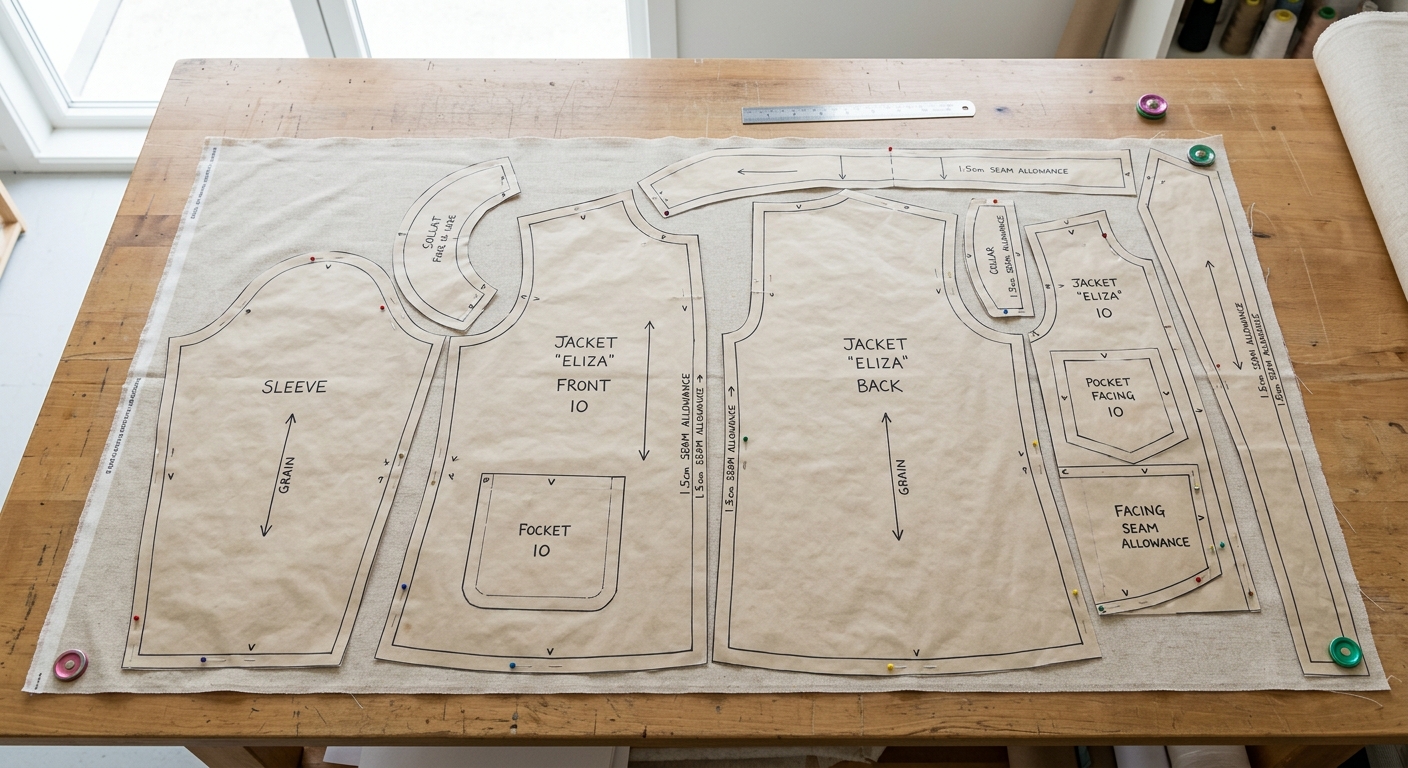
Nesting means interlocking pattern pieces so the curve of one fits into the notch of another — like puzzle pieces, not like books stacked on a shelf. This single technique typically recovers 8-15% of yardage compared to a straight, evenly-spaced layout.
How it actually works on the table
Instead of laying every sleeve pointing the same direction with a margin around each, cutters flip alternating pieces upside-down so a sleeve's underarm curve tucks into the armhole curve of the piece next to it. For asymmetric pieces like collars, yokes, or pocket flaps, this can mean the difference between fitting 14 garments across a 60-yard length versus 11.
For instance, a mid-size activewear brand cutting leggings from nylon fabric found that switching from a grid layout to a nested CAD marker took their utilization from 81% to 93% on a 400-yard order — a recovery of roughly 48 yards, enough for an extra 30 pairs of leggings at no added fabric cost.
Grainline Discipline: Where Most Waste Actually Hides
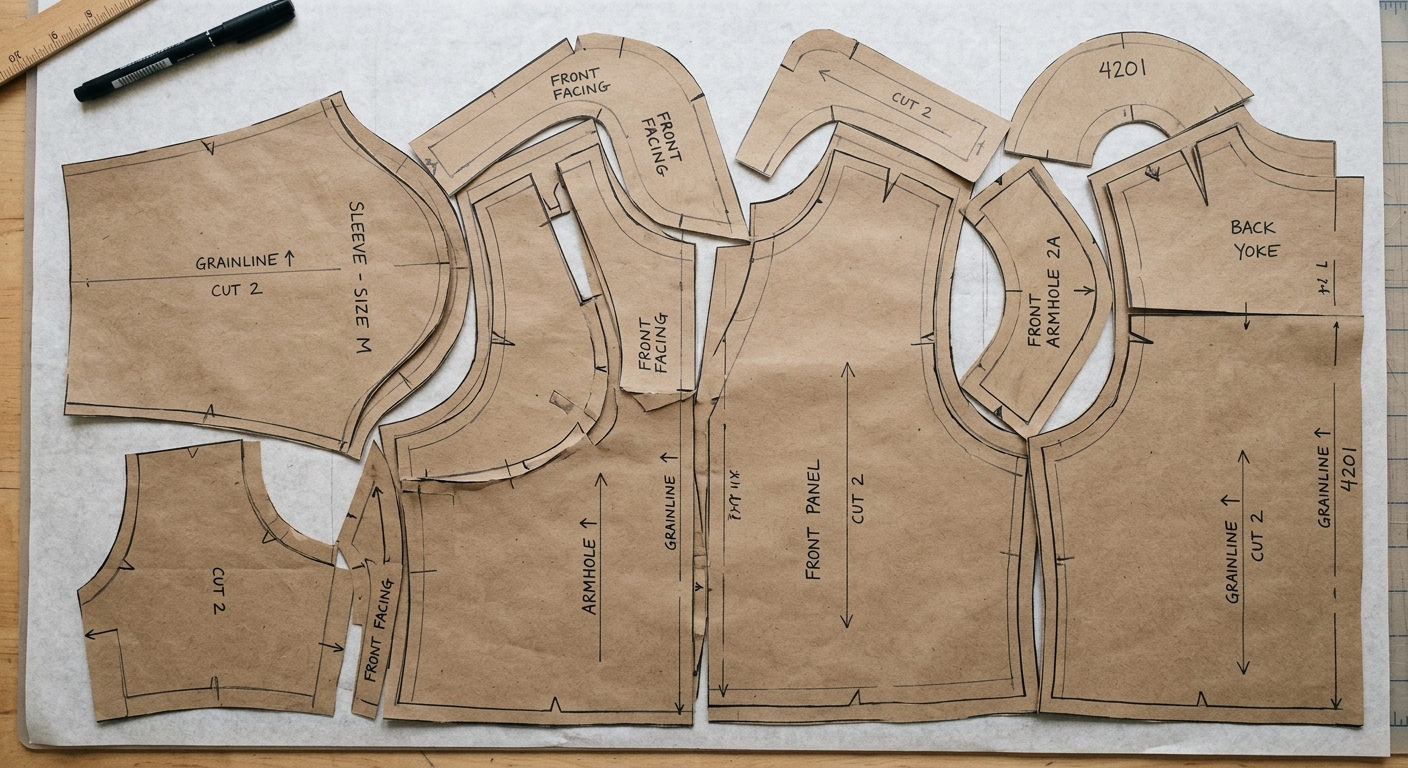
Ignoring grainline tolerance is the single most common way bulk buyers quietly torch yardage. Every pattern piece has an arrow indicating the direction it must run relative to the fabric's lengthwise grain — and deviating even 3-5 degrees off grain on woven fabric changes how the finished garment hangs, stretches, and wears over time.
The trade-off nobody talks about
Strict grainline adherence limits how pieces can rotate during nesting, which can lower marker efficiency by 4-6%. Loosening grainline tolerance on non-critical pieces (facings, small pocket bags, interfacing pieces) recovers that efficiency back — but only on pieces where off-grain won't show or won't cause functional stretch problems.
This is especially relevant with fabrics that have directional characteristics, like dobby fabric with its raised woven pattern, or anything with a visible nap or shine direction such as shimmer fabric. Get the grainline wrong on shimmer and you'll get patchwork-looking panels under different lighting — a costly mistake to discover after 300 yards are already cut.
Matching Marker Width to Bolt Width (The Step Most Buyers Skip)
A marker designed for 60″ fabric run on a 58″ bolt doesn't just lose 2 inches — it can force pieces to reposition entirely, sometimes triggering an extra row on the layout and wasting a full 6-10% more fabric than the width difference alone suggests.
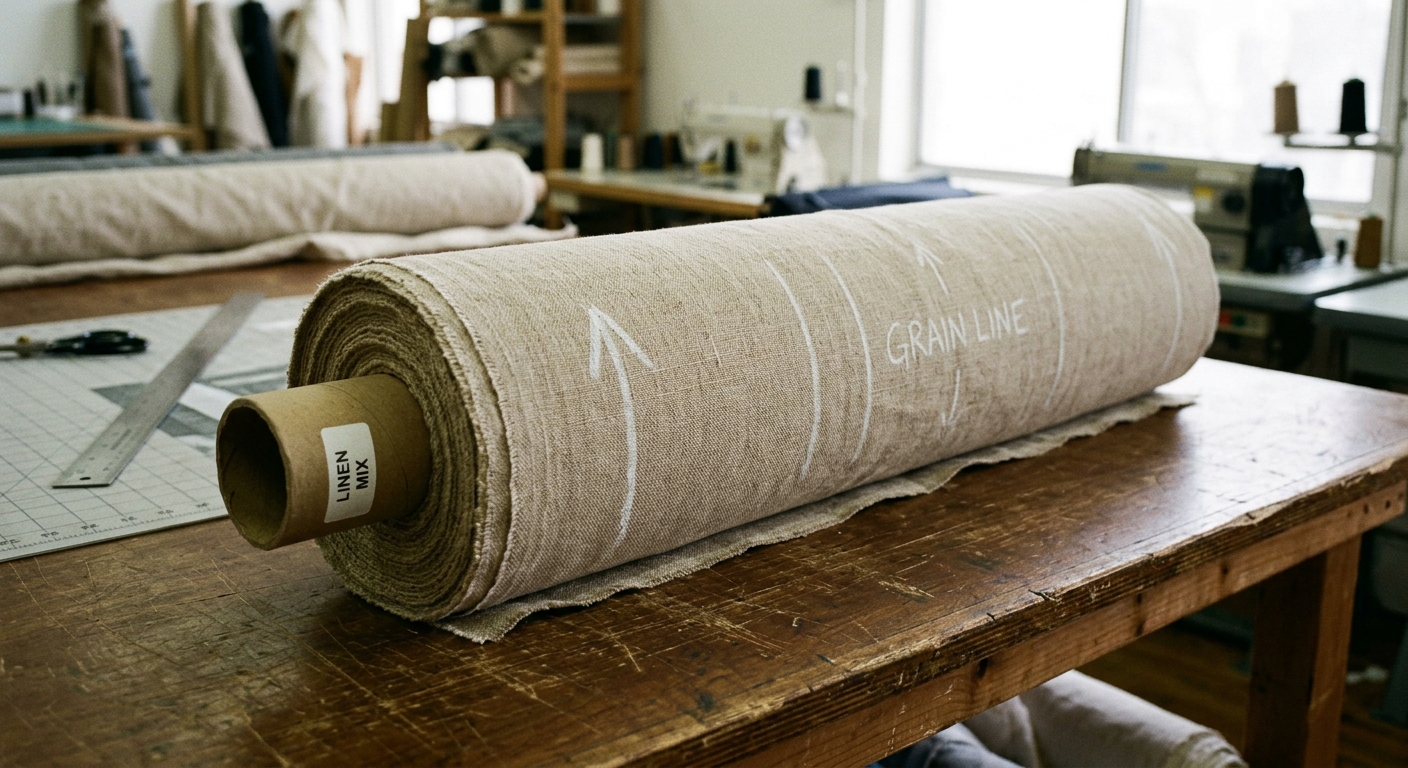
Before finalizing any marker, confirm actual usable width (not selvage-to-selvage width, which includes 0.5-1″ of unusable selvage on each side). This is a step buyers calculating yardage often miss — and it compounds the estimation errors covered in how to calculate exactly how much fabric you need. If your spec sheet says 58″ but three consecutive bolts measure 57.25″, your marker needs rebuilding, not your cutting technique.
A quick real-world check
Coat manufacturers working with coat fabric often run wide markers because panel pieces are large. A half-inch width shortfall on a 60″ marker can eliminate an entire piece from fitting per row — on a bulk coat order, that's the difference between 40 and 37 coats from the same 200-yard cut.
Zero-Waste Pattern Design vs. Zero-Waste Cutting Layout
These two terms get used interchangeably, but they're different disciplines with different payoffs. Zero-waste pattern design means the garment pattern itself is engineered so every piece is a rectangle, triangle, or shape that tessellates perfectly — think traditional kimono construction or modern designers who build patterns around a fabric's exact width. Zero-waste cutting layout means taking a conventional pattern (curved armholes, shaped darts, and all) and nesting it as efficiently as possible.
Full zero-waste design can hit 98-100% utilization but requires redesigning the garment — not always practical mid-season. Zero-waste layout optimization, by contrast, works with your existing patterns and typically gets you to 88-93% utilization with zero design changes. For most wholesale buyers reordering existing styles, layout optimization is the realistic win.
Fabric Type Changes the Efficiency Ceiling
Not every fabric nests the same way, and pretending otherwise leads to disappointing yield numbers. Fabrics with a one-way design, nap, or shine — where pieces must all face the same direction — cap your maximum efficiency at 75-85% no matter how skilled your nesting software is, because you lose the ability to flip pieces to interlock.
Fabrics that nest well
- Non-directional prints and solids — pieces flip freely, highest efficiency potential
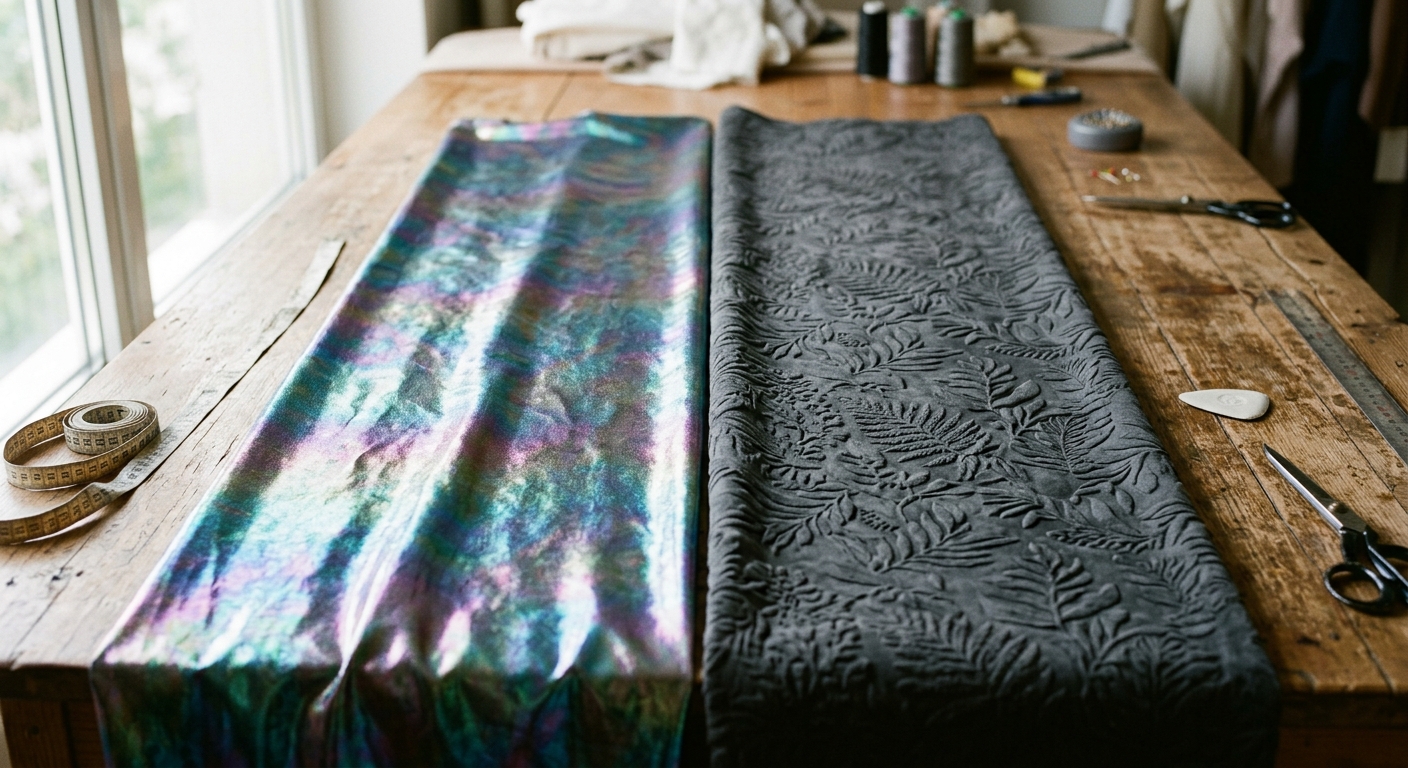
- Embossed fabric with symmetrical texture — generally flip-safe
- Stable knits — forgiving on minor grainline shifts
Fabrics that fight you
- Iridescent fabric — color shift means every piece must face one direction
- Napped or brushed goods — directional pile locks orientation
- Large-scale directional prints — pattern matching overrides nesting freedom
Know this going in and set realistic yield expectations before you commit to a yardage order — not after the marker comes back short.
The Software Question: When CAD Marker-Making Actually Pays Off
Manual nesting by an experienced cutter can get you to 85% efficiency. CAD-based automated nesting (Gerber, Lectra, Optitex) routinely pushes 90-96% because the software tests thousands of piece rotations in seconds — something no human has time to do by hand.
The breakeven point: CAD marker software subscriptions typically run $150-$400/month for small operations. If you're cutting more than roughly 800-1,000 yards a month, the yardage recovered from better nesting (often 40-80 yards at that volume) covers the software cost several times over. Below that volume, a skilled manual cutter with good nesting habits may be the more economical choice.
Practical Takeaway
Zero-waste cutting isn't a single trick — it's the compounding effect of nesting pieces tightly, respecting grainline only where it truly matters, matching your marker to actual bolt width, and knowing which fabrics can even be pushed toward high efficiency. Get those four things right and 10-15% yardage recovery on a typical wholesale order isn't optimistic — it's conservative.
Before your next bulk cut, pull your marker efficiency number and compare it against the 88-93% benchmark for layout optimization. If you're under that, there's real money sitting in your cutting room, not your negotiation with suppliers. Ready to order fabric that's cut to perform from the first yard? Browse apparel fabric by the yard at Global Fabric Whole Sale and put these layout gains to work on your next production run.





 Login with Google