-

Free Samples!



How to Read a Fabric Spec Sheet Without Getting Burned: The 8 Numbers That Actually Matter
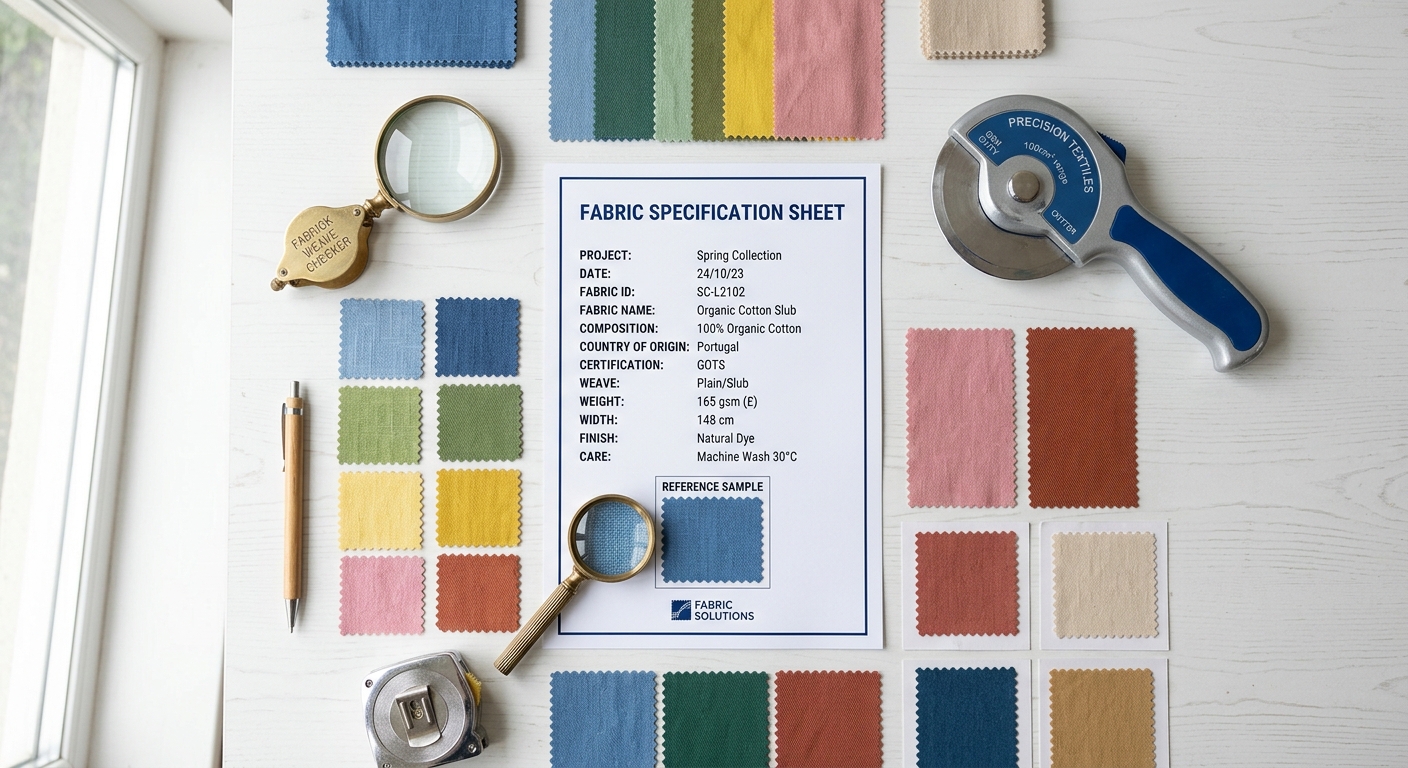
Table of Contents
The eight numbers that separate a profitable fabric order from a warehouse full of returns are: GSM (weight), tensile strength, pilling resistance, dimensional stability (shrinkage), colorfastness to washing, colorfastness to light, stretch and recovery, and abrasion resistance. Master these, and you can scan any spec sheet in under two minutes and know exactly whether that fabric will hold up in the real world. Ignore them, and you’re gambling — no matter how good the swatch looks in your hand.
Most spec sheets throw dozens of data points at you: fiber content percentages, weave density, air permeability, moisture wicking rates, formaldehyde content, and pH levels. Some of those matter for niche applications. But for the vast majority of wholesale fabric buyers — whether you’re sourcing for apparel, home textiles, or accessories — these eight numbers are the ones that will save you money, protect your brand reputation, and keep your customers coming back.
Why Most Buyers Read Spec Sheets Wrong
Here’s the uncomfortable truth: most fabric buyers skip the spec sheet entirely and rely on hand-feel and price. The ones who do read specs tend to fixate on fiber composition — “100% cotton” or “95/5 poly-spandex” — as if that alone guarantees quality. It doesn’t. Two fabrics with identical fiber content can perform wildly differently depending on yarn quality, weave construction, and finishing treatments.
A spec sheet is a performance promise. The numbers on it are (theoretically) backed by standardized lab tests. Your job isn’t to understand every test protocol — it’s to know which numbers predict real-world failure and which ones are just noise. Think of it like reading a nutrition label: you don’t need to understand every micronutrient, but you’d better check the sugar content before buying a case of “healthy” granola bars.
The eight metrics below are listed in rough order of how often they cause problems when ignored. Let’s break them down.
GSM — The Foundation Number Everyone Misunderstands
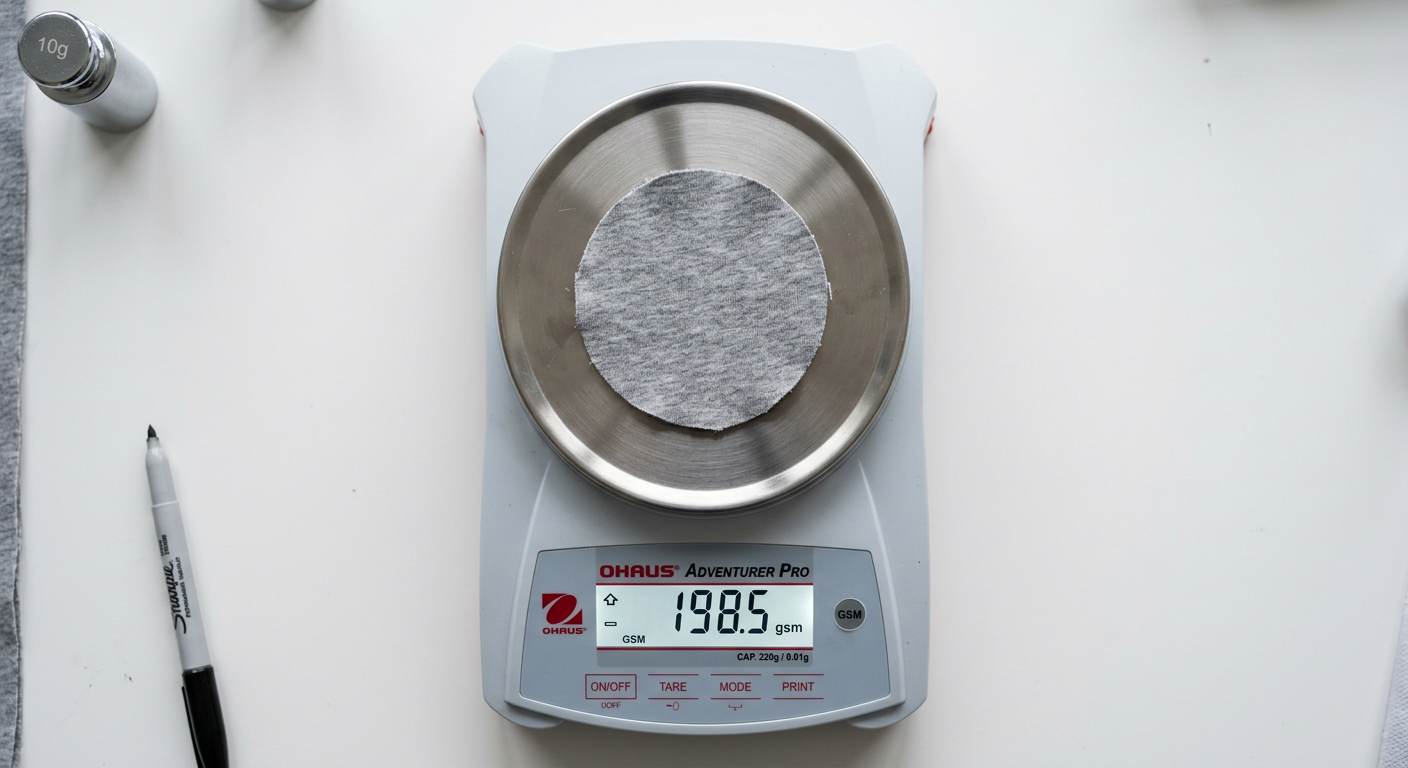
GSM (grams per square meter) tells you how much a one-square-meter piece of fabric weighs. That’s it. But buyers routinely confuse GSM with thickness, drape, or quality — and those are three different things. A 180 GSM silk charmeuse and a 180 GSM polyester mesh have the same weight on paper but couldn’t be more different in hand.
What GSM Actually Predicts
GSM is your best proxy for fabric density and, by extension, opacity and durability within the same fabric type. Comparing GSM across fabric types is meaningless. Comparing GSM within the same category — say, two different cotton jersey options — tells you which one is more substantial and less likely to be see-through.
The Red Flag
If a supplier quotes you a GSM and the delivered fabric tests more than 10% below that number, you have a problem. This is one of the most common quality shortcuts in wholesale: a spec sheet says 220 GSM, but the actual fabric clocks in at 195 GSM. That difference is visible and tangible to your end customer. We wrote an entire deep dive on how to read GSM like a pro if you want the full picture.
Quick Reference
- Lightweight apparel (blouses, linings): 80–150 GSM
- Mid-weight apparel (t-shirts, dresses): 150–250 GSM
- Heavyweight apparel (jackets, denim): 250–400 GSM
- Upholstery and home textiles: 250–600+ GSM
Tensile Strength — Will It Rip
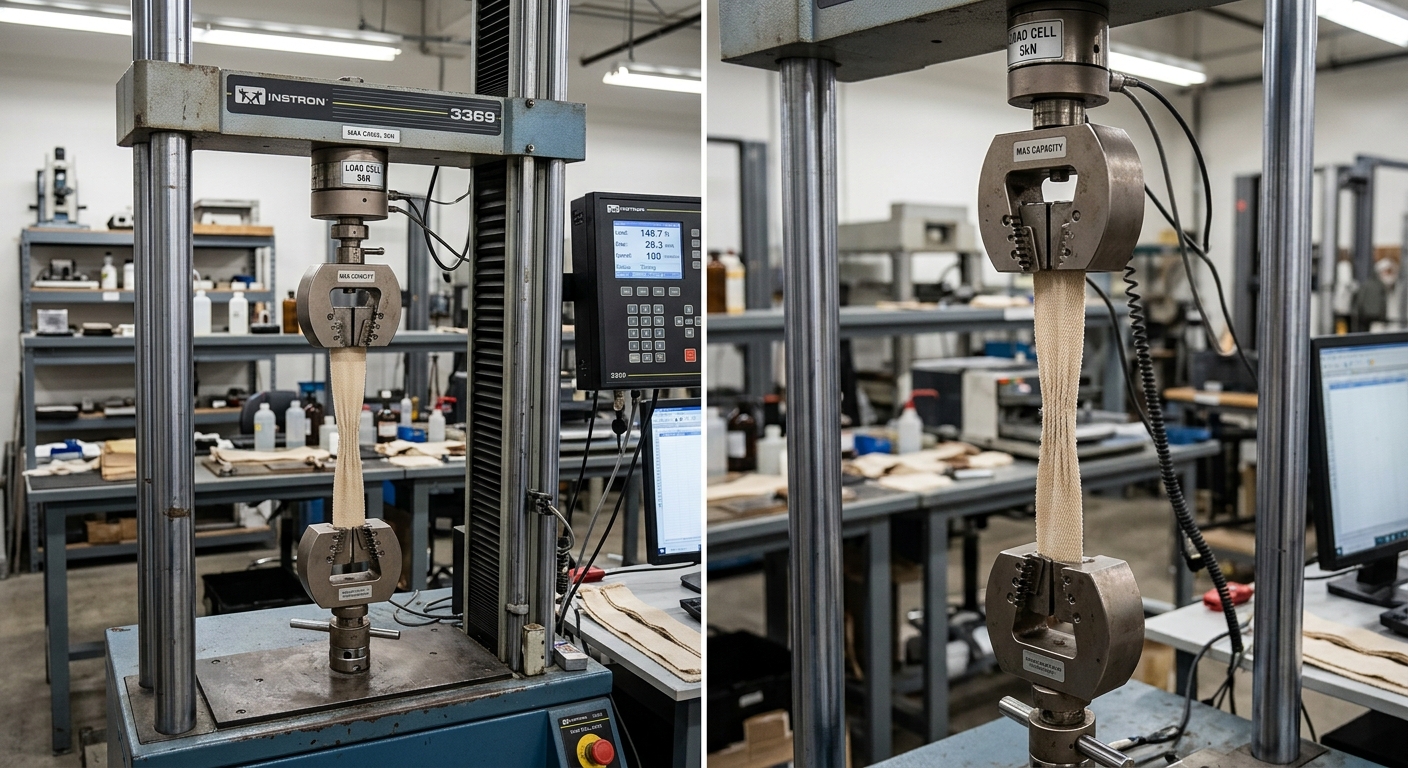
Tensile strength measures how much force (in Newtons) is needed to pull a fabric apart. If your fabric is going into anything that experiences stress — seams under movement, bags carrying weight, upholstery supporting bodies — this number is non-negotiable.
Warp vs Weft
Spec sheets typically list tensile strength in both warp (lengthwise) and weft (crosswise) directions. Woven fabrics are almost always stronger in the warp direction. If you see a big disparity — say 350 N warp but only 120 N weft — that fabric will tear easily along the weaker axis. For knits, the difference is usually smaller but still worth checking.
Real-World Scenario
A small activewear brand once sourced a poly-spandex blend for leggings based purely on stretch percentage and price. The spec sheet listed tensile strength at 180 N in the weft direction. After the first production run, they got a wave of returns: the fabric was splitting at inner-thigh seams during squats and lunges. Had they insisted on a minimum 250 N weft tensile for sportswear fabric, the entire debacle would have been avoided.
Minimum Benchmarks
- Light apparel (woven): ≥200 N
- Activewear/stretch apparel: ≥250 N in both directions
- Upholstery: ≥400 N
- Industrial/workwear: ≥500 N
Pilling Resistance — The Silent Brand Killer
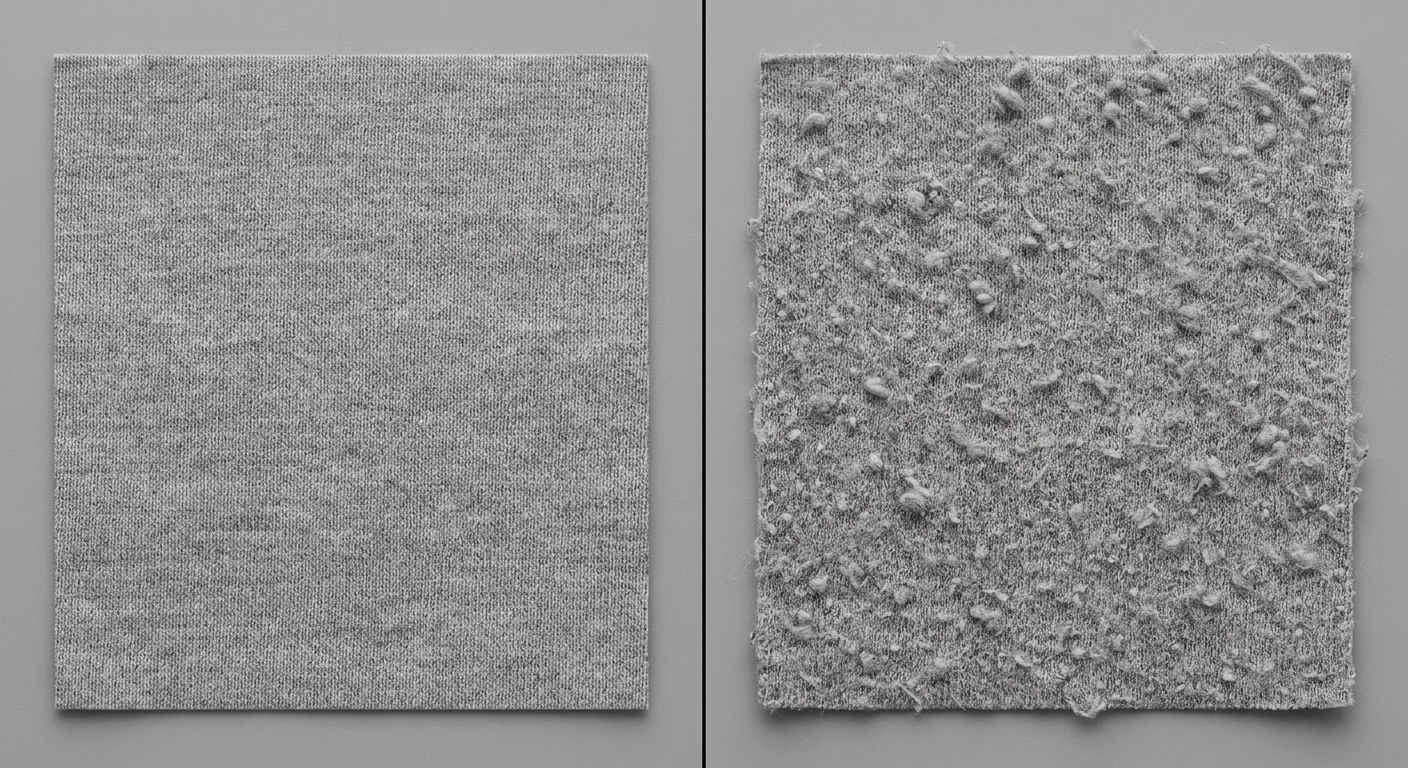
Nothing makes a garment look cheap faster than pilling. Those tiny fabric balls that form on the surface after a few washes or wears are the number-one reason consumers downgrade their perception of a brand. And yet, a shocking number of wholesale buyers never check this spec.
The Grading Scale
Pilling resistance is graded 1 through 5 under the Martindale or ICI pilling box method:
- Grade 5: No pilling (excellent)
- Grade 4: Slight pilling (good — acceptable for most apparel)
- Grade 3: Moderate pilling (borderline — okay for casual basics, risky for premium)
- Grade 2: Severe pilling (reject for anything customer-facing)
- Grade 1: Very severe pilling (reject entirely)
What Causes Pilling
Blended fabrics — especially polyester-cotton blends — pill more than pure fibers because the stronger synthetic fibers anchor the pills to the surface instead of letting them break off naturally. This doesn’t mean blends are bad; it means you need to verify the pilling grade before buying blended fabric in bulk. A well-finished poly-cotton blend can score Grade 4. A poorly finished one will hit Grade 2 within five washes.
Dimensional Stability — Shrinkage is Not a Minor Detail
Dimensional stability tells you how much a fabric will shrink (or stretch out) after washing and drying. It’s expressed as a percentage change in both length and width. A spec sheet might read “-3% warp, -2% weft” — meaning the fabric shrinks 3% lengthwise and 2% crosswise after the standard wash test.
Why ±3% is the Magic Number
For most apparel, anything within ±3% is manageable — pattern makers can account for it. Once you cross ±5%, you’re in trouble. A medium becomes a small. A 52-inch tablecloth becomes a 49-inch tablecloth. Returns spike, and your reputation takes a hit.
The Gotcha: Pre-Shrunk vs Sanforized
Some suppliers label fabric as “pre-shrunk” without specifying the residual shrinkage. Always ask for the actual tested percentage. “Pre-shrunk” might mean they reduced shrinkage from 8% to 4% — which still isn’t great. “Sanforized” is a more rigorous mechanical treatment that typically brings residual shrinkage under 1%, but it’s mainly used for woven cottons.
If you’re working with natural fibers like linen, shrinkage management becomes even more critical. Our guide on sewing with linen fabric covers pre-washing techniques that help control this.
Colorfastness — Two Tests, Two Different Enemies
Colorfastness appears on spec sheets in multiple forms, but two matter most: colorfastness to washing (ISO 105-C06 or AATCC 61) and colorfastness to light (ISO 105-B02 or AATCC 16). These measure how well dye survives laundering and UV exposure, respectively. They’re graded on a 1–5 scale (sometimes 1–8 for lightfastness), with higher being better.
Colorfastness to Washing
This test simulates multiple home laundry cycles and checks for two things: color change (did the fabric itself fade?) and color staining (did the dye bleed onto adjacent white fabric?). For anything that will be washed regularly — which is most apparel and home textiles — you want Grade 4 minimum on both metrics. Grade 3 means noticeable fading after a handful of washes. That’s a customer complaint waiting to happen.
Colorfastness to Light
This one is critical for anything exposed to sunlight: curtains, outdoor cushions, beachwear fabric, and display garments in retail windows. Grade 4 is acceptable for indoor use with limited light exposure. For anything near a window or used outdoors, insist on Grade 5 or higher. Deep, saturated colors like burgundy and indigo are particularly susceptible to UV fading if not properly dyed.
Pro Tip
If a spec sheet lists colorfastness as a single number without specifying which test, ask. “Colorfastness: Grade 4” is meaningless without context. Grade 4 to washing and Grade 2 to light are very different situations, and a lazy spec sheet that lumps them together is a red flag about the supplier’s testing rigor.
Stretch and Recovery — The Number Pair Nobody Checks Together
Stretch percentage gets all the attention. Recovery percentage does all the work. And most buyers only look at one of them.
Stretch Without Recovery is Baggy Knees
A fabric that stretches 30% but only recovers 80% of its original shape will bag out permanently after a few hours of wear. This is why cheap leggings develop saggy knees and why budget fitted sheets pop off mattress corners. The stretch number tells you how far the fabric can extend; the recovery number tells you whether it snaps back.
What to Look for
For 4-way stretch fabrics used in activewear, swimwear, or fitted garments, you want at least 90% recovery — ideally 95%+. The stretch percentage itself depends on the application: dance and athletic wear might need 25–30% elongation, while a stretch woven for trousers might only need 5–10%.
How It’s Tested
The standard test (ASTM D3107 or similar) stretches a fabric sample to a set percentage, holds it for a period, releases it, and measures how much it bounces back. Some spec sheets list “immediate recovery” and “delayed recovery” (after 1 minute or more). The delayed number is more realistic for garment performance. If you want a deeper understanding of stretch fiber types, our breakdown of spandex, Lycra, and elastane differences covers the fundamentals.
Abrasion Resistance — How Long Before It Falls Apart
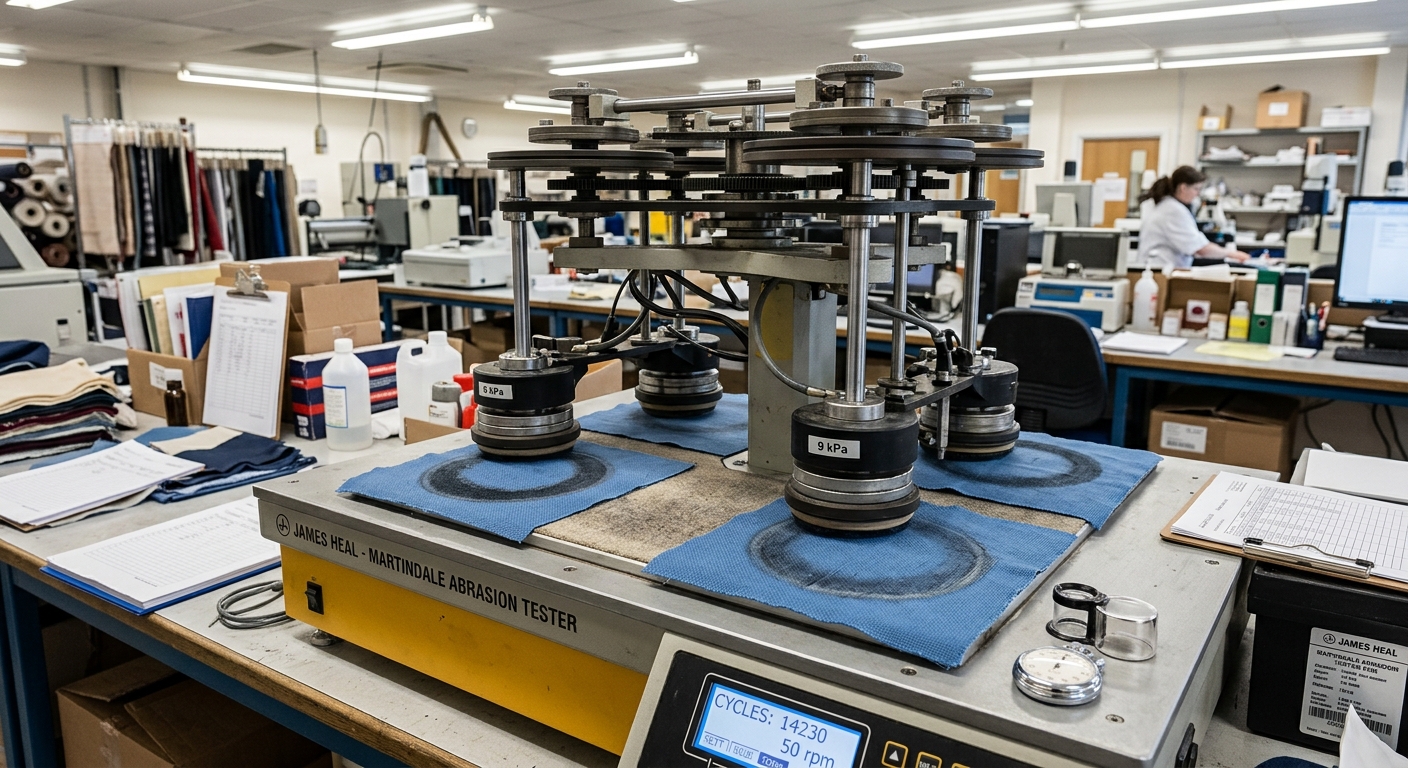
Abrasion resistance, usually measured by the Martindale method (ISO 12947), counts how many rub cycles a fabric can endure before showing visible wear. It’s the single most important durability metric for upholstery, and it’s criminally underused in apparel sourcing.
The Martindale Scale in Practice
- Under 10,000 cycles: Decorative use only — throw pillows, light curtains
- 10,000–15,000 cycles: Light domestic use — occasional seating
- 15,000–25,000 cycles: General domestic use — everyday sofas, dining chairs
- 25,000–40,000 cycles: Heavy domestic or light commercial use
- 40,000+ cycles: Heavy commercial — restaurants, hotels, public transit
Why Apparel Buyers Should Care Too
Even if you’re not sourcing upholstery, abrasion resistance predicts how quickly a garment will thin out at friction points: inner thighs, underarms, and collar edges. A Martindale count below 10,000 for a daily-wear garment means visible wear within a season. Our upholstery fabric durability guide goes deeper into matching Martindale ratings to specific use cases.
Real-World Example
A boutique hotel chain sourcing fabric for lobby seating chose a beautiful textured weave rated at 18,000 Martindale cycles. Within eight months, the armrests were visibly worn and the seats were thinning. For a high-traffic commercial setting, they needed 40,000+ cycles minimum. The replacement cost — including labor to reupholster 60 chairs — was four times what they would have spent on the right fabric from the start.
How to Use These 8 Numbers Together: A Buyer's Checklist
Knowing the numbers individually is useful. Knowing how to cross-reference them is where you stop getting burned. Here’s a practical workflow for evaluating any spec sheet in under two minutes:
Step 1: Confirm GSM Matches Your Application
Is the weight appropriate for what you’re making? If you’re sourcing for summer blouses and the GSM is 280, walk away — no matter how good the price.
Step 2: Check the Durability Trio
Tensile strength, abrasion resistance, and pilling resistance together tell you how long the fabric will last. If any one of these three is below your threshold, the other two don’t matter.
Step 3: Verify Dimensional Stability
Shrinkage over ±3% for apparel or ±2% for home textiles means you need to either negotiate pre-treatment or factor in significant pattern adjustments.
Step 4: Confirm Both Colorfastness Ratings
Check washing and light separately. Match them to your product’s actual use environment.
Step 5: For Stretch Fabrics, Demand Both Numbers
Never accept a stretch percentage without a corresponding recovery percentage. If the supplier can’t provide recovery data, that’s a warning sign about their testing standards — and possibly about the fabric itself.
When Numbers Are Missing
If a spec sheet is missing more than two of these eight metrics, ask for them explicitly. A reputable supplier will either provide the data or offer to have the fabric tested. A supplier who deflects or says “it’s standard quality” is a supplier you should approach with extreme caution. We covered more of these warning signs in our article on red flags when buying fabric online.
Stop Guessing, Start Specifying
A fabric spec sheet isn’t just a formality — it’s your contract with reality. The eight numbers above are the difference between a fabric that performs for years and one that falls apart after its first wash cycle. Print this checklist. Tape it to your desk. Reference it every single time you evaluate a new fabric source.
At Global Fabric Wholesale, every product listing includes detailed specifications so you can make informed decisions before you commit to a bulk order. Whether you’re sourcing modal fabric for premium basics or mesh fabric for performance layering, the numbers are right there — because we believe informed buyers make the best long-term customers.
Have questions about a specific spec or need help matching fabric performance to your project requirements? Reach out to our team — we’d rather spend ten minutes helping you choose right than see you stuck with a fabric that doesn’t deliver.





 Login with Google