

7 Red Flags When Buying Fabric Online (And How to Protect Yourself in 2026)

The biggest red flags when buying fabric online are missing technical specs, suspiciously low prices, no swatch options, stock-photo-only listings, hidden return policies, zero verifiable reviews, and unresponsive customer service. If you spot even two of these on a single store, walk away — you’re almost certainly looking at a seller who will cost you more in wasted time, bad material, and reshipping fees than you’d ever save on that “deal.” Below, we break down each warning sign in detail and give you a concrete playbook for protecting your money, your projects, and your sanity in 2026.
Red Flag 1: Vague or Missing Fabric Specifications
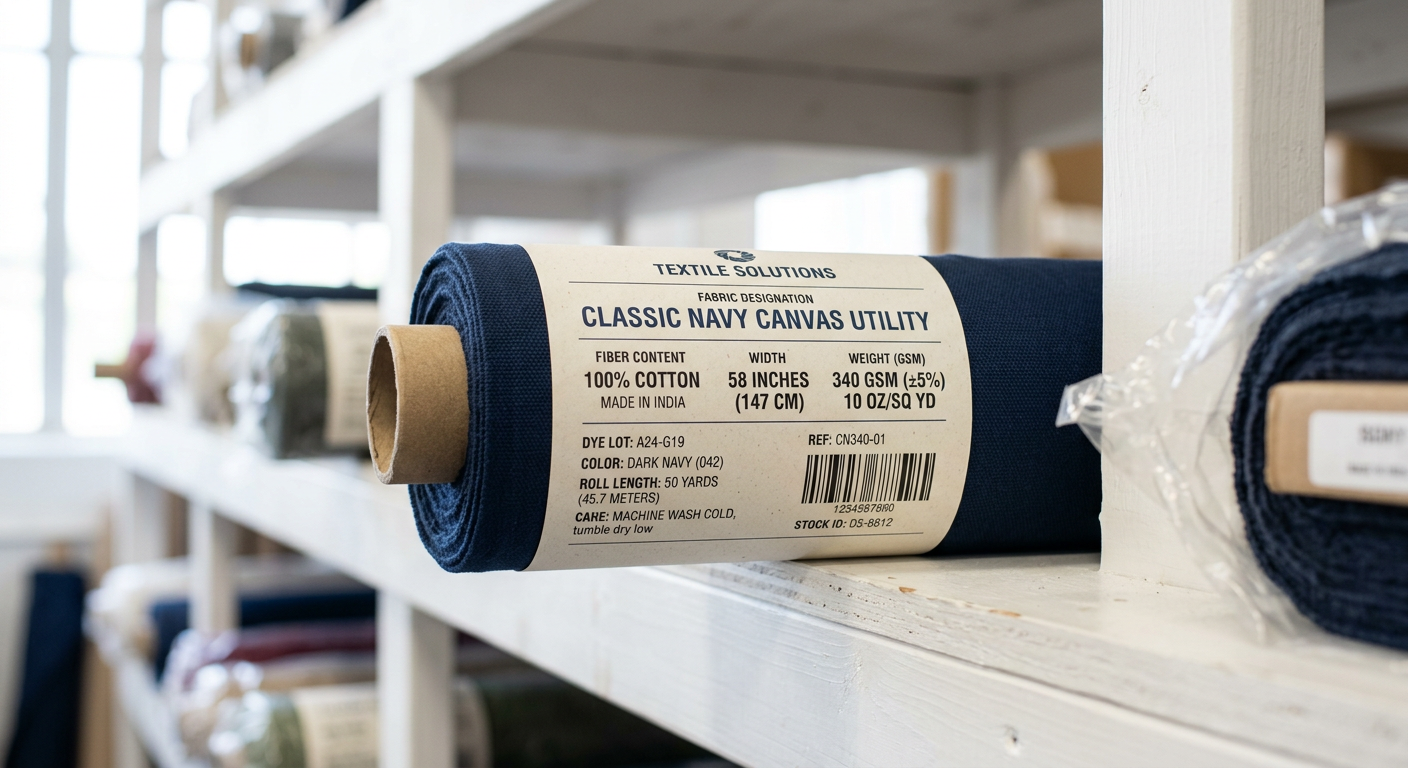
This is the single most common — and most damaging — red flag in online fabric shopping. If a listing doesn’t tell you the fiber content, the GSM (grams per square meter), the width, and the weave or knit type, you’re flying blind. And flying blind with fabric means your finished product suffers.
Why This Matters More Than You Think
A cotton jersey at 140 GSM behaves nothing like a cotton jersey at 220 GSM. One is a lightweight tee fabric; the other is a structured loungewear material. Without that number, you can’t match the fabric to your project — period. The same goes for width. Ordering 60-inch-wide fabric when you assumed 45 inches changes your yardage calculation by roughly 25%. That’s real money.
What a Trustworthy Listing Looks Like
A reliable product page will include at minimum: fiber composition (e.g., 95% cotton / 5% spandex), fabric weight in GSM or oz/yd², bolt width, weave or knit construction, and care instructions. If a store consistently omits these details, they either don’t know their own product — or they don’t want you to know it.
For instance, a small-batch sleepwear brand once told us they ordered “soft cotton” from a no-name store that listed zero specs. What arrived was a stiff poly-cotton blend at barely 100 GSM — completely unusable for sleepwear. They lost $400 and three weeks of production time.
Red Flag 2: Prices That are Too Good to Be True
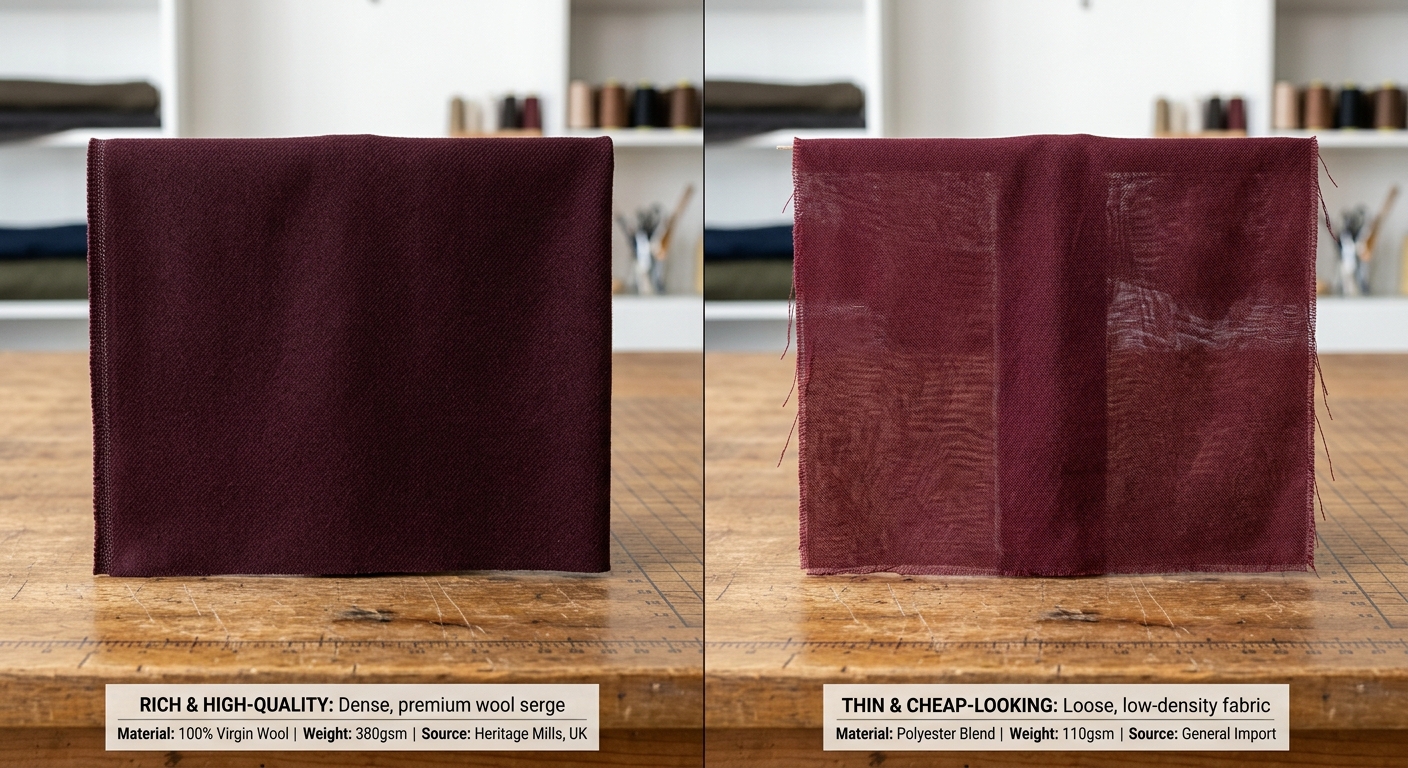
Here’s a hard truth: cashmere doesn’t cost $3 a yard. Genuine linen doesn’t sell for $2.50. If a price seems impossibly low for the fabric type, it’s because the product is not what it claims to be.
The Hidden Cost of “Cheap” Fabric
Ultra-low prices almost always signal one of three problems: mislabeled fiber content (polyester sold as cotton blends), substandard finishing (fabric that pills, shrinks, or bleeds after one wash), or irregular/defective goods being sold as first-quality. Any of these will cost you far more in returns, remakes, and lost customer trust than paying a fair price upfront.
How to Benchmark Pricing
Before you buy, check 3–4 reputable wholesale sites for the same fabric type and weight. If one store is 40–60% cheaper than every competitor, that’s not a bargain — it’s a trap. Legitimate wholesale discounts exist, but they typically come from bulk quantity tiers, not from magic pricing on single-yard orders.
Red Flag 3: No Swatch or Sample Option
Would you commit to 50 yards of fabric you’ve never touched? Neither should anyone. Yet plenty of online stores offer zero swatch or sample options, forcing you to gamble on color accuracy, hand feel, drape, and weight based on a screen image alone.
Why Screens Lie
Monitor calibration, ambient lighting, and even your browser can shift how a color appears. A “navy” on your laptop might arrive as a dark teal. A “medium weight” description could mean anything from 150 to 280 GSM depending on who wrote the listing. Swatches eliminate this guesswork entirely.
What to Demand
Any store serious about wholesale or repeat business will offer swatches — either free with shipping cost or for a small fee. If a seller refuses or doesn’t even mention the option, they likely know their product won’t match your expectations. Move on.
Pro tip: When you do receive swatches, wash them once using the care method you’d use in production. This reveals shrinkage, color bleeding, and pilling before you commit to a full order.
Red Flag 4: Stock Photos Instead of Real Product Images
If every product image looks like it was pulled from a generic photo library — perfectly lit, no wrinkles, no texture detail, and suspiciously identical across different fabric types — you’re probably not looking at the actual product you’ll receive.
What Real Fabric Photography Includes
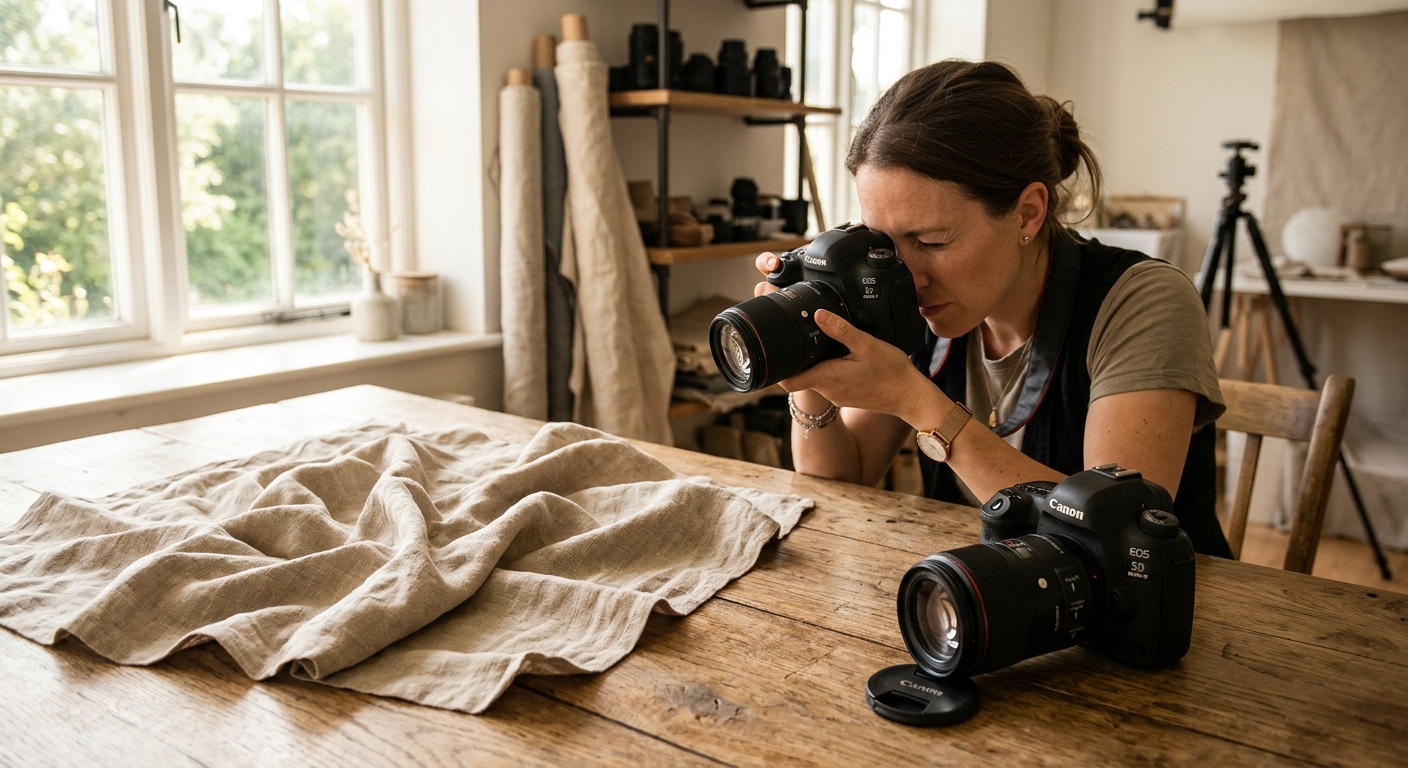
Trustworthy stores show you the fabric in multiple ways: a full bolt shot, a close-up of the weave or knit structure, a drape shot showing how the fabric falls, and ideally a shot with a ruler or hand for scale. These images tell you more than any product description ever could. You should be able to see the texture, the sheen (or lack thereof), and get a genuine sense of the fabric’s character.
Reverse Image Search is Your Friend
Suspect a photo is stolen? Right-click the image and run a Google reverse image search. If the same photo appears on 15 different websites selling 15 different “products,” you have your answer. This takes 10 seconds and can save you hundreds of dollars.
Red Flag 5: A Return Policy: Hidden, Vague, or Nonexistent
A store’s return policy tells you everything about how much they trust their own product. If you have to dig through five pages of fine print to find it — or it simply doesn’t exist — that’s a store that expects complaints and has built its business model around not handling them.
Key Policy Elements to Look for
- Defect coverage: Does the store accept returns for fabric that arrives damaged, stained, or materially different from the listing?
- Timeframe: Is there a reasonable inspection window (at least 7–14 days)?
- Cut fabric: Many stores won’t accept returns on cut yardage — that’s standard. But they should still cover defective goods.
- Refund method: Cash refund, store credit, or replacement? Know before you buy.
A Real-World Cautionary Tale
A costume designer we know ordered 30 yards of what was listed as faux leather for a theater production. What arrived was a thin vinyl with a chemical smell that wouldn’t pass a basic fire-safety test. The store’s return page? A single sentence: “All sales final.” She was stuck with unusable material and had to reorder from a reputable supplier at rush pricing. Total loss: over $600 plus a week of schedule delays.
Red Flag 6: No Verifiable Customer Reviews
Reviews are the social proof of the fabric world. A store with zero reviews — or nothing but suspiciously identical five-star praise posted on the same day — is a store with no track record you can verify.
How to Spot Fake Reviews
Look for these tells:
- All reviews posted within a short time window (e.g., 20 reviews in one week, then silence)
- Generic language that could apply to any product (“Great quality! Fast shipping!”)
- No mention of specific fabric characteristics, projects, or use cases
- No photos from actual buyers
Where to Check Beyond the Store’s Own Site
Search the store name on Google, Reddit, sewing forums, and Trustpilot. Real customers talk — especially unhappy ones. If a store has been around for years but has zero presence in any sewing community or review platform, that silence is deafening.
Conversely, a store that has a mix of 3-, 4-, and 5-star reviews with detailed comments about fabric hand, color accuracy, and shipping speed is one that’s earned real trust. Perfection is suspicious; honesty is not.
Red Flag 7: Unresponsive or Unreachable Customer Service
Before you place a large order, test the store’s customer service. Send an email asking a specific question — something like “What’s the exact GSM of your heavyweight cotton twill?” or “Can you confirm the dye lot consistency across 50 yards?” If you get no response within 48 hours, a vague non-answer, or an auto-reply that never gets followed up, you now know exactly how they’ll treat you when something goes wrong with your order.
Contact Information Checklist
A legitimate fabric seller should provide at least three of these: a phone number, an email address, a physical mailing address, and live chat. If the only contact option is a web form buried in the footer — and the “About Us” page reads like it was generated by AI with no real company details — proceed with extreme caution.
The Pre-Order Test
This is the simplest due diligence step that almost nobody takes. Ask a technical question. Time the response. Evaluate the quality of the answer. A store that knows its product will give you a specific, confident reply. A store that’s just drop-shipping mystery fabric from an overseas warehouse will give you nothing useful — or nothing at all.
Quick-Reference: Trustworthy vs Suspicious Fabric Stores
| Feature | Trustworthy Fabric Store | Suspicious Fabric Store |
|---|---|---|
| Fabric Specifications | Lists full fabric specs clearly | Uses vague words like “soft” or “premium” only |
| Swatch or Sample | Offers swatches or samples | No sample option available |
| Real Photos | Shows real fabric photos | Uses generic stock images |
| Return Policy | Has clear return and defect policies | Return policy is hidden or unclear |
| Customer Reviews | Has detailed buyer reviews | Reviews are missing, generic, or suspicious |
| Customer Service | Responds to technical questions | Gives vague replies or does not respond |
| Payment Method | Supports protected payment methods | Pushes risky payment methods like wire transfer |
We’ve compiled the key differences into a comparison table above. Print it out, bookmark this page, or screenshot it — and run through this checklist every time you consider a new online fabric supplier. It takes five minutes and can save you thousands.
The Two-Strike Rule
One red flag might be an oversight. Two red flags are a pattern. If a store triggers two or more of the warning signs above, don’t rationalize it. Don’t tell yourself “but the price is so good.” The price is good because something else isn’t. Find a better supplier.
How to Protect Yourself: A Practical Buying Checklist for 2026
Now that you know what to watch for, here’s your step-by-step protection plan before placing any online fabric order:
Order swatches first: Always. No exceptions for orders over 10 yards.
Verify specs: Confirm fiber content, GSM, width, and construction. If the listing doesn’t provide them, ask directly. If the store can’t answer, leave. Use our guide on how to read GSM like a pro to know exactly what you need.
Calculate your yardage accurately: Over-ordering wastes money; under-ordering delays projects. Use a fabric yardage calculator before committing.
Read the return policy: Before you add anything to your cart.
Check reviews: On third-party platforms, not just the store’s own site.
Test customer service: With a specific question before placing a large order.
Pay with a protected method: Credit cards and PayPal offer buyer protection. Avoid wire transfers or cryptocurrency for first-time purchases from unknown sellers.
Document everything: Screenshot the listing, save confirmation emails, and photograph the fabric immediately upon arrival — before cutting a single yard.
This checklist isn’t paranoia. It’s professionalism. Every experienced fabric buyer has learned at least one of these lessons the hard way. You don’t have to.
Shop Smarter, Not Cheaper
The online fabric market in 2026 is bigger and more accessible than ever — which means there are more great suppliers and more bad ones competing for your attention. The difference between a successful project and a costly disaster often comes down to 15 minutes of due diligence before you click “buy.”
At Global Fabric Wholesale, we list full technical specifications on every product page, offer swatches, maintain transparent return policies, and have a real customer service team that actually answers technical questions. Whether you’re sourcing jacket fabric for a production run or lace by the yard for a bridal collection, you deserve to know exactly what you’re getting before you commit. Browse our catalog, order a swatch, and see the difference a trustworthy supplier makes.




 Login with Google