


Sourcing Fabric from Overseas Mills: Lead Times, Customs, and the Real Math on Landed Cost

Sourcing fabric from overseas mills can shave 30–50% off your per-yard cost, but only if you calculate true landed cost — not the FOB quote on the proforma invoice. Expect lead times of 60–120 days door-to-door, duties of 4–25% depending on HTS classification, and another 8–15% in freight, brokerage, and handling fees you didn't see coming. If you skip that math, your “bargain” mill order can end up costing more than buying domestic.
The FOB Trap: Why the Mill Quote Is Almost Never Your Real Cost
Here's the mistake first-time importers make on day one: they see a quote of $3.20/yard FOB Shanghai and compare it to a domestic price of $5.80/yard. Easy win, right? Not even close.
FOB (Free On Board) means the mill's responsibility ends the moment the container hits the deck of the ship. Everything after that — ocean freight, terminal handling, customs entry, duty, brokerage, drayage, and warehouse offload — is on you. By the time fabric is sitting on your loading dock, that $3.20/yard typically lands between $4.40 and $5.10. The savings are still real, but they're a fraction of what the quote suggested.
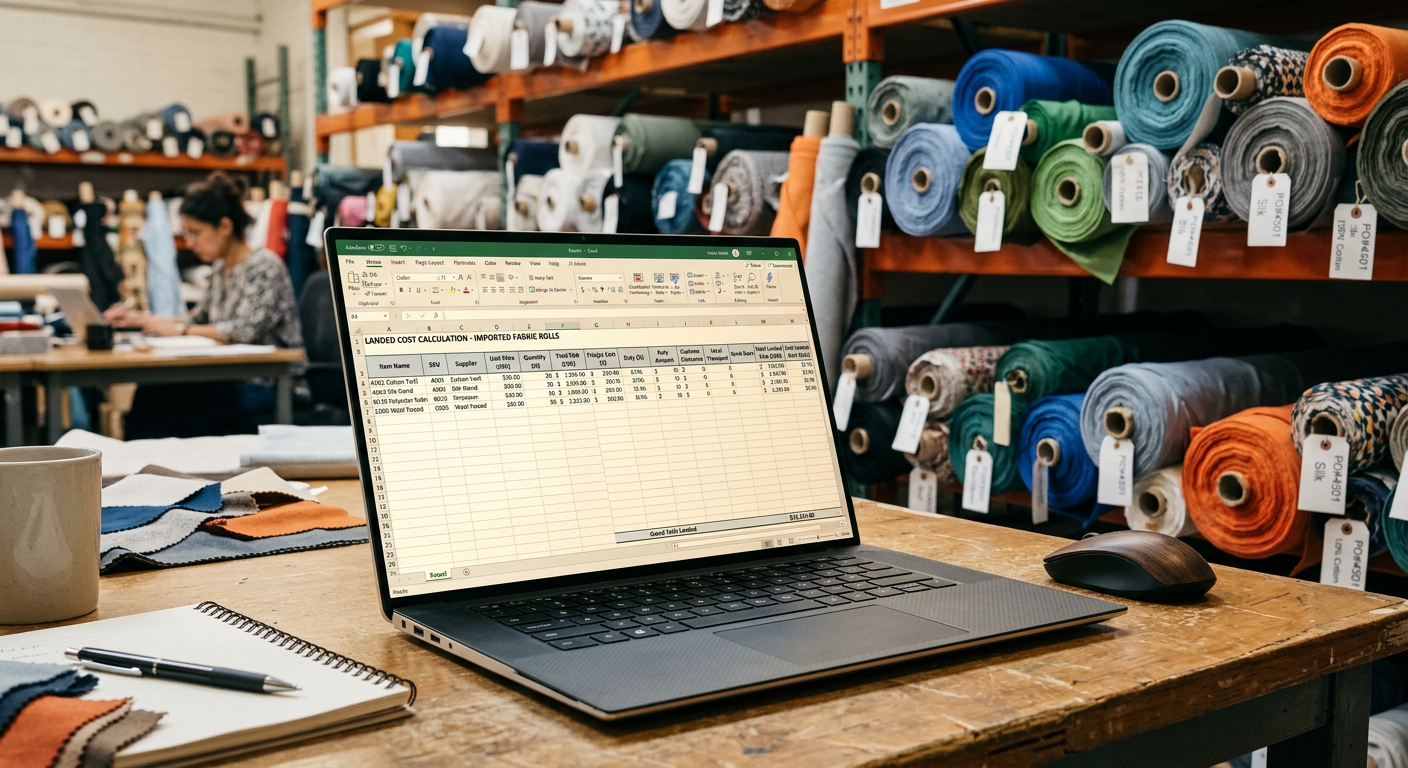
The fix is simple: never compare FOB to delivered. Build a landed cost spreadsheet before you send a deposit. We'll walk through the line items below.
Real Lead Times: 90–120 Days Is Normal, Not a Worst Case
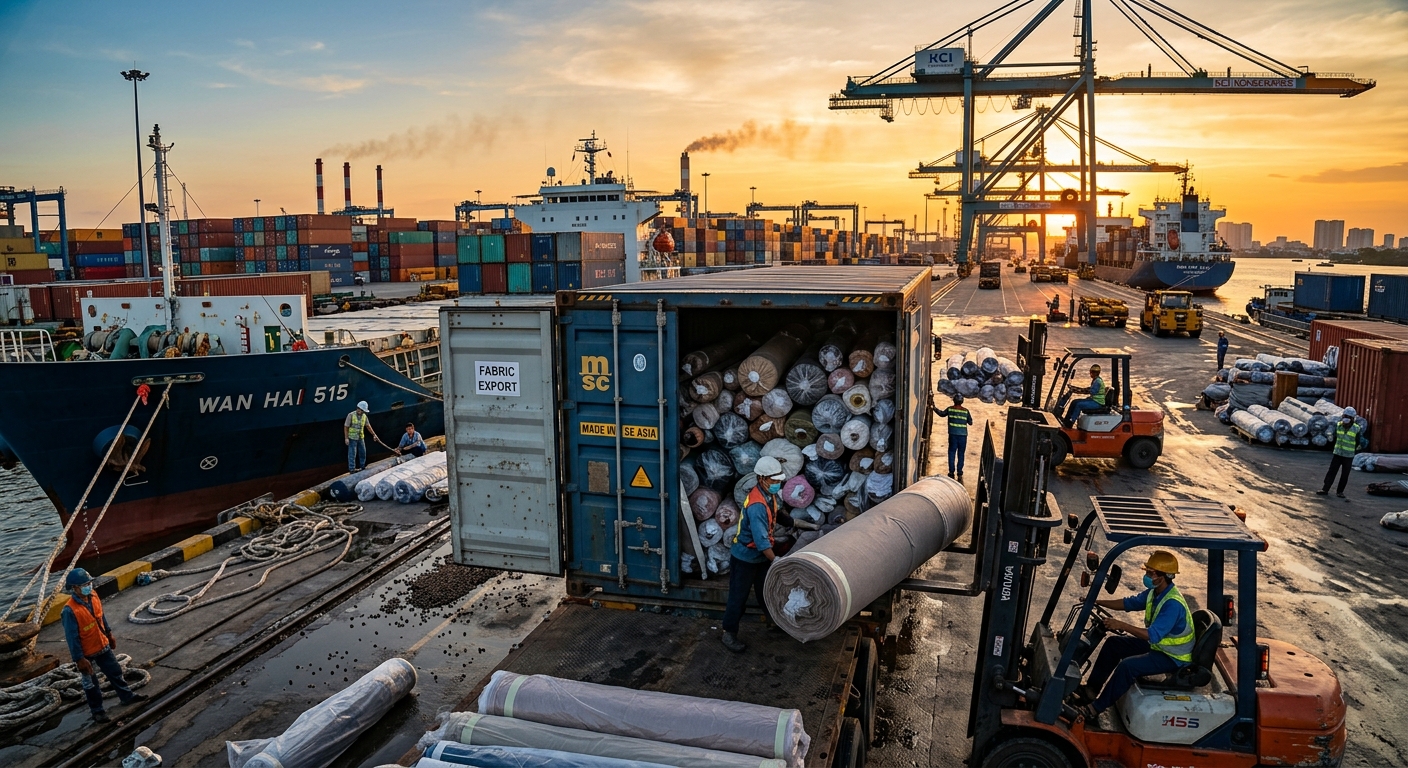
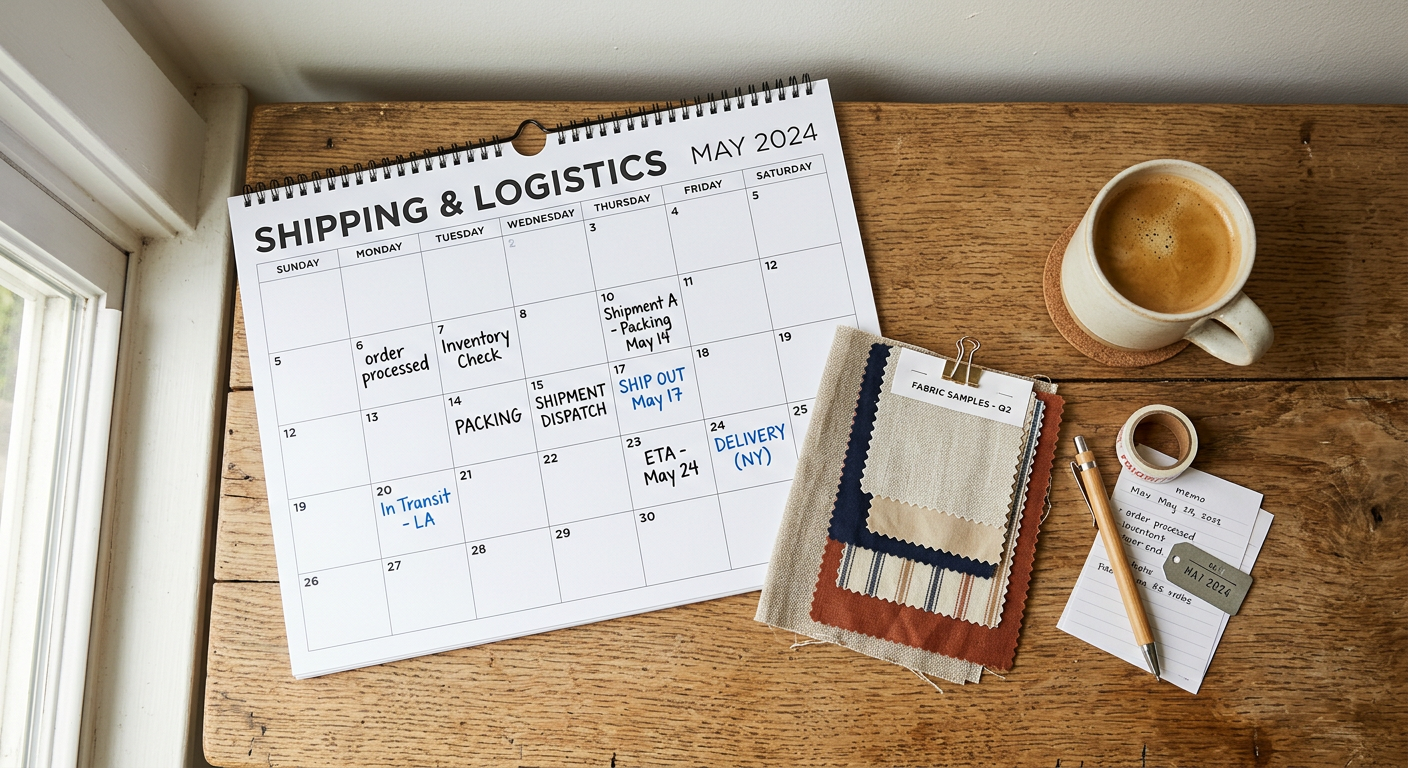
If your sales team is promising delivery in 8 weeks based on the mill saying “ready in 45 days,” you have a problem. The 45-day number is production only. The full timeline looks more like this:
- Sampling and approval: 2–4 weeks (lab dips, strike-offs, hand feel approval)
- Yarn dyeing or knitting/weaving: 30–60 days depending on dye method and mill backlog
- Finishing and QC: 7–14 days
- Booking and consolidation: 5–10 days waiting for vessel space
- Ocean transit (Asia to US West Coast): 18–25 days; to East Coast via Panama, 30–38 days
- Customs clearance and drayage: 3–7 days
Add it up: 90–120 days is the honest answer. Chinese New Year, Golden Week, Diwali, and Ramadan can each tack on 2–3 weeks if your production window overlaps. A buyer ordering coat fabric in September for a fall delivery is already too late — that program needs POs cut by April or May. For seasonal programs, check our notes on planning a coat fabric buy well before the season turns.
HTS Codes and Duty Rates: The Number That Quietly Decides Your Margin
Two fabrics that look identical on the roll can have wildly different duty rates because of their HTS (Harmonized Tariff Schedule) classification. Get this wrong and you'll either overpay duty for years or get hit with a CBP penalty on audit.
Rough 2026 US duty ranges for common fabrics:
- 100% cotton woven: 7–10.5%
- Polyester woven: 12–16%
- Cotton/poly blends: often 14.9–17% (blends usually duty higher than either pure fiber — counterintuitive but true)
- Knit fabrics: 10–18.5% depending on fiber and construction
- Coated/laminated fabrics: often lower, 2.7–7.5%, because they are classified under Chapter 59
Country-of-origin matters too. Section 301 tariffs on Chinese-origin textiles add 7.5–25% on top of base duty depending on the HTS subheading. A polyester fabric at 16% base + 25% Section 301 lands at 41% duty — that destroys most margins. Vietnam, Bangladesh, India, Turkey, and Portugal don't carry that surcharge. For more on how blends shift the math at the spec sheet level, see our breakdown on cotton vs. polyester vs. blends in bulk.
Pay a licensed customs broker $150–300 for a binding ruling before you commit to a large program. Cheapest insurance you'll ever buy.
Freight Math: When Air Beats Sea (Yes, Really)
Conventional wisdom says always ship by sea. Conventional wisdom is often wrong when the order is small or the fabric is light.
Quick rule: if your total shipment is under 100 kg and the per-yard value is over $8, air freight often beats sea LCL once you factor in LCL's hidden fees (CFS charges, ISF filing, chassis fees, demurrage risk). A 500-yard sample order of premium faux leather might weigh 90 kg — by air at $7/kg it's $630 plus a $200 clearance fee. The same shipment by LCL is $180 in freight but $450 in destination fees, and it takes 5 weeks instead of 6 days.
For FCL (full container), the math flips hard in favor of sea. A 20-foot container holds roughly 9,000–11,000 yards of medium-weight woven fabric depending on roll diameter. At $3,500 for the container, that's $0.32–0.39/yard in ocean freight — basically a rounding error on your landed cost.
The Hidden Line Items Nobody Quotes Upfront
Here's the list that surprises most first-time importers. Every one of these is real, every one is per-shipment, and they add up to 8–15% on top of FOB:
- ISF filing (10+2): $35–50, mandatory 24 hours before vessel loads or you face a $5,000 penalty
- Ocean freight: see comparison table above
- Bunker adjustment factor (BAF): $50–200, fluctuates with fuel prices
- Terminal handling charges (THC): $150–350 at destination
- Customs entry fee: $125–250 per entry from your broker
- Merchandise processing fee (MPF): 0.3464% of cargo value, $32 min / $634 max
- Harbor maintenance fee (HMF): 0.125% of cargo value (sea only)
- Chassis and drayage: $400–900 per container from port to warehouse
- Container freight station (CFS) fees (LCL only): $80–150 per CBM
- Demurrage risk: $150–300/day if you don't pick up within the free days
For a mini case study: a small bedding brand we know imported 6 CBM of printed cotton sateen — FOB cost was $11,400. They budgeted $1,200 for freight. Actual landed cost? $14,890. That extra $2,290 came almost entirely from the line items above. Margin on the finished pillowcase went from a planned 62% to 51%. Not a disaster, but not what was promised to the board.
MOQ Reality at the Mill Level
Domestic distributors will sell you 50 yards. Overseas mills will not. Typical mill MOQs in 2026:
- Stock fabric, existing colors: 500–1,500 yards per color
- Dyed-to-match (custom color): 1,500–3,000 yards per color, sometimes per shade
- Custom prints (rotary screen): 3,000–5,000 yards per colorway minimum
- Digital prints: 200–500 yards (the one bright spot for small brands)
- Custom yarn or specialty constructions: 5,000+ yards, often 10,000
The trap: a mill agent says “MOQ flexible” to get the conversation going. What they mean is “MOQ flexible if you pay a surcharge of 20–40% per yard.” That surcharge can wipe out your import savings entirely. If you can't hit the natural MOQ, you're often better off buying stock-supported fabric from a US-based wholesaler. We covered tactics for pushing back on this in our MOQ negotiation playbook.
Quality Control: The Inspection You Cannot Skip
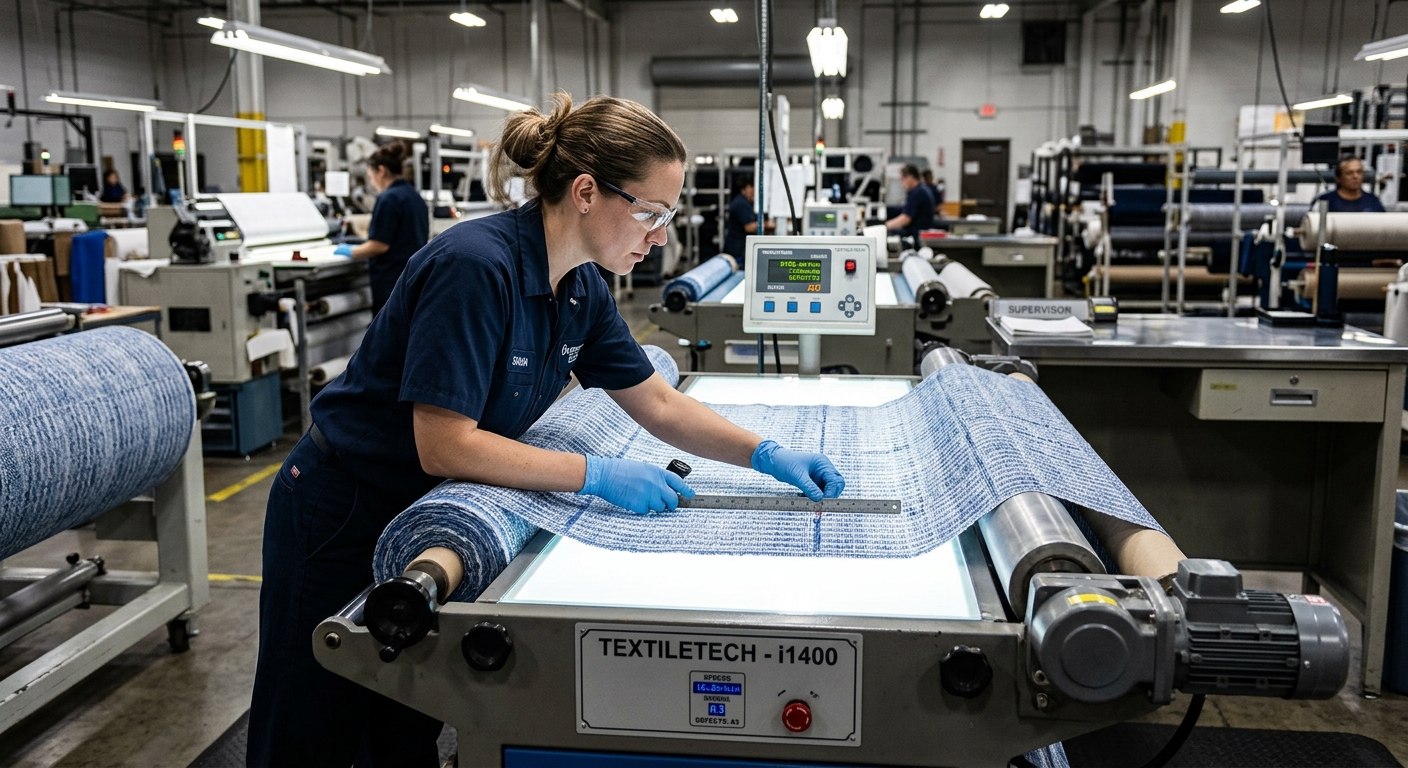
If you take one piece of advice from this article: pay for a third-party pre-shipment inspection. SGS, Bureau Veritas, Intertek, and QIMA all do AQL 2.5 textile inspections for $250–450 per man-day. That fee has saved buyers from disasters that ran into six figures.
What gets checked: GSM tolerance (±5% is industry standard, push for ±3%), width consistency, shade banding within and between rolls, shrinkage, colorfastness to washing and crocking, defect count per 100 linear yards (4-point system), and roll length accuracy. Mills routinely ship rolls labeled 100 yards that contain 94. Over a 5,000-yard order, that's $1,600+ of fabric you paid for and never received.
Real example: a uniform manufacturer ordered 8,000 yards of poly-cotton twill from a new mill. They skipped the inspection to save $400. On arrival, 22% of rolls failed the 4-point system and the shade variance between roll heads exceeded 5 Delta-E. Reject? They'd already paid 100%. Recutting and rework cost them $34,000 and a delayed shipment to their customer. If color consistency keeps biting you on imports, our piece on preventing dye lot variance is required reading.
Payment Terms and Currency Risk: Don't Wire 100% Upfront
Standard mill terms are 30% deposit on PO, 70% balance against a copy of the bill of lading. Some mills push for 50/50 or even 100% upfront — push back hard. If a mill refuses any payment structure other than 100% in advance, that's a red flag worth taking seriously (we listed others in our red flags when buying fabric online guide).
For orders over $30,000, consider a letter of credit (L/C) or escrow through Alibaba Trade Assurance. Yes, L/Cs cost 0.5–1.5% of the order value in bank fees. Yes, they're worth it — they tie payment to documentary proof of shipment and quality.
Currency is the silent killer. If you quote a customer in USD but pay the mill in CNY or EUR, a 4% currency swing between PO and final payment can eat your entire profit on a slim-margin product. For programs over $100k, lock in a forward contract with your bank — costs roughly 0.3–0.7% and removes the variable entirely.
When Importing Direct Doesn't Actually Make Sense
Direct import is great. It's not universally great. Skip the mill and buy from a US-based wholesaler when:
- Your annual volume on a given SKU is under 3,000 yards
- You need fabric in under 8 weeks
- You're prototyping and need to swap fabrics quickly
- You can't tie up working capital for 120 days
- You don't have warehouse space to receive a full container
- The duty rate on your HTS pushes landed cost within 15% of domestic anyway
A boutique apparel brand running 800 yards a season of shirt fabric across six colorways will lose money trying to import direct — the MOQs alone force them to overbuy by 4x. A contract manufacturer doing 50,000 yards a year of the same fabric in two colors absolutely should import. The break-even is usually around 5,000–8,000 yards per SKU per year. Run your own math before assuming direct is the answer.
Your Landed Cost Checklist Before You Sign the PO
Before you wire a deposit to any overseas mill, you should have answers to these in writing:
- HTS classification confirmed by a licensed broker (not the mill)
- Duty rate including any Section 301 or anti-dumping surcharges
- Country of origin documentation (form A, GSP eligibility if applicable)
- Freight quote from at least two forwarders, door-to-door
- Pre-shipment inspection booked with a third party
- Payment terms in writing, ideally with L/C or escrow protection
- Production timeline with milestone dates, not just “ready by X.”
- Tolerance specs on GSM, width, shrinkage, and shade variance
- Cargo insurance (0.3–0.5% of CIF value — cheap, skip at your peril)
Direct import isn't risky because it's hard. It's risky because most buyers underestimate the line items and overestimate the savings. Do the full math, and the savings — when they're real — are genuinely substantial.
If you'd rather skip the 120-day lead times and customs paperwork for now, we keep deep stock across most categories on the fabric type catalog at Global Fabric Wholesale — shipped from US warehouses, no broker required. Register for a wholesale account to see tiered pricing and request swatches before you build out your next program.




 Login with Google