


How to Read a Fabric Spec Sheet Without Getting Burned on Your Next Order

Reading a fabric spec sheet correctly is the single most important skill that separates profitable bulk buyers from those who eat the cost of a bad shipment. Every number on that document — GSM, shrinkage percentage, colorfastness grade — is a promise from the supplier, and if you don't know what those numbers should look like for your specific application, you're essentially signing a blank check. This guide walks you through every critical field on a standard fabric specification sheet, explains what the numbers actually mean in practice, and shows you exactly where suppliers hide (or omit) the details that end up costing you money.
Why Spec Sheets Exist — And Why Most Buyers Skim Them
Here's a hard truth: the majority of wholesale fabric disputes — wrong weight, unexpected shrinkage, colors that bleed after one wash — could have been caught at the spec sheet stage. A spec sheet isn't marketing material. It's a technical contract between you and your supplier that defines exactly what you're paying for.
The problem? Most buyers treat it like fine print. They glance at the fiber composition, maybe check the width, and move on. That's how you end up with 500 yards of legging fabric that pills after three wears or a bolt of upholstery material that fades in direct sunlight within weeks.
What a Complete Spec Sheet Should Include
A properly formatted spec sheet covers at minimum: fiber content and blend ratio, fabric construction type (knit, woven, non-woven), weight (GSM or oz/yd²), width, thread count or gauge, shrinkage percentages, colorfastness ratings (to washing, light, rubbing, and perspiration), pilling resistance, tensile and tear strength, and any applicable finish or treatment details. If your supplier's spec sheet is missing more than one or two of these, that's your first red flag.

GSM: The Number That Tells You More Than You Think
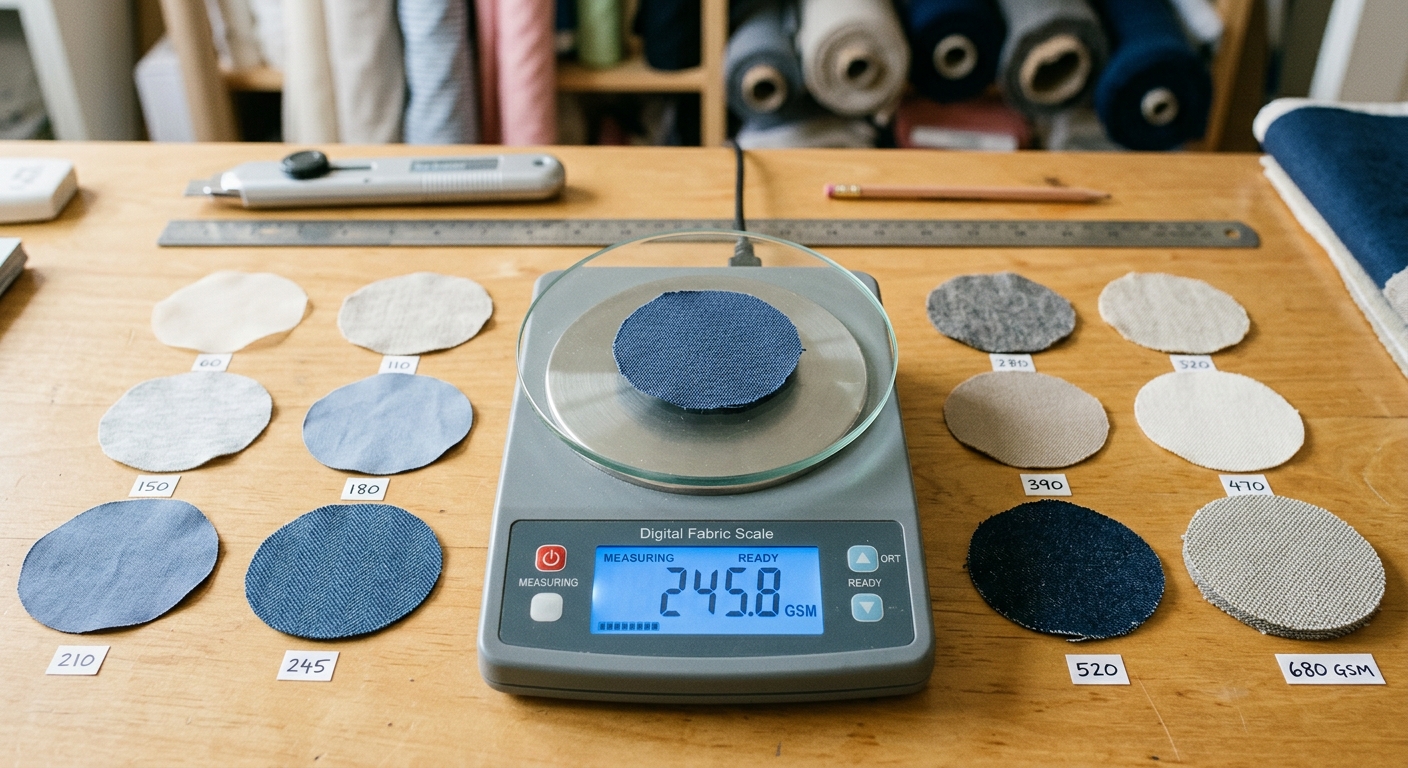
GSM stands for grams per square meter, and it's the single most referenced number on any fabric spec sheet. But most buyers misunderstand what it actually controls. GSM doesn't just tell you how heavy a fabric feels — it directly predicts drape, opacity, durability, and even sewing behavior.
GSM Ranges and What They Mean
- Under 150 GSM: Lightweight territory. Think chiffon, voile, lightweight jersey. Good for linings, summer garments, and sheer applications. Expect these fabrics to be translucent and require delicate handling during cutting and sewing.
- 150–300 GSM: The mid-weight sweet spot for most apparel. T-shirt jerseys typically land around 160–200 GSM. Sweatshirt fleece sits closer to 250–300 GSM. This range balances comfort with structure.
- 300–500+ GSM: Heavy-duty territory. Upholstery fabrics, canvas, heavy denim, and winter outerwear live here. Higher GSM means more material per unit area, which means higher cost per yard — so verify this number matches your needs exactly.
The Tolerance Trap
Here's where buyers get burned: a spec sheet might list 280 GSM, but the actual production run comes in at 255 GSM. That's a 9% variance. Most suppliers build in a ±5% tolerance, and some push it to ±10%. Always ask for the tolerance range in writing if a supplier won't commit to a tolerance, as that tells you everything about their quality control.
For instance, a small activewear brand ordering 1,000 yards of polyester spandex blend at 230 GSM discovered the delivered fabric was actually 205 GSM — technically within the supplier's unstated ±15% tolerance. The fabric was noticeably thinner, showed more transparency during stretch, and their customers started returning leggings for being see-through. The spec sheet listed 230 GSM. The purchase order didn't lock down a tolerance. Expensive lesson.
Fiber Content and Blend Ratios: The Devil is in the Percentages
A spec sheet that says “polyester/cotton blend” without exact percentages is useless. There's a massive performance difference between 65/35 poly-cotton and 80/20 poly-cotton. The former breathes reasonably well; the latter feels distinctly synthetic against skin.
Why a 5% Swing Matters
Fiber blend ratios control everything downstream: how the fabric takes dye, how it shrinks, how it pills, how it drapes, and how it performs in the wash. A skirt fabric with 5% spandex has comfortable stretch recovery. Drop that to 2% spandex and the garment bags out at the knees and seat after a few hours of wear.
Always cross-reference the fiber content with the end-use performance claims. If a supplier claims a fabric is “moisture-wicking” but the blend is 95% cotton and 5% polyester, that's physically implausible. Cotton absorbs moisture; it doesn't wick it. Either the blend ratio is wrong or the performance claim is.
Regulatory Compliance
In the US, the Textile Fiber Products Identification Act requires accurate fiber content labeling. If you're reselling finished goods, the fiber content on your spec sheet must match what goes on the care label. Getting this wrong isn't just a quality issue — it's a legal one.
Shrinkage: The Silent Order Killer
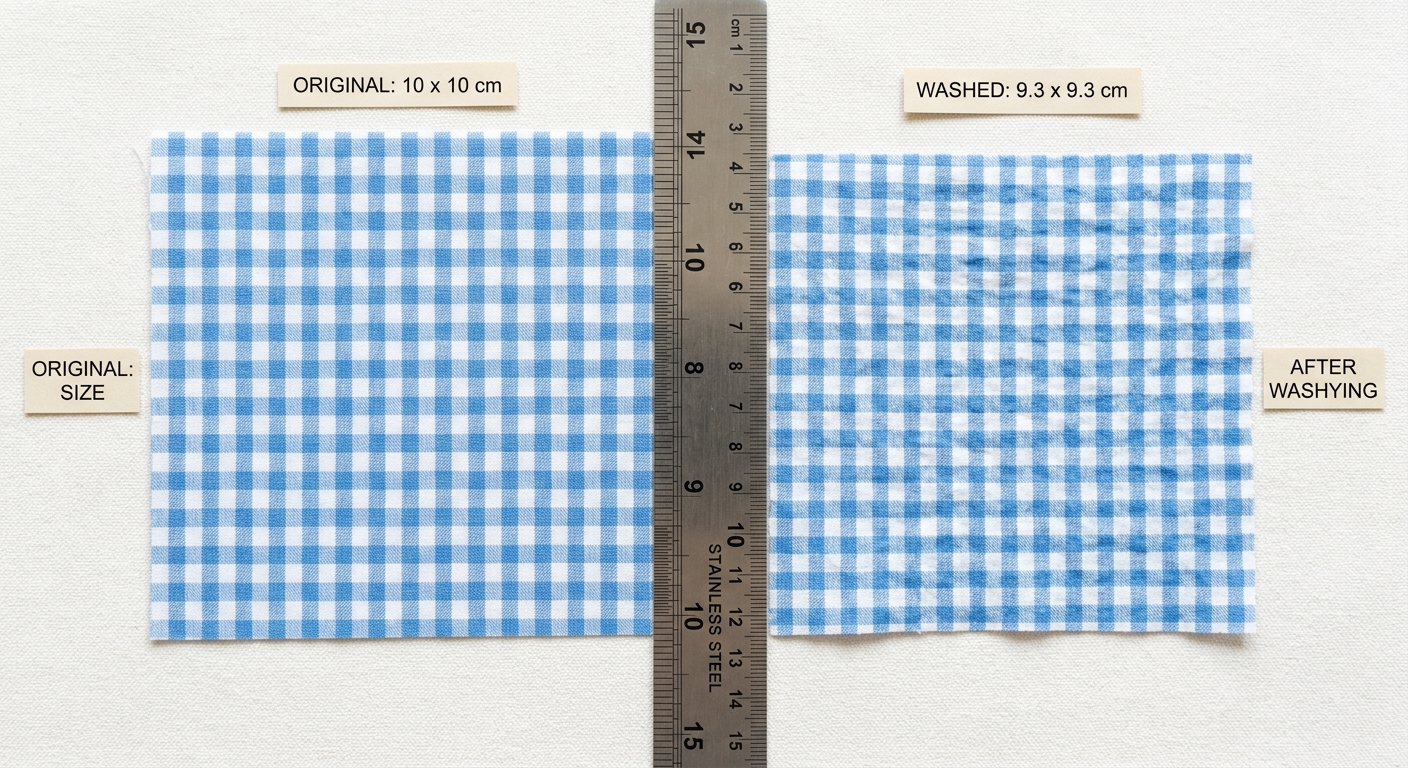
Shrinkage is the spec that causes the most financial damage in wholesale fabric buying, full stop. A 3% shrinkage rate might sound small, but on a 60-inch-wide fabric, that's nearly 2 inches of width loss. For a garment manufacturer cutting hundreds of panels, that can mean every single piece comes out undersized.
Warp vs Weft Shrinkage
A good spec sheet breaks shrinkage into two directions: warp (lengthwise, along the selvage) and weft (crosswise). Fabrics almost never shrink evenly in both directions. A knit jersey might shrink 5% in the warp but only 2% in the weft. If the spec sheet gives you a single number — say “3% shrinkage” — ask which direction. If the supplier can't tell you, they probably haven't tested it properly.
Pre-Shrunk vs Not
Some spec sheets note that the fabric has been pre-shrunk or “sanforized.” This matters enormously. A pre-shrunk fabric with 1% residual shrinkage is a very different product from a non-treated fabric with 5% shrinkage that the supplier expects you to handle during garment finishing. Know which one you're getting and adjust your pattern grading accordingly.
Real-world example: a home textiles company ordered 2,000 yards of a cotton twill for throw pillow covers. The spec sheet listed 4% shrinkage but didn't specify direction or whether the fabric was pre-treated. After the first wash, the covers shrank unevenly — the length pulled in 6% while the width only moved 2%. Every single pillow cover puckered at the seams. The entire production run had to be remade with adjusted cut patterns.
Colorfastness Ratings: Decoding the Grey Scale
Colorfastness is tested and rated on a 1–5 grey scale (ISO 105 standard), where 5 means no color change and 1 means severe fading or bleeding. Most buyers know this much. What they don't know is that there are multiple types of colorfastness, and a fabric can score well on one and terribly on another.
The Four Colorfastness Tests That Matter
- Colorfastness to washing (ISO 105-C06): Will the color survive repeated laundering? For apparel, you want a minimum rating of 4.
- Colorfastness to light (ISO 105-B02): Will the color fade in sunlight? Critical for tapestry and upholstery fabrics that sit near windows. Demand a rating of 4+ for any home décor application.
- Colorfastness to rubbing/crocking (ISO 105-X12): Does color transfer when rubbed? Tested both dry and wet. Dark colors — especially black fabrics — are notorious for poor wet crocking scores.
- Colorfastness to perspiration (ISO 105-E04): Essential for activewear and intimate apparel. If this isn't on the spec sheet for body-contact fabrics, request it.
What Ratings are Acceptable
For most commercial apparel, a rating of 3.5–4 across all categories is the baseline. Anything below 3 is a reject for garments that will be washed regularly. For upholstery, light fastness is the critical metric — you need a 5 or close to it, because sunlight exposure is cumulative and irreversible.
If a supplier provides colorfastness data without specifying which test standard was used, push back. “Good colorfastness” is meaningless without a number and a test method.
Pilling Resistance and Abrasion: The Specs Buyers Forget to Check
Pilling resistance is the most overlooked spec on the sheet, and it's the one your end customers will notice first. Nothing kills a product's reputation faster than fabric that pills after a handful of wears.
The Martindale Test
Pilling is typically tested using the Martindale method (ISO 12945-2), which rubs fabric against itself for a set number of cycles and rates the result on a 1–5 scale. For apparel, you want a minimum of 3 (moderate pilling). For high-end garments or coarse-textured fabrics used in outerwear, push for 4+.
Abrasion Resistance (Martindale Cycles)
Related but distinct from pilling, abrasion resistance measures how many rubbing cycles the fabric can endure before it breaks down. This is reported as a raw number — 20,000 Martindale cycles is the minimum for light domestic upholstery. Heavy commercial use (hotel furniture, restaurant seating) demands 40,000+. If you're buying fabric for bags or accessories, bag-weight fabrics should be tested to at least 25,000 cycles.
A spec sheet that lists pilling resistance but not abrasion resistance (or vice versa) is giving you an incomplete picture. Always request both.
Width, Selvage, and Usable Width: Small Details, Big Cost Impact
The width listed on a spec sheet is almost never the usable width. A fabric listed at 60 inches might have 58 inches of usable face between the selvages. That 2-inch difference doesn't sound like much until you're calculating fabric yield for a 10,000-unit production run.
Cuttable Width vs Total Width
Always ask whether the stated width includes selvages. Some suppliers measure edge-to-edge; others measure cuttable face only. A 2-inch discrepancy across 1,000 yards means you're short roughly 55 square yards of usable fabric. At $8 per yard, that's $440 you didn't budget for — and that's on a relatively small order.
Width Consistency Along the Roll
Cheap production runs sometimes have width variation within a single roll — wider at the beginning, narrower toward the center where tension was higher during weaving or knitting. A good spec sheet will note a width tolerance (e.g., 58” ±0.5”). If there's no tolerance listed, ask for it. If the supplier can't provide one, consider that a quality control warning.
Tensile Strength and Tear Strength: When Durability is Non-Negotiable
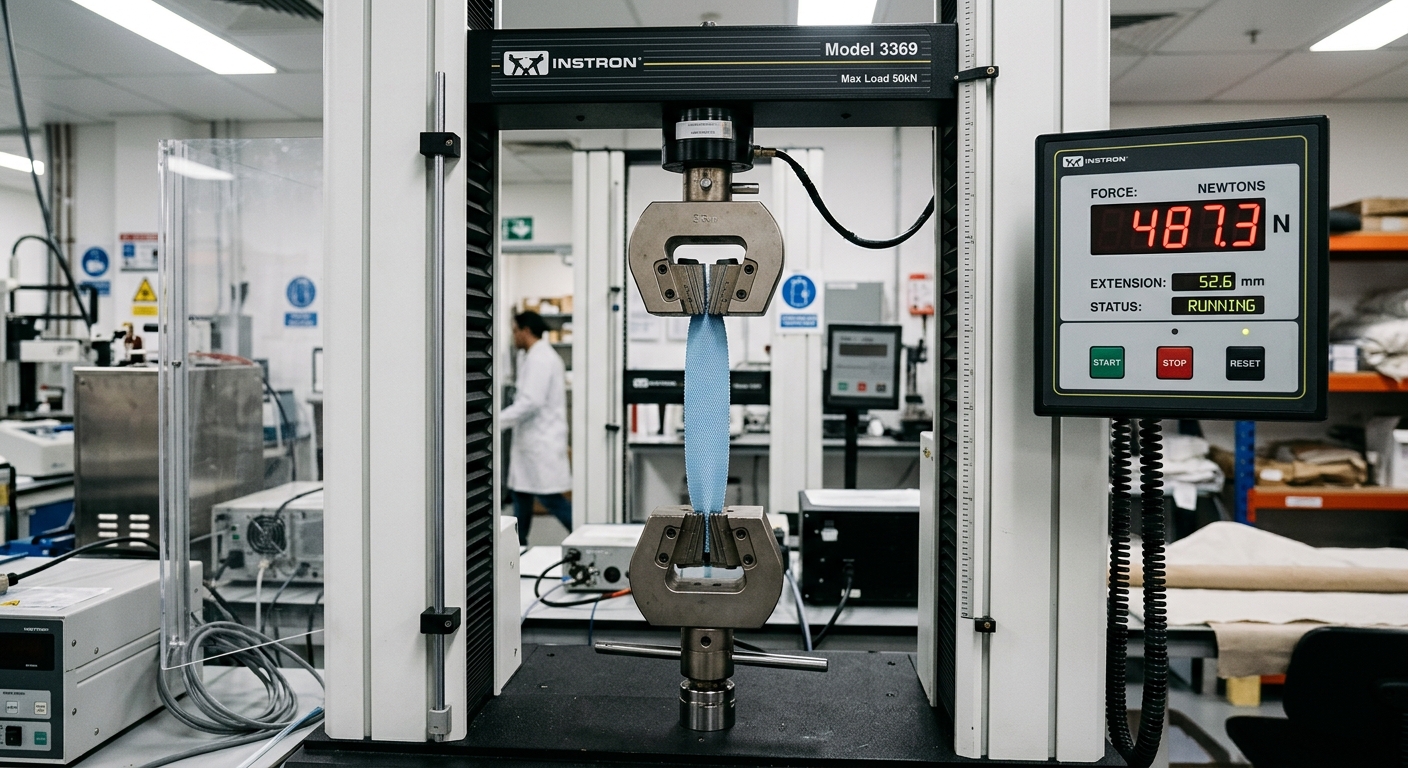
Tensile strength measures the force required to pull a fabric apart. Tear strength measures the force needed to propagate an existing tear. They're different tests, and both matter — especially for performance applications like workwear, outdoor gear, and heavy-use home textiles.
Reading the Numbers
Tensile strength is reported in Newtons (N) or pounds-force (lbf), separately for warp and weft. A woven cotton poplin might have a warp tensile strength of 300 N and a weft of 200 N. That asymmetry is normal — warp yarns are typically stronger because they're under tension during weaving.
What should concern you is when the warp-to-weft ratio is wildly unbalanced (e.g., 400 N warp vs. 100 N weft). That suggests the weft yarns are significantly weaker, which can cause seam failures along the crossgrain in finished garments.
Minimum Thresholds by Application
- Light apparel (blouses, linings): 150+ N in both directions
- Moderate apparel (pants, jackets): 250+ N
- Workwear and outerwear: 400+ N
- Upholstery: 350+ N, with tear strength of 15+ N minimum
Finish and Treatment Specs: What's Been Done to Your Fabric
Many fabrics arrive with chemical or mechanical finishes that alter their hand feel, appearance, or performance — and these treatments should be documented on the spec sheet. If they're not, you're flying blind.
Common Finishes to Look for
- Sanforizing: Mechanical pre-shrinking. Reduces residual shrinkage to under 1%.
- Mercerization: Chemical treatment for cotton that increases luster and dye uptake. Mercerized cotton looks and feels noticeably different from untreated cotton.
- Water-repellent coating (DWR): Applied to outdoor and performance fabrics. Has a limited lifespan — ask how many wash cycles the treatment survives.
- Anti-pilling treatment: Enzyme or singeing process that reduces surface fuzz. Improves pilling scores but can affect hand feel.
- Flame retardant: Required for certain commercial applications (hospitality, children's sleepwear in the US). Must meet specific standards like NFPA 701 or CPSC 16 CFR 1615.
Why This Matters for Your End Product
Finishes wear off. A DWR-treated fabric that beads water beautifully on the sample swatch might lose that property after 15 washes. If your product's selling point depends on a finish, the spec sheet needs to tell you the treatment method, the standard it was tested to, and its expected durability. “Water-resistant finish” without further detail is not a spec — it's a marketing claim.
Putting It All Together: Your Spec Sheet Checklist Before You Sign the PO
Don't treat the spec sheet as a formality. Treat it as your insurance policy. Before you commit to any wholesale fabric order, run through this checklist:
- Fiber content — exact percentages, not vague blend descriptions
- GSM — with stated tolerance (±5% max for quality suppliers)
- Width — usable/cuttable width, not total width, with tolerance
- Shrinkage — broken out by warp and weft, with pre-treatment status noted
- Colorfastness — ratings for washing, light, rubbing (dry and wet), and perspiration where applicable, with ISO test standards cited
- Pilling resistance — Martindale rating, minimum 3 for apparel
- Tensile and tear strength — warp and weft values in Newtons
- Finishes — type, method, durability, and applicable standards
- Construction details — weave or knit type, thread count or gauge
If any of these are missing, request them before placing your order. A reputable supplier will have this data readily available from their quality control lab. A supplier who can't produce it — or won't — is telling you that their QC process is either nonexistent or something they'd rather you not examine closely.
At Global Fabric Wholesale, we provide detailed specifications for every fabric we sell because we believe informed buyers make the best long-term customers. Whether you're sourcing lightweight jersey for a summer collection or heavy-duty canvas for commercial bags, knowing how to read a spec sheet puts you in control of your supply chain — and keeps your margins intact.






 Login with Google