-

Free Samples!



The Chemistry of Water-Repellent Coatings: DWR, PU, and PVC Explained for Bulk Buyers

Table of Contents
DWR, PU, and PVC repel water through three completely different chemical mechanisms — DWR lowers surface tension on individual fibers so water beads up and rolls off, PU forms a continuous polymer film that physically blocks liquid while still letting vapor pass, and PVC creates a fully sealed plastic membrane with zero permeability. Pick the wrong one for your application and you'll either pay for waterproofing you don't need, or ship a product that fails a hydrostatic test in the first field trial. Understanding the chemistry isn't academic — it's the difference between a bulk order that performs for two years and one that gets returned in month three.
What DWR Actually Does at the Molecular Level
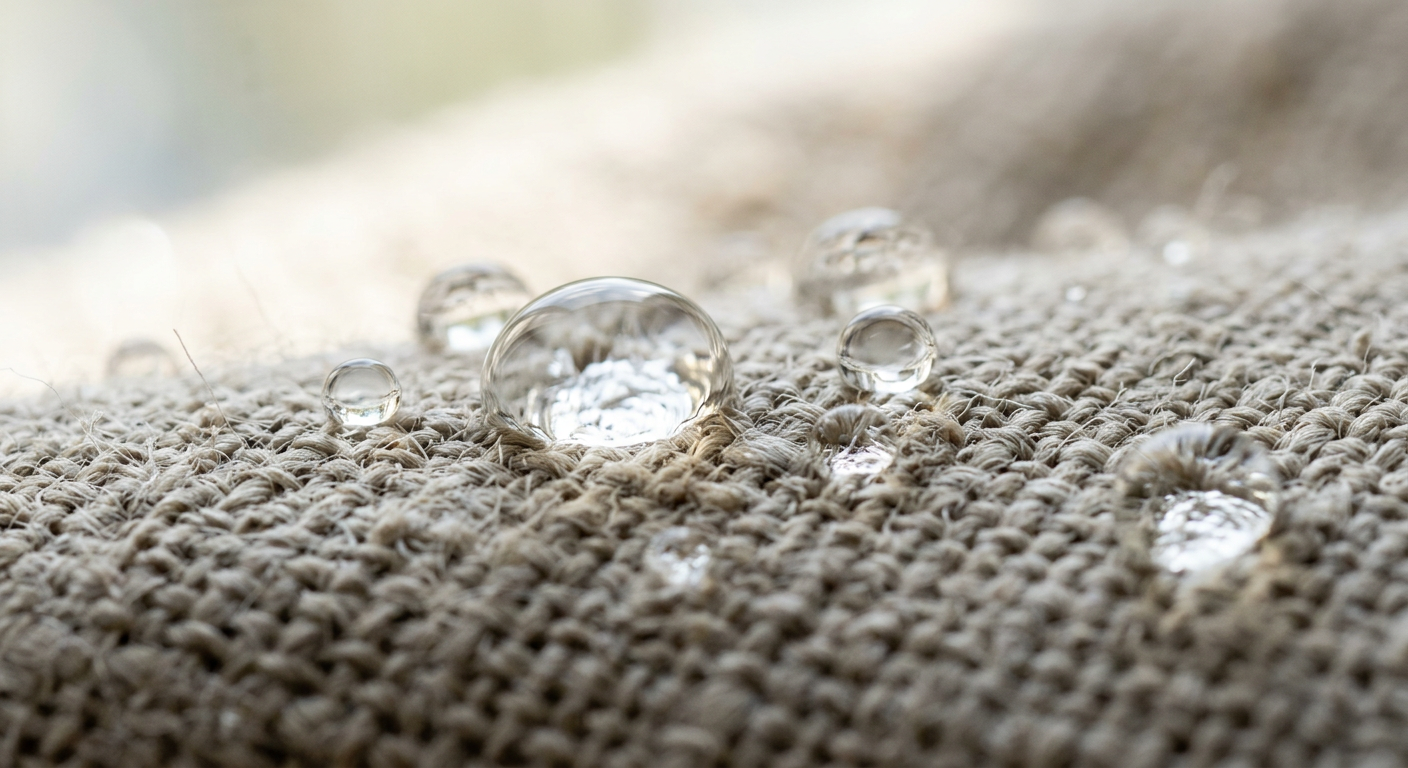
Here's a fact that surprises most buyers: DWR doesn't waterproof anything. It just makes water bead up and roll off instead of soaking in. That's it. DWR (Durable Water Repellent) works by attaching long-chain molecules — traditionally fluorocarbons, increasingly hydrocarbon or silicone-based alternatives now that C8/C6 fluorochemicals are getting regulated out of the market — to individual fibers. These chains create a low-surface-energy shell around each thread, so water can't “wet” the fiber surface.
The catch: DWR is a treatment, not a structural coating, so it wears off. Expect meaningful degradation after 20-40 wash cycles or heavy abrasion, which is why performance jacket brands tell customers to run garments through the dryer periodically — heat reactivates the chain orientation on the fiber surface. For bulk buyers, that means DWR is never your only line of defense on a genuinely waterproof product. It's a finish layered on top of a woven or knit base, most often paired with a tighter weave like the ones found in pique fabric or a brushed face for wind resistance.
Where DWR Alone Is the Right Call
If your product just needs to shrug off light rain or morning dew — think softshell jackets, daypacks, or golf wear — DWR alone is often the smarter spend. It keeps the fabric breathable and lightweight, and it costs a fraction of a full PU or PVC lamination.
PU Coatings: The Workhorse of Real Waterproofing
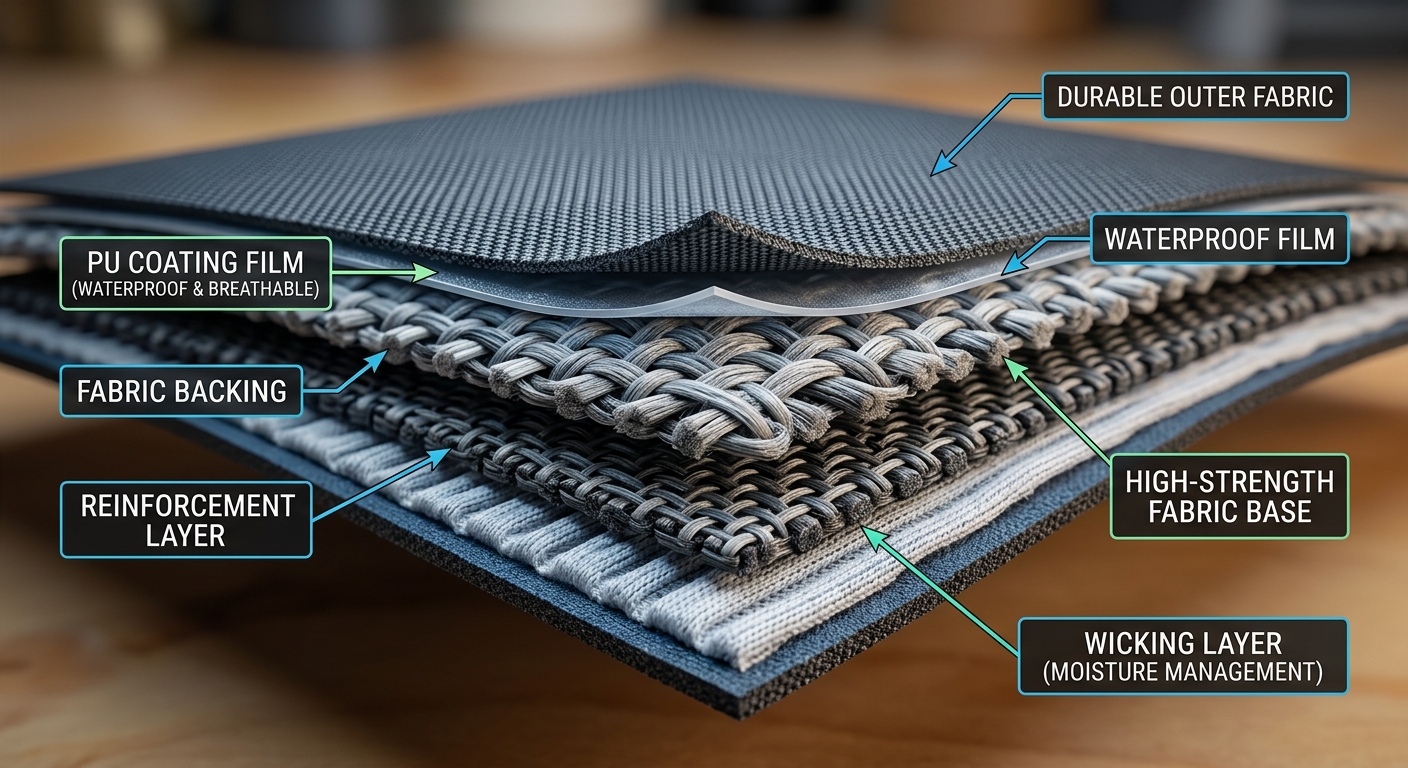
Polyurethane coating is where waterproofing actually happens as a physical barrier rather than a surface trick. A liquid PU resin is knife-coated or laminated onto the back of a base fabric and cured, forming a continuous film measured in microns. Standard hydrostatic head ratings for PU-coated fabric run anywhere from 1,000mm to 10,000mm+ — meaning the fabric can withstand a column of water that tall before leaking, per the standard ISO 811 test.
The clever part of modern PU chemistry is microporous engineering. Manufacturers can introduce microscopic pores (smaller than a water droplet but larger than a water vapor molecule) that let sweat escape while still blocking rain. This is the science behind genuinely waterproof breathable fabric — it's not a marketing term, it's a real polymer structure doing double duty.
A Real-world Example
A hospitality linens buyer sourcing outdoor cabana curtains for a resort chain switched from a basic PVC tablecloth vinyl to a PU-coated polyester after guests complained the old material felt stiff and trapped heat in direct sun. The PU version held up through a full monsoon season and stayed flexible below 40°F, something PVC struggled with on the same property's poolside furniture covers.
PVC Coatings: Total Waterproofing, Zero Breathability
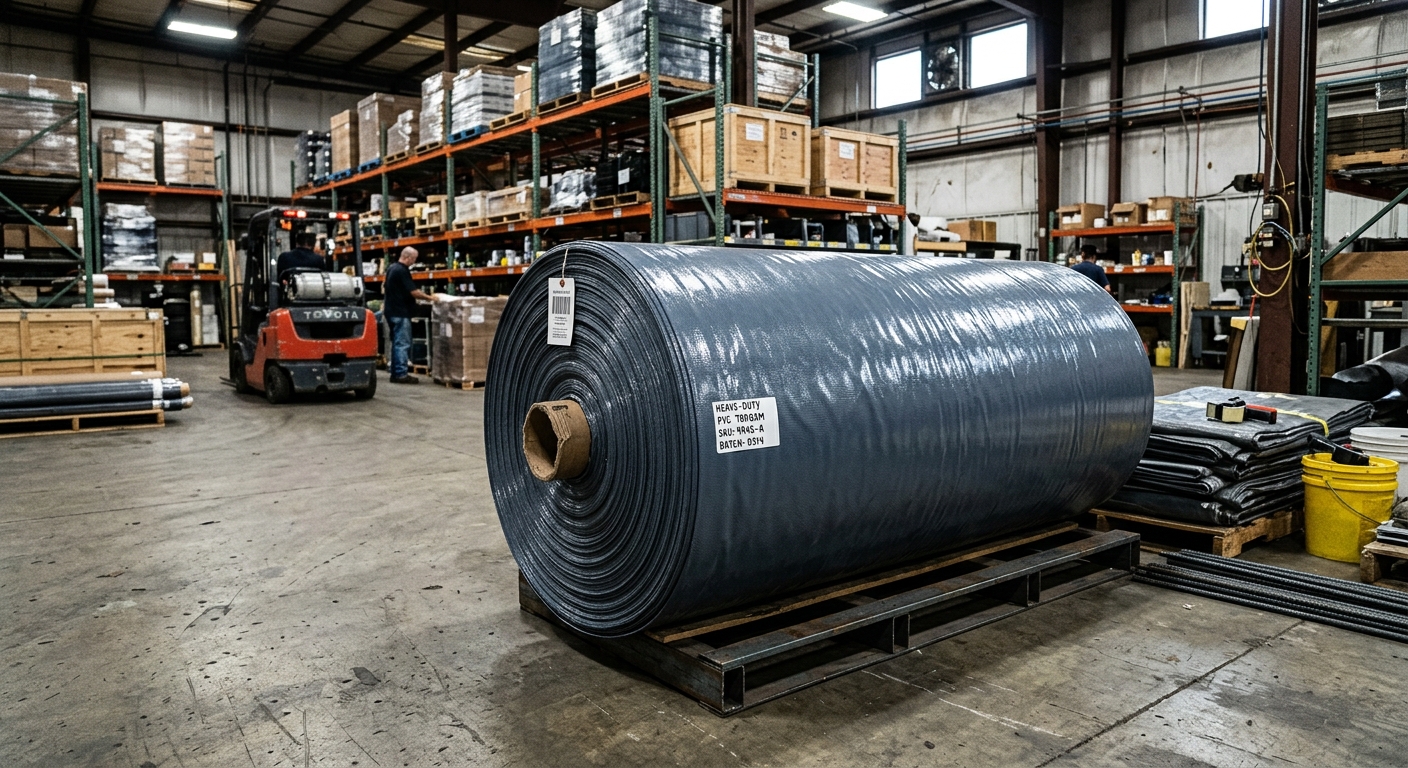
PVC coating is the blunt instrument of the three. A plasticized vinyl film — usually 150 to 300+ gsm — is bonded directly to a woven or knit substrate, and the result doesn't let a single molecule of water or vapor through. That's exactly why PVC dominates categories where breathability is irrelevant: truck tarps, industrial tablecloths, marine covers, conveyor belting, and heavy-duty upholstery for outdoor bars and food trucks.
The tradeoff is flexibility over time. Plasticizers — the additives that keep PVC soft — migrate out of the film gradually, especially under UV exposure and temperature swings. That's why cheap PVC tarps go stiff and crack within a season while a well-formulated commercial-grade PVC can last 5+ years. If you're sourcing PVC-coated material for anything going outdoors long-term, ask your supplier for the plasticizer type and UV stabilizer package before you commit to a container order — it's the single biggest predictor of field failure.
Hydrostatic Head and MVTR: The Two Numbers That Actually Matter
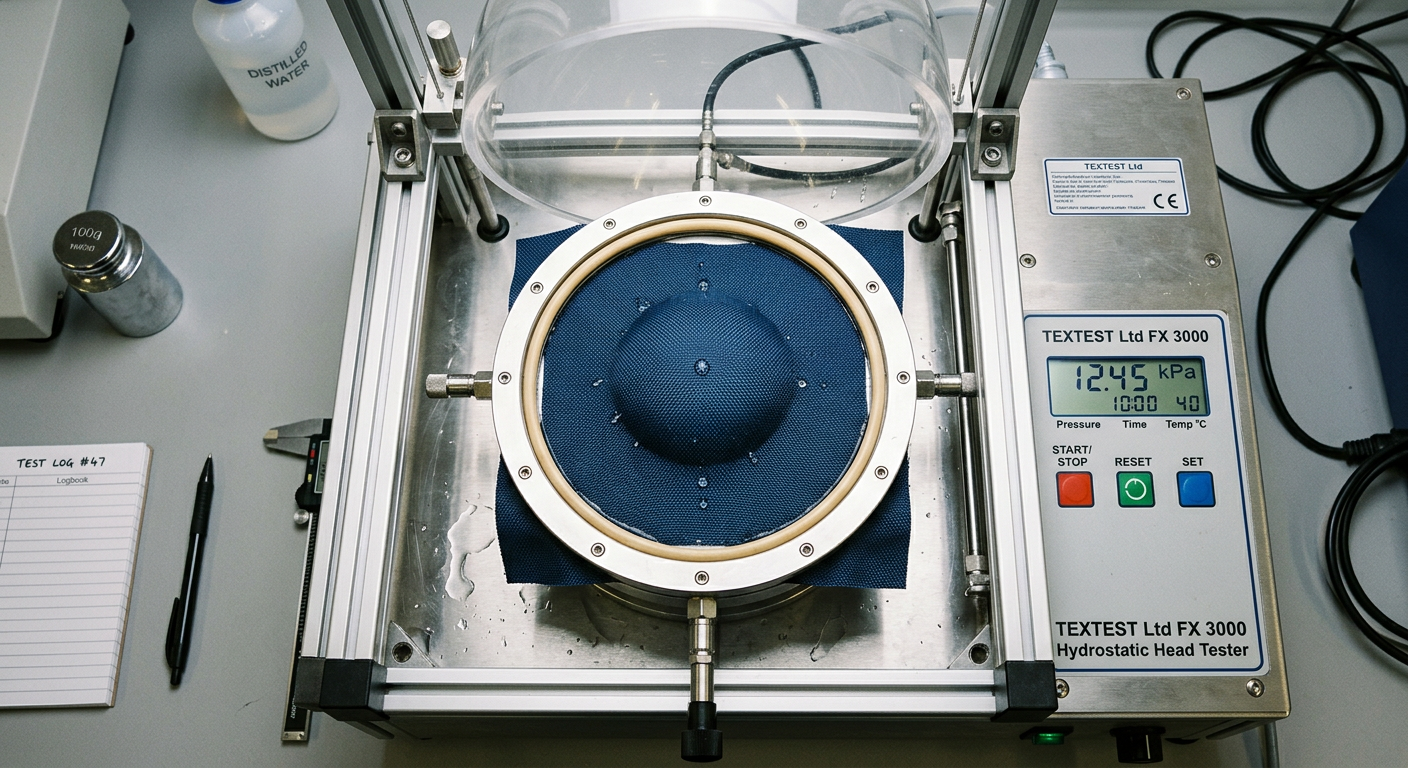
Most spec sheets throw around “waterproof” without a number attached, and that's a red flag. Two metrics tell you the real story: hydrostatic head (HH), measured in millimeters, tells you how much water pressure the fabric resists before leaking. Moisture Vapor Transmission Rate (MVTR), measured in grams per square meter per 24 hours, tells you how breathable it is.
- 1,000-3,000mm HH — light rain resistance, fine for fashion outerwear
- 5,000-10,000mm HH — genuine rainwear and outdoor gear territory
- 20,000mm+ HH — mountaineering and technical marine gear
- MVTR under 5,000g — you'll feel clammy wearing it during activity
- MVTR 10,000-20,000g — solid breathable performance for activewear
If you've read our guide on how to read a fabric spec sheet, you already know spec sheets can be padded with impressive-sounding but irrelevant numbers. HH and MVTR are the two you actually verify with a lab test report, not a supplier's marketing copy.
Environmental Regulation Is Rewriting the DWR Playbook
Long-chain PFAS-based DWR (C8 fluorocarbons) is being phased out across the EU, California, and increasingly by major retailers regardless of jurisdiction. If your current DWR-treated inventory relies on older C8 chemistry, expect that supplier relationship to get complicated fast — several EU countries now restrict sale outright.
The replacement chemistries — C6 fluorocarbons and increasingly PFAS-free hydrocarbon or dendrimer-based repellents — perform slightly worse on oil and stain repellency but are catching up fast on pure water repellency. For bulk buyers, this means asking suppliers directly: “Is this DWR PFAS-free, and what's the wash-durability rating compared to the C8 version you used to carry?” Any supplier who can't answer that clearly is a supplier you should be auditing anyway — our 12-point supplier audit checklist covers exactly this kind of chemical compliance question.
Matching Coating Chemistry to Your Actual Product
Skip the temptation to over-engineer. A children's rain jacket doesn't need 20,000mm hydrostatic head — it needs to survive puddle-jumping and a wash cycle, which puts it squarely in DWR-plus-light-PU territory. A cruise ship deck cushion needs full PVC sealing because it's sitting in standing water and direct sun for years, not hours.
Quick Decision Framework
Ask three questions before specifying a coating: How long will the product be exposed to water in a single use? Does the end user need breathability, or is it a static object like furniture or a cover? And what's your acceptable cost-per-yard ceiling? A brushed-back softshell using brushed fabric as the base with a DWR finish will run far cheaper than a fully PU-laminated technical shell, and for 80% of fashion outerwear applications, that's more than enough performance.
What Bulk Buyers Get Wrong About Coating Durability
The biggest mistake we see: buyers assume a coated fabric's waterproof rating is permanent. It isn't. PU coatings hydrolyze over time — moisture in the air slowly breaks down the polyurethane's ester bonds, which is why PU-coated raincoats from a decade ago often go sticky or delaminate in storage even if never used. This is accelerated by heat and humidity, which circles back to something we've covered before: how you store wholesale fabric rolls directly affects coating lifespan, not just the base textile.
For inventory planning, that means PU and PVC-coated rolls are not indefinite-shelf-life materials. If you're warehousing coated fabric for more than 12-18 months, test a sample swatch before committing it to a production run — hydrolysis doesn't always show visible signs until the coating is flexed or stressed.




 Login with Google