


How to Store Wholesale Fabric Rolls So They Don’t Mildew, Crease, or Lose Value

Store wholesale fabric rolls horizontally on suspended rods in a climate-controlled room at 65–72°F and 45–55% relative humidity, wrapped in breathable Tyvek or unbleached muslin — never plastic. That single setup prevents the three problems that quietly destroy fabric inventory value: mildew from trapped moisture, hard creases from compression, and yellowing from UV and acidic contact. The details below show exactly how to build it, what shortcuts cost you, and how to triage rolls that are already showing damage.
Why Fabric Storage Failures Cost More Than You Think
A single mildewed bolt of 60-yard cotton sateen at $4.50/yard is $270 down the drain — and that's before you factor in the cross-contamination risk to rolls stacked next to it. Mold spores travel. One musty bolt can taint a dozen.
The damage usually isn't visible until you unroll for a customer. By then, you've lost the sale, lost trust, and lost the inventory. The three failure modes to prevent are:
- Mildew and mold — caused by humidity above 65% combined with poor airflow.
- Permanent creases and shoulder marks — caused by stacking, kinking, or storing on undersized cores.
- Yellowing, fading, and acid migration — caused by UV exposure, fluorescent lights, and contact with raw cardboard or untreated wood.
The good news: every one of these is preventable with setup decisions you make once and benefit from for years. The bad news: most warehouses get at least two of the three wrong.
The Temperature and Humidity Sweet Spot
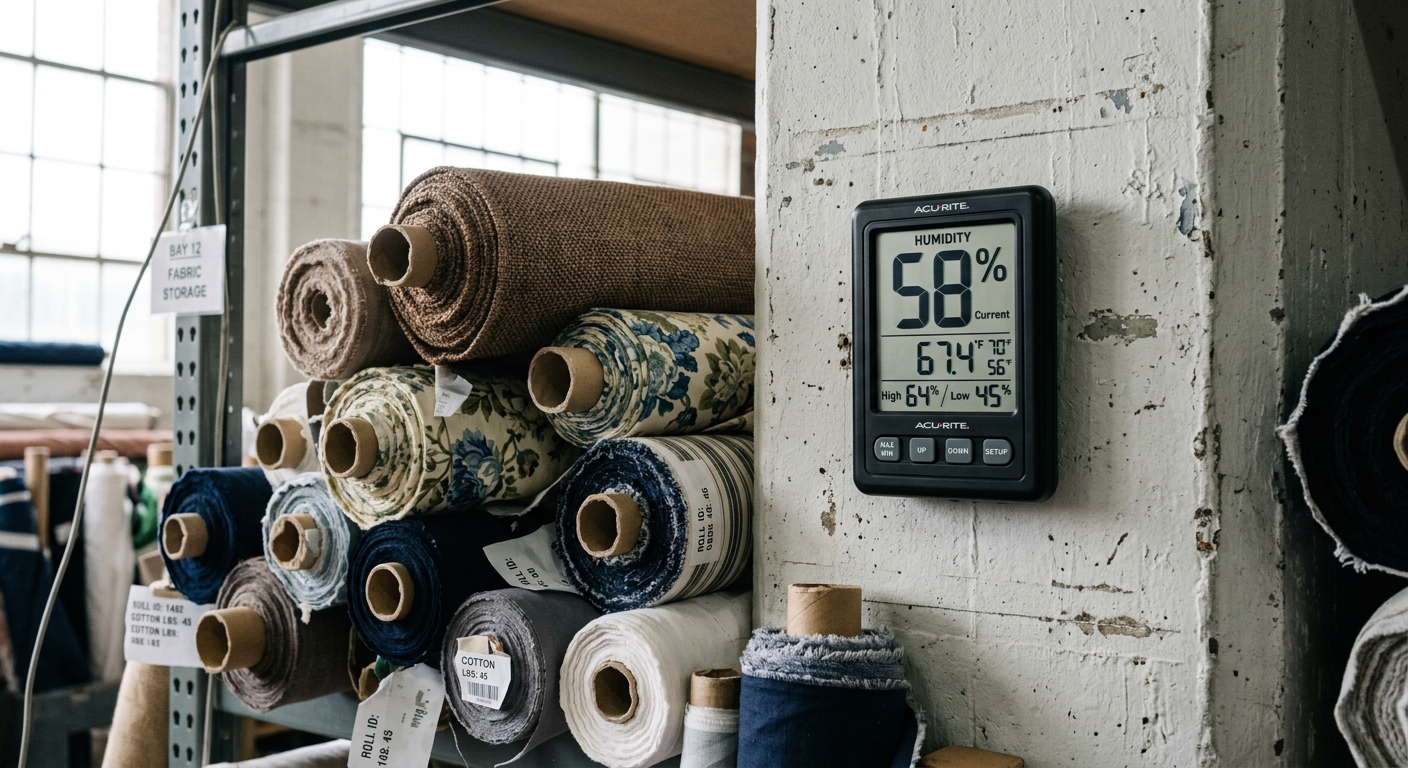
Aim for 65–72°F (18–22°C) and 45–55% relative humidity. That's not a suggestion — it's the same range textile conservators use at the Smithsonian, and it works because it sits below the mold-growth threshold (60% RH) while staying above the brittleness threshold (35% RH) where natural fibers start to dry out and crack.
What Happens Outside That Range
- Above 65% RH: mildew within 4–6 weeks on cotton, linen, and wool. Synthetics resist longer but absorb musty odors that are nearly impossible to remove.
- Below 35% RH: silk and fine wovens lose suppleness; static buildup attracts dust and lint that bonds to the surface.
- Temperature swings above 15°F daily: condensation forms inside roll cores, which is where mildew starts unseen.
Buy a $30 digital hygrometer for every storage zone and log readings weekly. A small warehouse in a humid climate may need a 70-pint dehumidifier running continuously from May through September. The electricity cost is roughly $40/month — far less than one ruined roll of jacquard fabric.
Horizontal Suspended vs Vertical vs Stacked: Pick the Right Setup
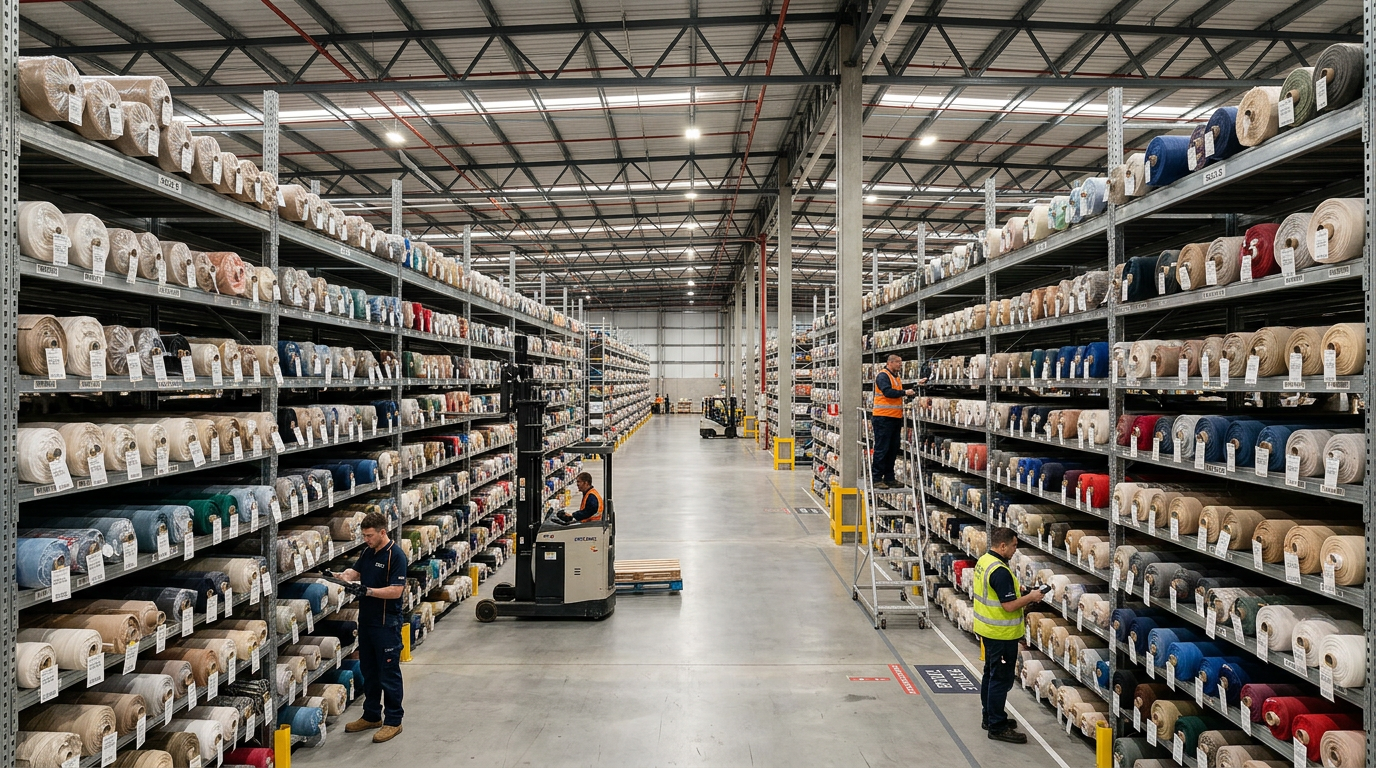
Vertical storage looks tidy and saves floor space, but it crushes the bottom edge of every roll under its own weight. For rolls heavier than about 40 lbs — which includes most denim fabric, upholstery weights, and 60-yard wovens — vertical is a slow death sentence.
Horizontal suspended storage is the gold standard. You run a steel rod or pipe through the cardboard core, then rest the rod ends on shelf brackets. The fabric never touches anything but air. To unroll, you just spin it.
When Stacking Is Acceptable
Light knits, polar fleece, and short remnants under 15 yards can stack three to four high without permanent damage — but never directly on concrete. Concrete wicks moisture and leaches alkaline residue into the bottom roll. Use a pallet with kraft paper between layers.
For a quick visual on which structures handle compression best, our breakdown of twill, sateen, poplin, and oxford weaves explains why tighter weaves resist crease memory better than loose ones.
Wrapping Materials That Help (And the Ones That Destroy Fabric)
Here's the rule almost everyone gets wrong: do not wrap fabric in plastic for long-term storage. Plastic traps moisture vapor coming off the fibers themselves. Inside that sealed environment, you've built a humidor for mold.
What to Use Instead
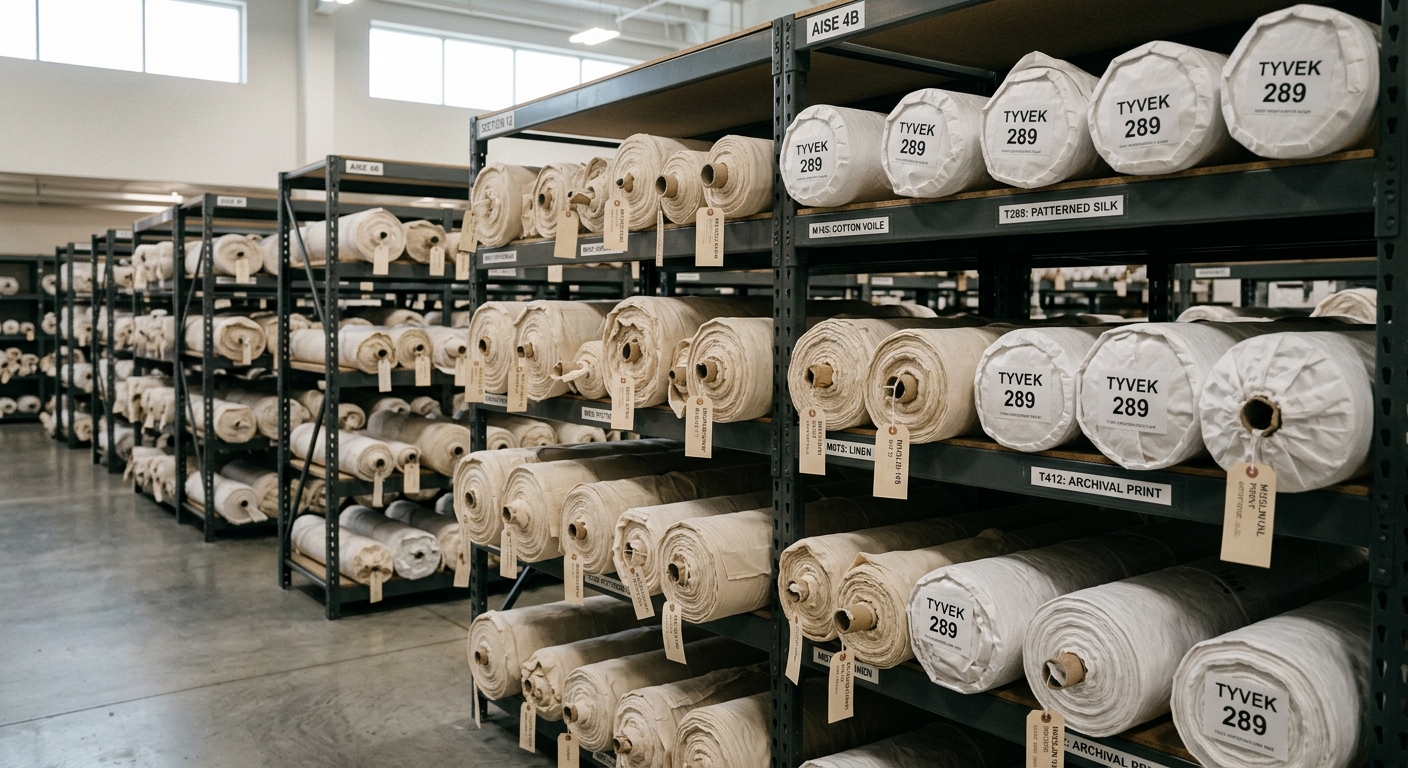
- Tyvek — breathable, water-resistant, dust-proof. Best for high-value rolls like silk shantung or hand-embroidered pieces.
- Unbleached muslin or cotton sheeting — cheap, breathable, washable. The workhorse choice.
- Acid-free tissue — interleave between layers on the roll itself for vintage or dye-sensitive fabrics.
What to Avoid
- Plastic sheeting, shrink wrap, polyethylene bags (for storage longer than 30 days)
- Raw cardboard cores — the lignin in untreated cardboard releases acids that yellow fabric in 6–12 months. Use acid-free cores or wrap the core in muslin first.
- Newsprint — ink transfers, period.
For example, a costume-rental company we worked with was losing roughly 8% of their inventory annually to yellowing on white and ivory costume fabrics. The cause was acid migration from cheap cardboard cores. Switching to acid-free cores and muslin overwraps dropped losses to under 1% the following year.
Light: The Slow Killer Nobody Tracks
UV from sunlight and UV-emitting fluorescent tubes will fade an exposed strip of dyed fabric in 3–4 months. The faded edge is permanent, and on a 60-yard roll, that's potentially 5+ yards of unsellable material.
Practical Light Rules
- No direct or indirect sunlight on stored rolls. Cover windows with UV film or blackout shades.
- Switch warehouse lighting to LED with a color temperature of 3500–4000K and UV output near zero.
- Keep light levels under 50 lux at the roll surface for sensitive dyes. That's roughly the brightness of a dim hallway.
Fabrics dyed with reactive or direct dyes — common on cottons and rayons — fade fastest. Vat-dyed and pigment-printed goods hold up better. Our deep dive on natural vs. synthetic dyes and fading covers which dye classes resist light damage and which need extra protection.
Airflow, Pest Control, and the Things That Live in Warehouses
Stagnant air is mold's best friend. Even at 50% RH, a corner with no circulation can develop pockets of higher humidity around dense roll clusters. Run a small oscillating fan on low 24/7 in each storage bay — it consumes about $5/month in electricity and prevents micro-climates.
Pests that Target Fabric Inventory
- Carpet beetles and clothes moths — eat wool, silk, cashmere, and any fabric with food residue or perspiration on it. Yes, even “clean” samples that touched human skin.
- Silverfish — feed on starches in cotton sizing and on cardboard cores.
- Rodents — nest in soft goods and urinate on rolls, causing permanent staining and odor.
Prevention Without Chemicals on Fabric
Use cedar blocks or lavender sachets in storage bays — never mothballs (naphthalene residue is hard to wash out and irritates buyers' skin). Inspect rolls quarterly. Vacuum the floor weekly, not sweep — sweeping kicks up spores and eggs.
Roll Tension and Core Choice: Where Creases Are Born
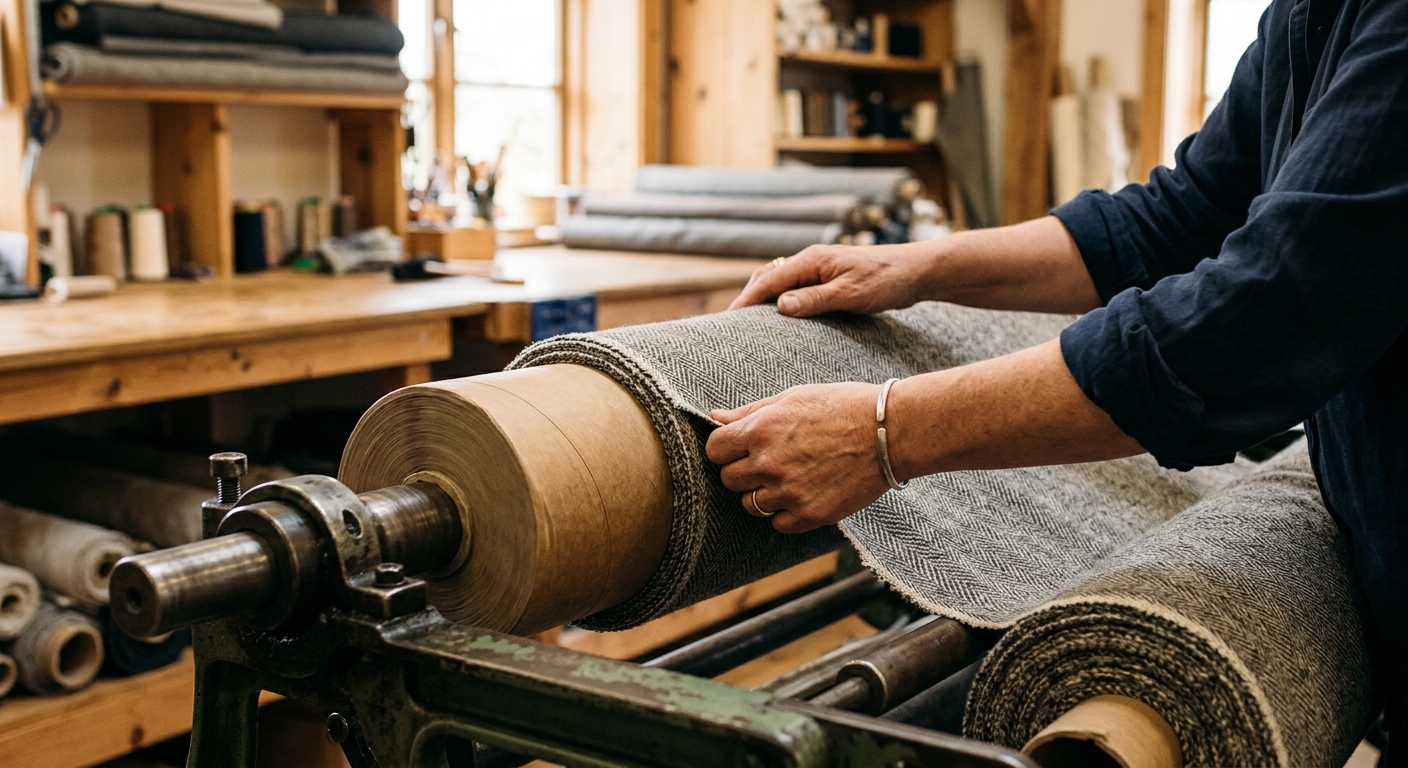
A crease isn't caused only by folding. It's caused by uneven tension during winding combined with time under compression. If you're re-rolling returned or sampled goods yourself, this matters.
Re-rolling Best Practices
- Use a core at least 3 inches in diameter for wovens, 4 inches for heavy upholstery, and never less than 2 inches for fine silks.
- Wind under even, light tension. Over-tight rolls compress the inner layers and create memory creases that won't steam out.
- Roll face-out for prints and pile fabrics (velvet, corduroy) so the pile isn't crushed inward. Roll face-in for delicate wovens to protect the surface from dust.
Pile fabrics deserve special mention. If you stock velvet, velour, or velveteen, never store them folded — ever. The crush marks are permanent. Always rolled, always face-out, on a core no smaller than 4 inches.
Inventory Rotation and Inspection Schedule
Fabric isn't wine. It doesn't improve with age. The longer a roll sits, the more it accumulates dust, the more its sizing breaks down, and the more likely a buyer will reject it on inspection.
The FIFO Rule for Textiles
First in, first out. Tag every incoming roll with a receiving date — a $0.05 hangtag or a barcode is enough. When a customer orders, pull the oldest roll of that SKU first. This is non-negotiable for natural fibers and printed goods, both of which degrade visibly over 18–24 months.
Quarterly Inspection Checklist
- Unroll the first 12 inches of each roll and check for discoloration, musty smell, and edge damage.
- Rotate the roll 180 degrees on its rack to redistribute any compression points.
- Wipe the rack and re-vacuum the floor.
- Log humidity readings and any pest sightings.
One mid-size importer of suit fabric built this into their warehouse routine and cut customer claims for “arrived musty” or “visible crease” by roughly 70% in the first year — a number their CFO felt directly on the return-merchandise line.
Triage: What to Do When a Roll Already Shows Damage
Sometimes you inherit a problem. Maybe a roll arrived from an overseas mill in a damp container, or you bought a closeout lot that sat in someone else's bad warehouse. Don't toss it yet.
For Mild Mildew Smell (No Visible Mold)
Unroll the fabric in a dry, well-ventilated space for 48–72 hours. If the smell persists, dry-clean a yard test piece. Many synthetic blends recover fully; pure wool and silk often don't.
For Visible Mold Spots
Isolate the roll immediately — mold spreads. Cut out the affected yardage with a 12-inch buffer on each side. The rest may be salvageable after cleaning, but disclose the history if you resell it.
For Creases and Shoulder Marks
Steam, don't iron. A commercial garment steamer at 180–210°F relaxes most crease memory in cotton, linen, and rayon. Polyester and acrylic creases are usually permanent because the fibers were heat-set in the wrong position.
For Yellowing
On whites and pastels, a cold-water soak with oxygen bleach (not chlorine) can lift acid-migration yellowing. Test a swatch first. If the yellowing is from UV degradation rather than acid, it's permanent — the fiber itself has changed.
Build the Storage System Once, Reap the Returns for Years
Here's the short version: horizontal suspended racking, 65–72°F at 45–55% RH, breathable wraps, acid-free cores, LED lighting under 50 lux at the rolls, oscillating airflow, quarterly inspections, and strict FIFO. None of those individually is expensive. Together, they're the difference between selling fabric at full margin and writing off 8–12% of inventory every year.
If you're sourcing high-value rolls — silks, jacquards, specialty wovens, or anything dye-sensitive — the storage setup pays for itself in the first prevented loss. And if you need help selecting fabrics that ship well and store well from the start, the team at Global Fabric Wholesale can walk you through which mills package for long-haul shelf life and which require extra protection on your end. Browse the full applications catalog to see options matched to your end-use, and order with confidence that what arrives is what you'll still have months from now.





 Login with Google