-

Free Samples!



How Many Yards Are Actually in a Roll of Fabric? Put-Up, Usable Yield, and the Roll Math Buyers Get Wrong

Table of Contents
There is no standard number. Apparel fabric generally arrives in rolls running somewhere between about 40 and 100 yards. Quilting cotton has one convention worth knowing: the 15-yard bolt sold in quilt shops. Longer put-ups exist, but they are a supplier decision rather than an industry standard, so confirm the length before you plan a cut. The figure that governs your order is the put-up minus the short end, not the average your supplier quotes. Everything below is the arithmetic that turns that range into a purchase order you can defend line by line.
Key takeaways
- There is no standard roll length: apparel fabric runs roughly 40 to 100 yards per roll, quilting cotton bolts are fixed at 15, 25 or 40 yards, and put-up varies with the mill, the fabric weight and the unit the supplier buys in.
- Ask for the guaranteed minimum roll length and the per-roll tolerance instead of the average, because a lot can average out while individual rolls come in short and you cut from a roll, not from a mean.
- Divide total cut area by usable width, not nominal width: the same 4.2 square meters of pattern pieces needs about 3.75 m at 112 cm usable and about 3.07 m at 137 cm.
- In the reverse calculation the yield divisor moves the answer far more than any buffer: a 400-unit run at 1.6 net yards each needs 19 rolls at 88 percent yield and 20 at 82 percent, with a 40-yard guaranteed minimum.
- Freight is charged on gross weight and packaging scales with roll count, so the same yardage in fewer, longer rolls costs less to move and that saving is a real part of any volume discount.
How Many Yards Are in One Roll? It Is a Range, Not a Number
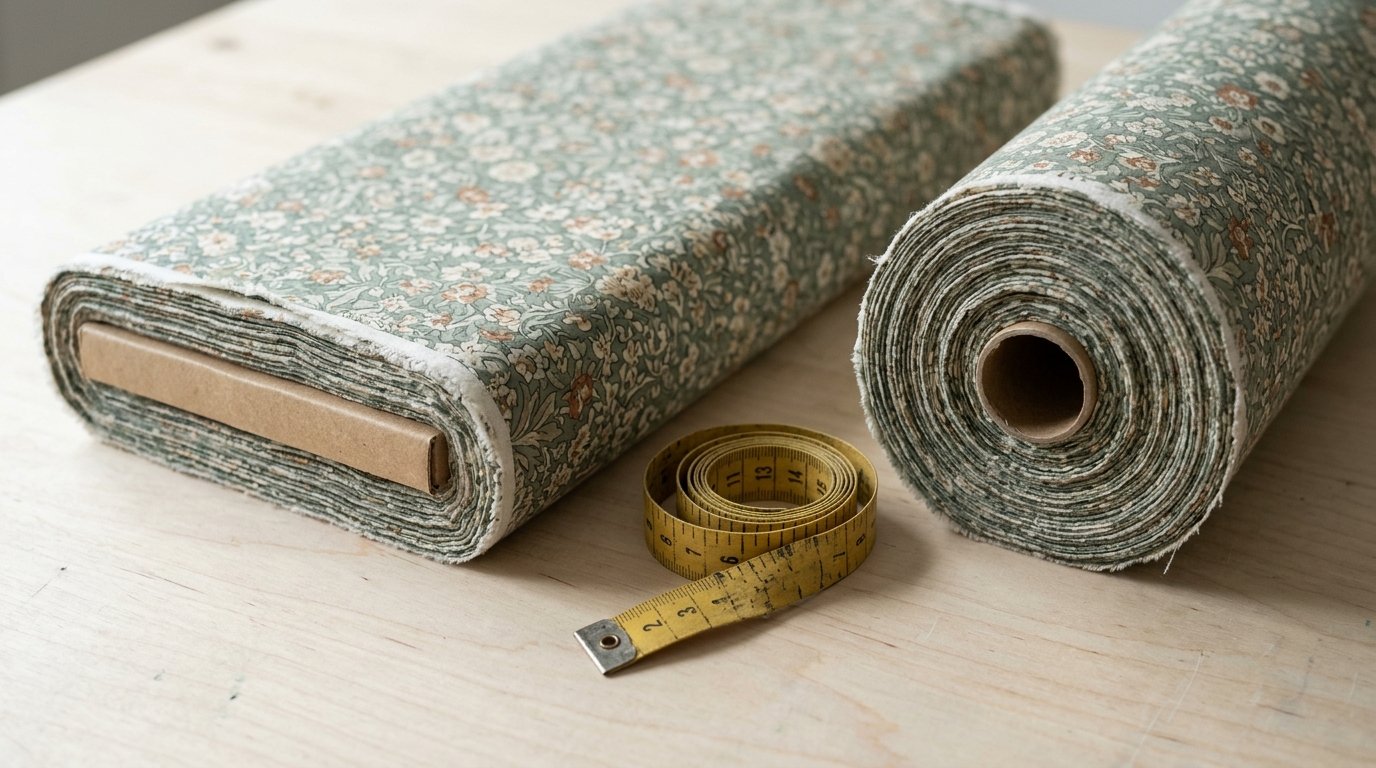
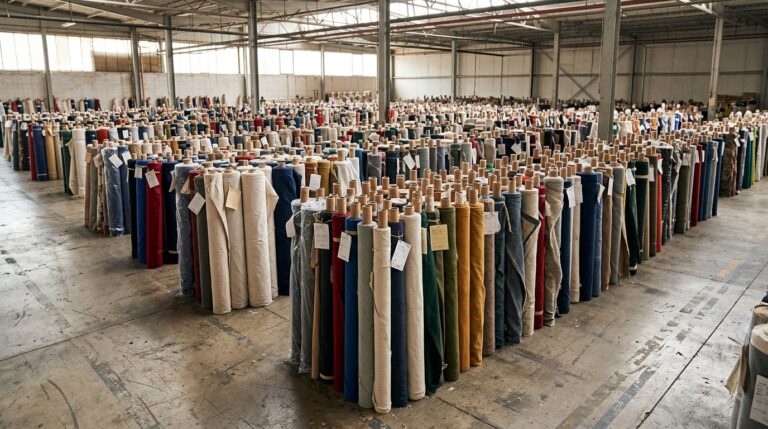
Three words get used as if they mean the same thing, and they do not. A bolt is fabric folded flat and stacked, the form quilting cotton and most retail apparel fabric arrives in. A roll is wound on a core or into a firm cylinder so it can be shipped and stacked without creasing. Put-up is the mill's own term for how many yards it winds into one package. The same fabric can ship in any of the three, which is why a quote that says roll has told you nothing yet.
Why No Universal Number Exists
Put-up comes out of the mill's winding equipment, the thickness and weight of the cloth, and the unit the supplier actually buys in. A 450gsm wool-blend coating cannot wind the same yardage onto a roll as a 160gsm nylon-spandex tricot, and both of those weights are real in this catalogue: a 20% Wool 80% Polyester Tweed Plaid at 450gsm (15.9 oz) and a 77% Nylon 23% Spandex Tricot Jacquard at 160gsm (5.64 oz). Ten yards of the first is a lifting problem. Ten yards of the second is a hand-carry. Any supplier who quotes you one roll length for every fabric is quoting a habit, not a capability.
What the Ranges Usually Look Like
The table below gives the put-up you will meet most often by category. Read every figure as a convention to confirm on the lot you are buying, not a standard anyone is bound by. Mills change put-up between lots without announcing it, usually because the winding line changed or because the order was bought by weight rather than length.
Quilting Cotton Is the Fixed Exception
Quilting cotton bolts are cut to a standardized retail market at fixed lengths of 15, 25 or 40 yards. That consistency exists because the cloth is sold into a shelf market where a known bolt length is part of the product itself. Apparel and upholstery goods have no equivalent, which is exactly why nobody can hand you a universal roll length and be telling the truth.
Why the Nominal Length Is Not What You Can Cut
The outer end of a roll usually carries a crease from the core, a skewed edge, or the mill's own sample cut, so the last yard or two is discounted before you ever lay a marker on it. A 50-yard roll does not deliver 50 cuttable yards. Buyers who plan on the nominal figure run short on the final units of an order, and those units are the ones that will not match the dye lot on the re-order.
If you ask a supplier only one question, ask this: what is the put-up on this lot, and is it consistent across every roll in the shipment? A supplier who cannot answer that in writing has not measured their own stock.
Fabric Width Decides Your Yardage Before Roll Length Ever Does
Total cut area of all pieces, divided by usable width, equals running length. That identity is the whole of yardage math, and it explains why two fabrics sold at the same price per yard can cost wildly different amounts per finished piece. Do the area work in one unit and convert once at the end: inches to yards is divide by 36, meters to yards is multiply by 1.0936.
Usable Width Is Not Nominal Width
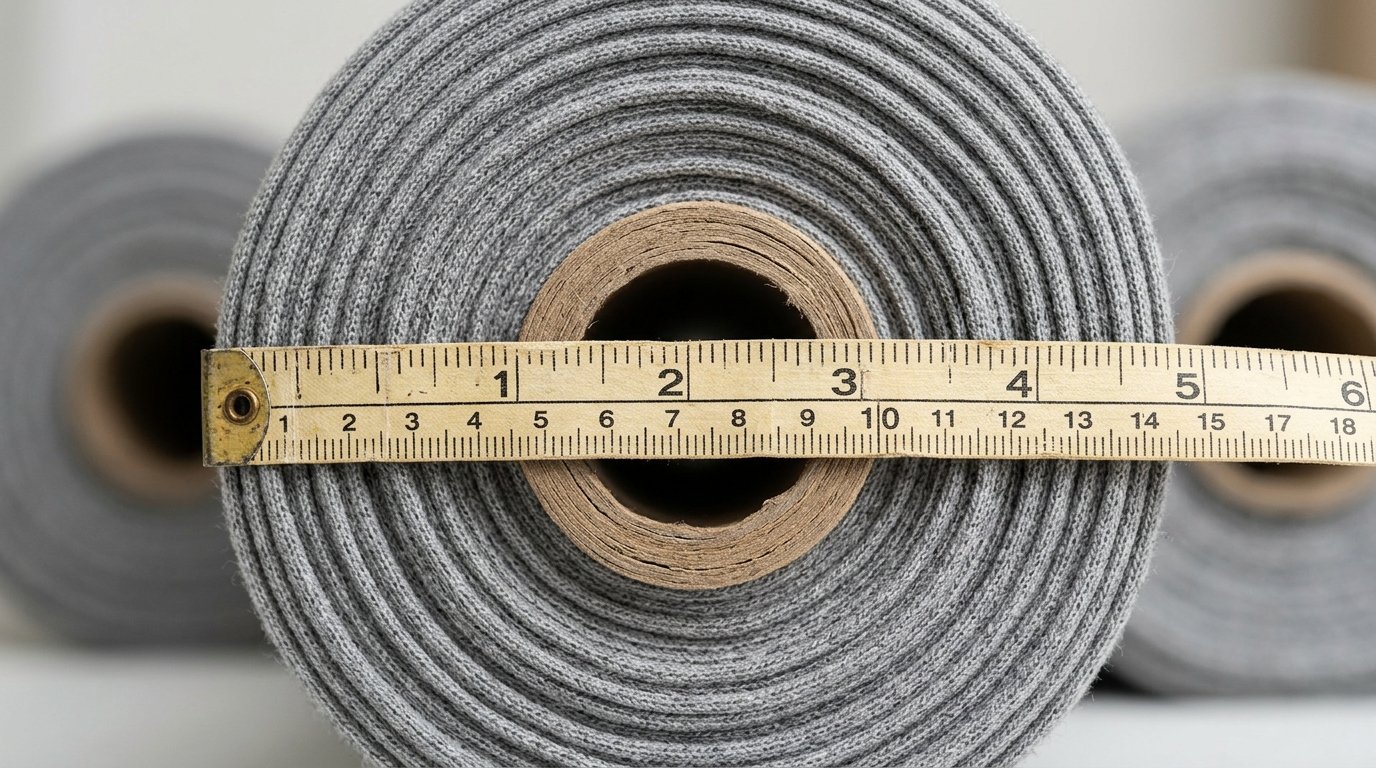
Selvedge comes off both edges. On tubular or slack-selvedge knits there is more waste at the edge than on a tightly woven roll, and a printed fabric can lose another strip where the print fails to register. A buyer dividing by the nominal width on the spec sheet is computing a number the cutting table cannot deliver.
The Same 4.2 Square Meters on Two Widths
Take a pattern whose pieces total 4.2 square meters of cut area. At roughly 112 cm of usable width (44/45 in) you need about 3.75 m of running length. At roughly 137 cm (54 in) the same pieces need about 3.07 m. Same garment, roughly 0.68 m of difference, most of a yard, and it repeats on every unit in the run. That single relationship is worth more to a production buyer than any yardage chart.
Widths You Will Actually Meet
- 45 in / 115 cm and 55 in / 140 cm, the reference widths used by pattern makers
- 44, 54, 60 and 108 in, the widths US yardage calculators ask for before rounding up to the nearest quarter yard
- 54 in on standard plain goods such as solids and vinyls
- 160 cm to 185 cm on the interlock range, where 160 cm and 185 cm are the most common
Dividing area by width is an average, never a layout. It tells you whether a fabric is in the right ballpark. It does not prove your marker fits, because nesting is a geometry problem, not a division problem.
Here is the part that trips up buyers: a wider roll usually lowers yardage per garment while raising price per yard. So a 185 cm interlock at a higher per-yard figure can beat a 160 cm roll at a lower one. The only honest comparison is cost per finished unit rather than cost per yard.
How Do I Measure How Many Yards of Fabric I Need? Lay It Out, Do Not Guess
No calculator can see your pattern, your size, or the usable width you get after the selvedge is trimmed. Tools produce a starting estimate. A layout produces a number you can defend, and the gap between the two is often the gap between finishing the order and chasing a re-order in a different dye lot.
Prep the Pieces Before You Measure Anything
- True up every piece. A piece that has stretched or been trimmed crooked measures short and lays out wrong.
- Mark grainlines on everything. Grain decides rotation, and rotation decides whether the gaps between shapes can be filled.
- Double the width of anything cut on the fold and flag it as a fold piece so it is not counted twice.
- Count multiples: two sleeves, two fronts, facings, pockets, cuffs, waistbands, interfacing. Facings and pockets are the pieces that quietly go missing from a tally.
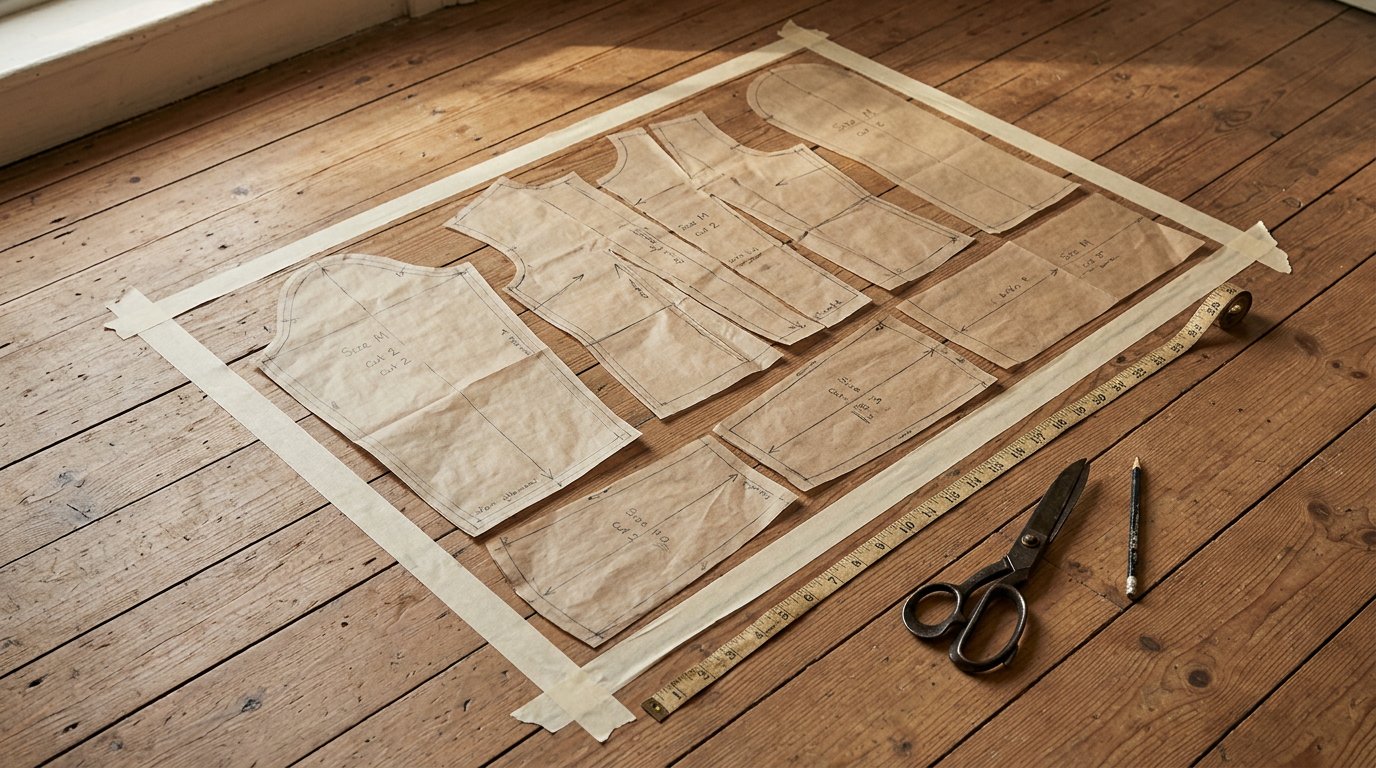
Do the Layout on the Floor at True Usable Width
Run a tape line on the floor at the width you will actually have, which means subtracting roughly 1 in of selvedge per side from the nominal figure. Lay paper strips or spare pattern pieces inside it. Nothing gets cut until the number is settled. It takes fifteen minutes and it is the only method that accounts for your specific shapes rather than an average.
On the Fold or Single Layer Changes the Total
Fold work needs half the piece width but produces mirrored pairs. Single-layer cutting needs the full piece width, nests asymmetric and shaped panels tighter, and is the only option for some pieces. Same pattern, two different totals, so decide the cutting method before you buy rather than after.
Piece Count Is Not Linear
Adding one sleeve can break a row and cost more length than the sleeve itself occupies. That is why multiplying a single garment's yardage by quantity misleads production buyers: the tenth unit and the four-hundredth unit do not consume the same length unless the marker is built for multiples from the start.
Three Allowances, Kept Separate
List seam allowance, hem allowance and print-matching allowance as three separate line items instead of folding them into a vague bit extra. A number you can audit is a number you can defend, and when a cut comes up short you will know which allowance failed instead of re-arguing the whole estimate.
One-Way Prints, Nap, and Stretch Direction: The Yardage You Lose to Direction
Directional fabric cannot be nested efficiently, and the loss is not a small percentage you can round away. On a long run it is the difference between a marker that fits the roll and one that does not, and the shortfall appears at the cutting table, not at the quote stage.
What Forces a Single Direction
- Pile fabrics: corduroy, velvet, velour, fleece and sherpa all change tone when the pile runs the other way.
- Prints with an obvious up and down: text, figures, landscapes, anything a customer would notice upside down.
- Fabrics with a distinct face: coatings, metallics and some jacquards read lighter or darker depending on which way the piece runs.
The Mechanism, Not a Percentage
A two-way layout lets pieces flip 180 degrees to fill the gaps between shapes. A one-way layout leaves those gaps as waste. Same pattern, more running length, and the extra length grows with how awkward the shapes are. Wide skirt panels waste relatively little because they tile well. Angled yokes, raglan sleeves and bias pieces waste a lot.
Stretch Direction Is the Same Trap on Knits
A two-way stretch knit cannot be rotated 90 degrees to save width without changing how the garment hangs. A four-way stretch fabric can, which opens layout options that do not exist on a two-way knit. A 160gsm 77% Nylon 23% Spandex Tricot Jacquard in this catalogue carries 4-Way Stretch, Anti-UV and Cool Touch properties, and that four-way behaviour is a cutting advantage on top of the hand feel. The interlock range runs from 78% Polyamide 22% Spandex through 75% Nylon 25% Spandex to Tencel-rayon-acrylic-spandex blends, and each one needs its stretch direction checked before you price the order.
Railroading for Upholstery and Contract Work
Railroading runs the pattern across the roll width instead of along it, so each cut crosses the full width and the length goes further. It is off the table when the design has a stripe or a directional repeat that would end up sideways. Plaid, which typically runs 120 to 450gsm in cotton, polyester or blends, is the classic case where the repeat sets the constraint rather than the pile, so check orientation before assuming railroading is available.
If the fabric has a direction, lay the marker out in one direction and price the order on that number. Do not price it two-way and hope the cutting room finds space that was never there.
Is 3 Yards Enough to Make a Dress? Buffer Math by Buyer Type
Three yards is a real answer to a real question, but only with a width attached to it. Three yards of 45 in fabric makes a simple sheath in a small size and very little else. Three yards of 60 in can carry a fuller skirt or a larger size. Anyone publishing a single figure without naming the width is guessing at your pattern, your size and your cutting method.
Three Buyers, Three Buffers
- Home sewist: round to the nearest quarter yard and add a small cushion for a layout mistake or a matching repeat. You are buying insurance on one garment, and the insurance is cheap.
- Workroom, buying per garment: build in tolerance for cutting error and re-cuts, because a remake costs more than the extra fabric and delays the whole ticket.
- Production buyer: work in marker yield plus a sample allowance. A per-unit cushion is meaningless when the marker is laid once and cut in a lay of forty plies.
Why the Half-Yard Buffer Fails at Scale
Adding half a yard to each of 400 units would be 200 yards, which no buyer would sign off, so the habit gets dropped the moment volume appears. The real risk sits somewhere else entirely: a marker that cannot fill the usable width wastes a measurable share of every ply, and that is what runs an order short. Yield, not cushion, is the variable worth arguing about.
Rounding Rules That Hold Everywhere
- Round up, never down.
- Never trim an order to land on a whole number of rolls. The twenty missing units will not match the dye lot you already cut.
- If the fabric will shrink, plan the cut on the dimension it will become, not the one printed on the invoice. Weight also changes what a pattern eats, and heavier terry does not fold as flat as light terry, which is worth knowing when you budget yardage for garments sewn from French terry.
Average Roll Length Is a Marketing Number. Guaranteed Length Is a Contract
An average roll length can be met while several individual rolls in the same lot come in short. You cut from a roll, not from an average, so the number that matters on a spec sheet is the guaranteed minimum, not the mean. This is where most first-time bulk buyers lose money without noticing.
Questions That Turn a Quote Into a Contract
- What is the tolerance per roll, expressed as a length rather than a percentage?
- What counts as a short roll, and at what threshold does the remedy trigger?
- What remedy applies when a roll falls below the guaranteed minimum: credit, replacement, or a make-up on the next order?
- Who pays the freight on a roll that has to go back?
Continuous Length Versus Spliced
Confirm whether a long length is one continuous piece or two pieces joined to make the number. Forty yards in two pieces will not run a forty-yard marker without an extra join you did not plan, did not price, and probably cannot place where the pattern needs it. Ask for the join count per roll in writing.
Put the Clauses in the Purchase Order
Short-roll and cut-yardage clauses belong in the purchase order, not in an email thread nobody opens when the shipment is late. Ask for the packing list with measured length per roll before dispatch, so a short roll becomes a conversation before shipping rather than a claim after arrival. Partial rolls that arrive short also end up sitting in storage longer than planned, and storing wholesale rolls without mildew or creasing is a discipline that starts with knowing exactly what length you are holding.
From Yardage to Rolls on the PO: The Reverse Calculation (and Why Price Per Yard Lies)
Net garment yardage becomes a roll order in five steps, and the term that moves the answer is the yield divisor, not the buffer. Buyers who fiddle with the buffer are adjusting the wrong dial.
- Net cut yardage per unit, multiplied by units.
- Divide by the yield rate you measured from a real marker, not a percentage borrowed from a previous style.
- Add sampling and top-of-production yards.
- Divide by the guaranteed minimum roll length.
- Round up to whole rolls.
The Arithmetic on a 400-Unit Run
Take a hypothetical run of 400 units at 1.6 net cut yards each. That is 640 yards. Measure the marker at 88% yield and you need about 727 yards. Add 15 yards for sampling and top of production, so 742. With a guaranteed minimum of 40 yards per roll that is 18.55 rolls, which means 19 rolls and 760 yards on the order. Now run the same 640 net yards at 82% yield: 780 yards before sampling, 795 after, which is 20 rolls. The buffer never moved. The yield did.
How Roll Length Feeds Price Per Yard
Longer rolls mean fewer cut ends, less leftover and less handling per yard. A supplier quoting short rolls at a lower per-yard price can still cost more per finished unit, because you absorb the cut ends and the handling. Price per yard also cannot be compared across fabrics without width and weight attached, so put cost per square meter or cost per finished garment next to it before deciding anything at all.
Price Breaks Are Usually Yard or Weight Thresholds
Most breaks trigger on yardage or weight rather than roll count, which means consolidating several colors onto one purchase order often crosses a break you would miss ordering color by color. On the interlock range the tiers are 5% off 22 to 42 yards, 10% off 43 to 70 yards and 30% off 70-plus yards, with no minimum, so a single yard is a valid first order. Those are that category's terms, and interlock yard prices run $19.99 to $39.99. Above 300 kg the range moves to quote-based pricing.
Conversions in One Place
- 1 yard = 36 inches = 0.9144 meters
- 1 meter = 1.0936 yards
- A 50 m roll = 54.7 yards
- A 100-yard roll = 91.44 meters
- A kilogram quote only becomes comparable to a yard quote once GSM and width are on the table
What a Full Roll Weighs, and Why It Lands on Your Freight Bill
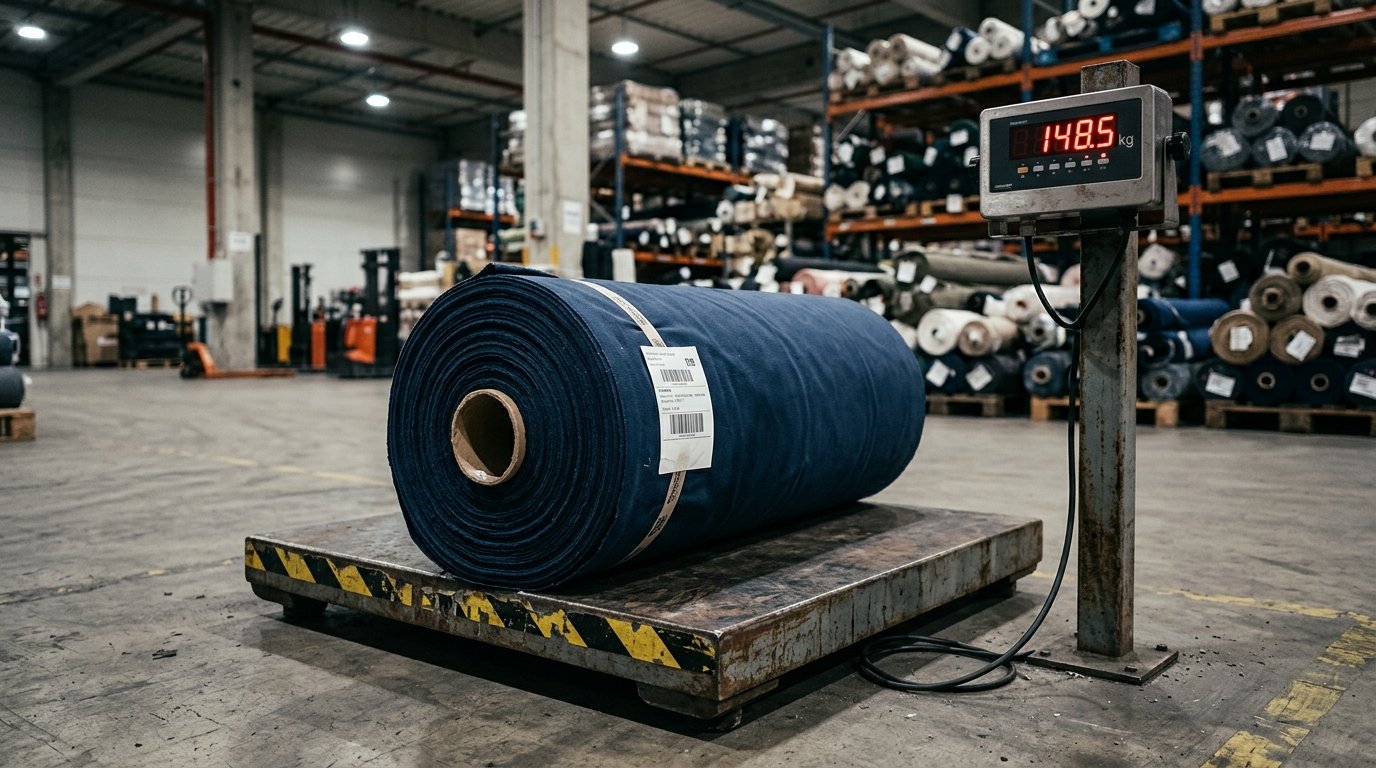
Kilograms per linear yard equals GSM times width in meters times 0.9144, divided by 1000. That single formula turns a roll into a freight line, and it is the number missing from most wholesale quotes. Work it on a 320gsm fabric on a 1.6 m roll: 320 x 1.6 x 0.9144 / 1000 = 0.47 kg per yard. Twenty-five yards of it is roughly 11.7 kg. A 60-yard roll is roughly 28 kg before the core, the poly bag and the pallet.
Weight climbs fast with GSM. A 370gsm 100% Cotton French Terry at the same 1.6 m width lands near 0.54 kg per yard, so a 60-yard roll is around 32 kg. A 180gsm French Terry at that width is nearer 0.26 kg per yard, less than half. Same yardage, half the freight, which is why a lighter fabric can be the cheaper order even at a higher price per yard.
Roll Count Drives Packing Cost
Freight is charged on gross weight, and packaging weight scales with the number of rolls rather than the number of yards. The same 600 yards in fifteen 40-yard rolls costs more to move than in ten 60-yard rolls, because there are five more cores, five more bags and more handling steps. That is also why a quote can look identical per yard and land differently per shipment.
Diameter Governs Handling
A heavy roll needs a stand or a two-person lift, and a manual cutting table often prefers split rolls even at a slightly higher cost per yard. A 30 kg roll nobody can lift onto the table is not useful stock, however good the price was.
This is the honest reason volume pricing exists. Fewer, longer rolls mean less handling, less packing material and less leftover per yard, and that saving is a real part of the discount rather than a favour. It is also why the tiers get quoted in yards or kilograms instead of roll counts.
The Roll-Order Checklist: Six Questions to Settle Before You Send the PO
Six answers settle a roll order. Get them in writing before the purchase order goes out and the rest of the transaction is arithmetic rather than negotiation.
- The put-up on this lot, and whether it holds across every roll in the shipment.
- The guaranteed minimum roll length, not the average.
- The per-roll tolerance, and the remedy if a roll comes in short.
- Continuous length or spliced, including the join count.
- Usable width after selvedge is trimmed, measured on the actual lot.
- Weight per roll, so the freight quote rests on something real.
Where Global Fabric Whole Sale Fits
If you want to test a fabric before committing to rolls, that is the sensible entry point. There are over 10,000 fabrics sold by the yard, shipping to 130-plus countries from the Foshan, Guangdong warehouse, and swatch cards are available on any interlock fabric for a small fee, which lets you measure width and check the hand before a roll is ordered. The interlock range has no minimum, so a single yard is a legitimate first order, and the yard-threshold discounts plus the 300 kg quote point are that range's terms. Ask for the equivalent terms on whatever category you are buying rather than assuming they carry across.
Sequence, Not Price
Order a swatch, measure the usable width yourself when it lands, run one marker on the real cloth, then scale the yardage to rolls with the guaranteed length in hand. That order of operations costs a few days and prevents the two mistakes that actually hurt: buying the wrong width, and buying a length that was never guaranteed in the first place. Questions about a specific lot go through customer support before you commit.
Frequently asked questions
How much should 1 yard of fabric cost?
Price per yard depends on fibre, weight and width, so there is no single benchmark. On Global Fabric Whole Sale, a 230gsm 60% Cotton 40% Polyester French Terry is $19.99 per yard, a 320gsm 95% Cotton 5% Spandex French Terry is $25.99, and the interlock range runs $19.99 to $39.99. Compare cost per square meter or per finished garment, because a wider, heavier fabric covers more ground.
How do I convert meters of fabric to yards?
Multiply meters by 1.0936. A 50-meter roll is about 54.7 yards, and a 100-yard roll is 91.44 meters. Going the other way, one yard is 36 inches or 0.9144 meters. Convert once, at the end of the calculation, so rounding errors do not compound across a long production order.
What is GSM, and why does it change how many yards fit on a roll?
GSM is grams per square meter, the weight of the cloth. Heavier fabric is thicker, so fewer yards wind onto a roll of the same diameter. A 450gsm wool-blend coating and a 160gsm tricot will not share a put-up, and weight drives freight too: a 320gsm fabric on a 1.6-meter width runs about 0.47 kg per yard.
Do I have to buy a whole roll of fabric?
Rarely. Global Fabric Whole Sale sells over 10,000 fabrics by the yard, and the interlock range has no minimum, so a single yard is a valid order. Volume discounts on that range start at 22 yards and rise at 43 and 70 yards. A full roll becomes worthwhile when the freight and handling saving outweighs the extra length.
How many yards are on a roll of upholstery fabric?
Usually somewhere between 20 and 50 yards. Upholstery rolls are shorter than apparel rolls because the cloth is heavier and wider, and because contract buyers often order in smaller multiples. Confirm the put-up for the lot and ask for the guaranteed minimum rather than the average before you build a cutting plan around it.



 Login with Google