


Fabric for Face Masks and Medical Textiles: What Filtration Ratings Actually Mean

Filtration ratings like BFE, PFE, and the ASTM F2100 levels measure how effectively a fabric blocks particles and bacteria at a specific size and speed — not how “thick” or “tight” the weave feels in your hand. A fabric can feel dense and still fail a 95% filtration test, while a thinner non-woven layer can outperform it dramatically. If you're sourcing fabric for masks or medical textiles, understanding what these numbers actually test — and what they don't — is the difference between passing inspection and getting a shipment rejected.
BFE, PFE, and N95: Three Ratings That Get Confused Constantly
Here's a mistake we see constantly: buyers treat BFE, PFE, and N95 as interchangeable terms. They're not, and mixing them up can get an entire order rejected by a compliance officer.
BFE (Bacterial Filtration Efficiency) measures how well a fabric blocks bacteria-carrying particles, typically around 3 microns, at a controlled airflow rate. PFE (Particulate Filtration Efficiency) tests smaller particles, usually 0.1 microns, which is a much tougher benchmark. N95 isn't a fabric rating at all — it's a respirator certification from NIOSH that covers the entire mask assembly, including fit, not just the material.
A fabric can score 98% BFE and still be worthless for an N95-rated product if it doesn't pass particulate testing or form a proper seal. If a supplier tells you their fabric is “N95 grade,” ask what they actually mean — that phrase alone tells you nothing verifiable.

Why Weave Structure Matters More Than Fabric Weight
A heavier fabric is not automatically a better filter — that's one of the most common and costly assumptions in this category. Filtration depends on fiber diameter, pore size, and layer structure, not GSM alone.
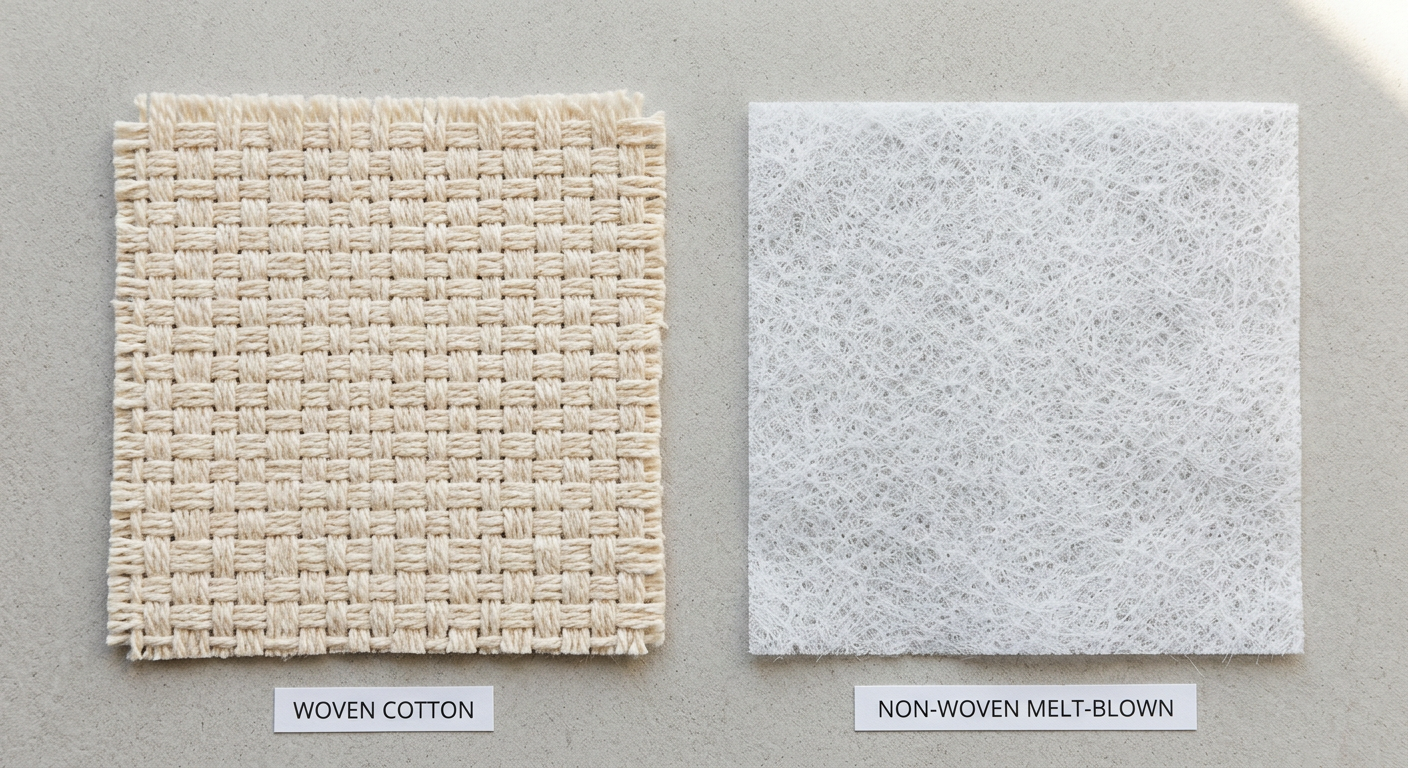
Woven cotton, even at a substantial weight, has visible gaps between threads through which particles slip easily. Melt-blown non-woven polypropylene, by contrast, is built from randomly oriented microfibers as fine as 1-4 microns, creating a maze-like structure that traps particles mechanically and electrostatically. That's why a 20 GSM melt-blown layer can outperform a 150 GSM woven cotton layer on filtration, even though the cotton feels far more substantial.
If you're new to reading fabric density specs generally, our guide on how to read GSM like a pro is worth reviewing before you evaluate any medical-grade material — the same weight numbers mean something very different in filtration contexts than they do in apparel.
ASTM F2100: The Standard That Actually Governs Surgical Masks
For surgical and procedure masks sold in the U.S., ASTM F2100 is the standard that matters, not a generic percentage claim. It sets three performance levels — Level 1, 2, and 3 — each raising the bar on BFE, PFE, fluid resistance, and breathability (delta P).
What Each Level Actually Requires
- Level 1: ≥95% BFE/PFE, low fluid resistance, lowest breathability requirement — suited for general procedures with minimal fluid exposure.
- Level 2: ≥98% BFE/PFE, moderate fluid resistance — used in moderate-risk clinical settings.
- Level 3: ≥98% BFE/PFE, highest fluid resistance — required for surgical settings with high fluid exposure like operating rooms.
A fabric supplier claiming “Level 3 material” needs to show you fluid resistance test data specifically, not just a filtration percentage. Fluid resistance and filtration are tested separately and one does not imply the other.
A Real Sourcing Scenario: Where Buyers Get Burned
Consider a mid-size PPE distributor sourcing fabric for reusable cloth masks in early 2024. They ordered a tightly woven polyester-cotton blend advertised as having “95% filtration.” What the spec sheet didn't clarify: that number was tested dry, at a single layer, using a particle size larger than what regulators actually test for respiratory protection.
When an independent lab retested the material under standard BFE protocol with 3-micron particles, filtration dropped to around 60%. The distributor had to eat the cost of re-engineering the mask into a three-layer design to hit compliance, which blew their margin and delayed a hospital contract by six weeks.
The lesson: always ask for the full test report, not just the headline percentage. It should specify particle size, test method (ASTM F2299 or F2101), layer count, and whether it was tested wet or dry.
Breathability vs Filtration: The Trade-Off Nobody Talks About Enough
Every gain in filtration efficiency costs you something in breathability — that's not a flaw, it's physics. Delta P (differential pressure) measures how hard someone has to breathe through the fabric, and it climbs as pore size shrinks and layer count increases.
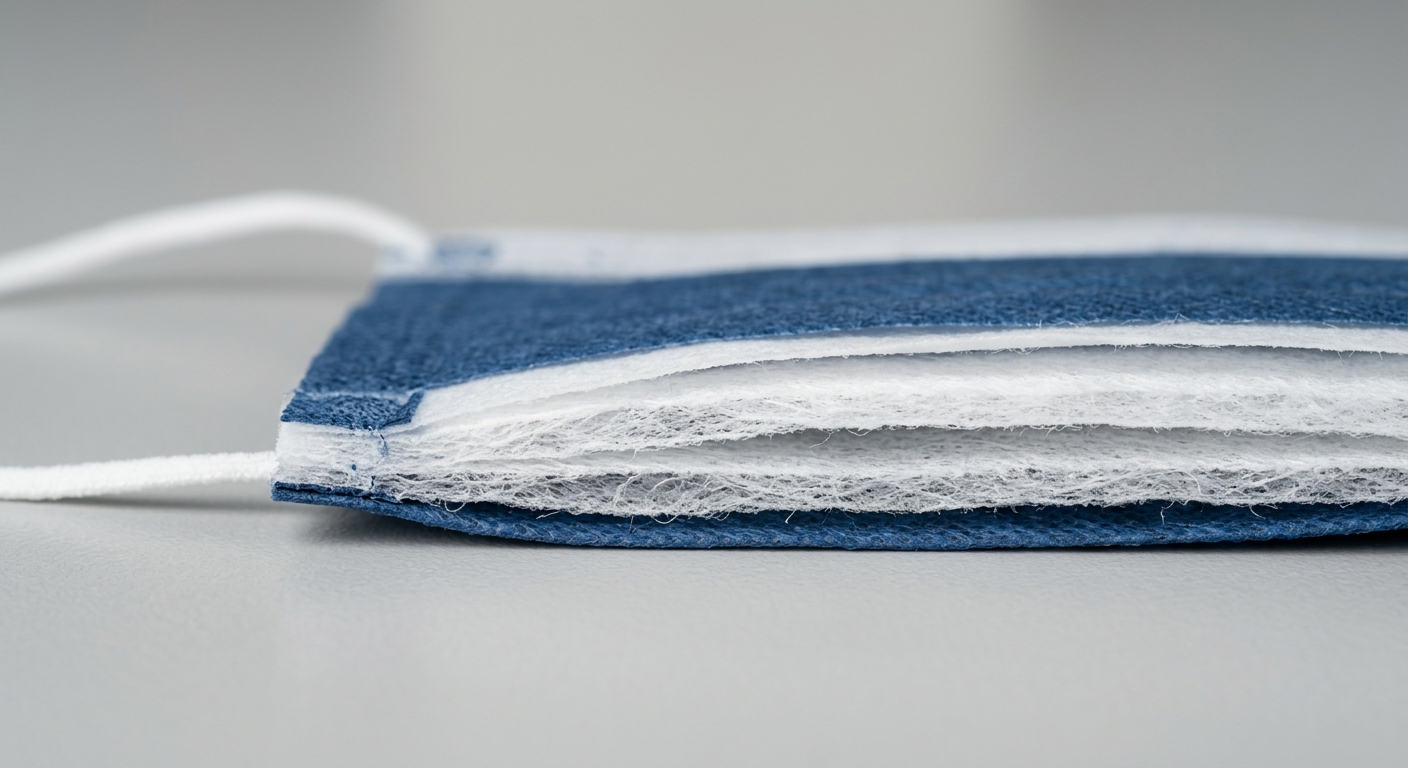
This is why a single-layer, ultra-tight weave rarely works well for wearable masks even when the filtration number looks great on paper. Manufacturers solve this by layering: a tighter filter layer sandwiched between more breathable outer and inner layers, similar in concept to how polar fleece traps warmth through structure rather than weight alone.
For comfort-layer fabric touching the skin, buyers often look toward stretchy fabric by the yard for ear-loop and lining components, since stretch fabrics rarely contribute meaningfully to filtration but significantly improve wearability and seal comfort.
Testing Claims You Should Never Take at Face Value
“Antimicrobial,” “antiviral,” and “filters 99% of particles” are three of the most abused phrases in medical textile marketing. None of them means anything without a cited test method and lab name.
Questions Worth Asking Every Supplier
- What test method was used — ASTM F2101, F2299, or ISO equivalent?
- Was the fabric tested as a single layer or as the full finished product?
- Is there a dated lab report from an accredited, independent facility?
- Does the filtration claim hold after washing, if the product is reusable?
This mirrors a broader sourcing problem we've covered before — if you haven't read our piece on red flags when buying fabric online, the same skepticism applies doubly to any medical-grade filtration claim.

How Washing and Reuse Actually Degrade Filtration
Reusable cloth masks lose filtration efficiency with every wash cycle — typically a measurable drop after 5-10 washes, and a steeper decline past 20, depending on fiber type. Woven cotton tends to hold up reasonably well structurally, but electrostatic charge in synthetic filter layers (common in melt-blown inserts) degrades faster and can't be restored by washing.
If your product line depends on repeated laundering, don't rely on a single filtration test taken from a brand-new sample. For instance, a hospitality client outfitting staff with reusable masks tested filtration at wash cycle zero, ten, and twenty — and found a nearly 15-point drop by cycle twenty, which forced them to shorten the recommended replacement interval on the product label.
Cotton fabric buyers evaluating base material for washable masks should look closely at our cotton fabric by the yard selection, paying attention to thread count and weave density rather than weight alone.
Sourcing Filtration-Grade Fabric Without Getting Burned
Before you commit to a bulk order, insist on three things: an independent test report matching your target standard, a sample batch for in-house verification, and clarity on whether the fabric is a finished multi-layer product or a raw filter material you'll need to engineer further.
It's also worth auditing the supplier itself, not just the material. Our 12-point supplier audit checklist applies directly here — medical textile suppliers should be able to produce documentation on demand, not promise to “send it later.”
If you're comparing raw material costs against performance, treat filtration fabric the same way you'd treat any technical spec — our guide on reading a fabric spec sheet breaks down which numbers are non-negotiable versus which ones are marketing filler.



 Login with Google