


Types of Stretch Fabric — And Which One Is Right for What You’re Making

Stretch fabric isn't one thing. A jersey T-shirt fabric, a scuba dress fabric, and a performance legging fabric all stretch — but they behave completely differently in terms of how much they give, how they hold their shape, and what you can make with them.
Picking the wrong type doesn't just affect how a garment looks on the hanger. It affects fit on a body, whether it keeps its shape after washing, and whether it's sewable at your skill level.
This guide breaks down the main types of stretch fabric by how they're built and — more importantly — by what they're actually built for, so you can match the right fabric to your project before you buy.
What Makes a Fabric 'Stretchy'?
Stretch in fabric comes from two main sources: the fiber content and the construction method.
Fiber-based stretch happens when an elastic fiber — typically spandex (also called elastane or Lycra) — is blended into the yarn. Even a small percentage, around 5–10%, adds significant recovery and hold.
Construction-based stretch comes from the way the fabric is knitted. Knit fabrics have interlocking loops that naturally give and spring back — even without added spandex.
Most modern stretch fabrics use both: a knit structure plus a spandex blend. The ratio and direction of stretch vary a lot between types.
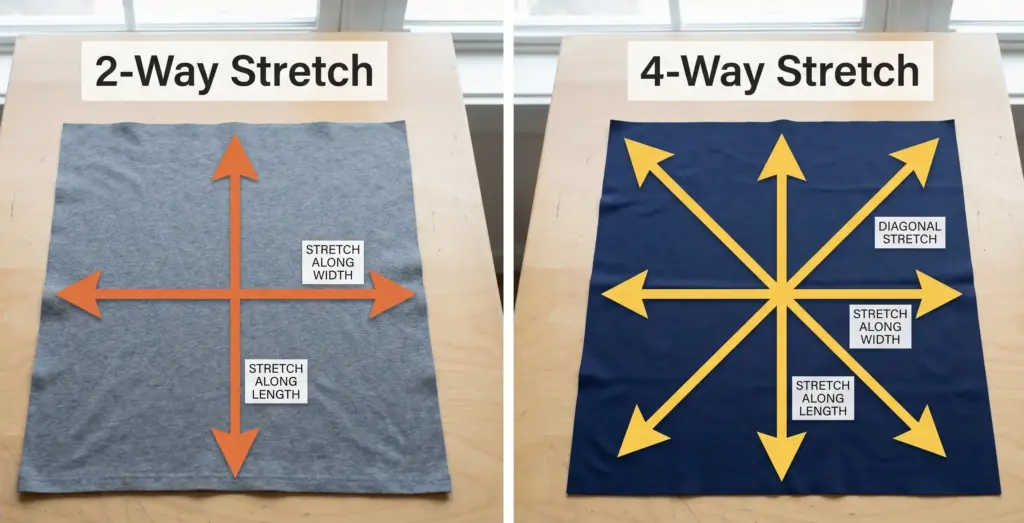
2-Way vs 4-Way Stretch — Quick Clarification
2-way stretch: fabric gives in one direction (usually crosswise). Most everyday knit fabrics work this way.4-way stretch: fabric gives in both directions (crosswise AND lengthwise). Essential for fitted activewear and leggings. If a garment needs to move with the body in all directions — yoga, running, swimming — you need 4-way stretch.
Quick Reference: Stretch Fabric Types at a Glance
Use this table to find your starting point. Each type is covered in more detail in the sections below.
| Fabric Type | Stretch Direction | Typical Content | Best For | Sew Difficulty |
|---|---|---|---|---|
| Single Jersey | 2-way | Cotton / Poly / Modal | T-shirts, casual tops, light dresses | Beginner-friendly |
| Rib Knit | 2-way | Cotton + Spandex | Tank tops, neckbands, cuffs, fitted tops | Beginner-friendly |
| French Terry | 2-way | Cotton / Bamboo / Poly | Hoodies, loungewear, casual pants | Beginner-friendly |
| Scuba (double knit) | 4-way | Polyester + Spandex | Structured dresses, skirts, blazers | Intermediate |
| Ponte di Roma (double knit) | 2-way | Poly / Viscose + Spandex | Tailored dresses, blazers, pants | Intermediate |
| Poly-Spandex | 4-way | Polyester 80–90% + Spandex | Leggings, yoga wear, casual activewear | Intermediate |
| Nylon-Spandex | 4-way | Nylon 75–85% + Spandex | Performance leggings, sportswear, swimwear | Intermediate |
A few things to keep in mind: 'sew difficulty' refers to how forgiving a fabric is for home sewists, not professional tailors. Heavier GSM fabrics within any type are generally easier to handle than very lightweight versions.
Stretch Fabrics for Fitted Activewear and Leggings
For leggings, yoga pants, and fitted sportswear, 4-way stretch is usually the safer choice. You want a fabric that moves with the body in every direction and returns to its original shape — without it, you're more likely to end up with bagging at the knees and a garment that loses its fit after a few wears.
The two strongest options in this category are nylon-spandex and polyester-spandex blends. You can explore both in our legging fabric collection.
Nylon-Spandex
Typically 75–85% nylon and 15–25% spandex. This combination gives the smoothest hand feel, the best recovery after repeated stretching, and strong overall durability. It's the fabric behind most performance leggings you'd find in a specialty activewear brand. Nylon-spandex is also commonly used in swimwear, where its softness and elasticity recovery hold up well under repeated use.
GSM range: 150–220 GSM. Lighter weights (150–170 GSM) work for swim and sheer-panel designs; heavier weights (180–220 GSM) give the compression and opacity most legging sewists are after.
Polyester-Spandex
Typically 80–90% polyester and 10–20% spandex. Similar in behavior to nylon-spandex, with slightly less softness and a touch more structure. Holds color well, dries fast, and is widely available.
For a closer look at how 4-way fabrics behave across projects, our 4-way stretch fabric page covers the full range of options.
GSM range: 160–220 GSM. For casual leggings and yoga wear, 170–190 GSM hits the sweet spot between coverage and comfort.
Stretch Fabrics for Casual Tops and Everyday Wear
For T-shirts, tank tops, casual dresses, and loungewear, you don't need 4-way stretch. A fabric that gives in the crosswise direction — enough to pull on comfortably and move freely — is sufficient. This opens up a wider range of options, most of which are easier to sew.
Single Jersey
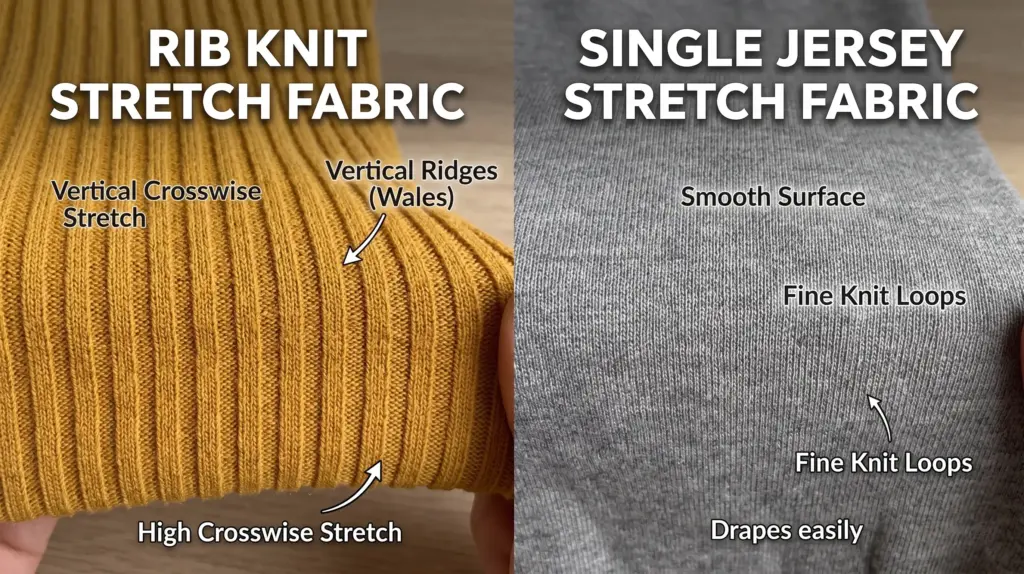
The most common knit fabric for T-shirts and casual tops. It's a basic one-sided knit with a smooth face and a slightly textured back. Natural crosswise stretch, no spandex required — though many versions include a small percentage for better recovery.
It's forgiving to sew, presses well, and comes in an enormous range of weights and fiber contents (cotton, polyester, modal, bamboo). If you're new to sewing with knits, single jersey is the most beginner-friendly starting point.
Rib Knit
Recognized by its vertical ribbed texture. Rib has more stretch than single jersey and a stronger snap-back, which is why it's the go-to for T-shirt neckbands, cuffs, and fitted tank tops.
The higher the rib ratio — 2×2 versus 1×1 — the stretchier and more defined the texture.
French Terry
A looped-back knit that looks like jersey on the outside with soft loops on the inside. It has 2-way stretch and is noticeably thicker than jersey, which makes it better suited to hoodies, sweatshirts, and casual pants. Learn more about it in our French terry fabric guide.
Browse our full stretchy fabric collection to find single jersey, rib, and French terry options in a range of fiber contents and weights.
Stretch Fabrics for Structured Dresses and Blazers
Not all stretch fabrics are meant to cling. Some are specifically engineered to hold their shape while still giving enough to be comfortable without a zipper. These are the fabrics that work for tailored dresses, midi skirts, and blazers — garments where you want a clean silhouette that holds through a full day of wear.
Both fabrics in this section are types of double knit — a construction where the fabric is knitted on both sides, giving it more body and shape retention than single jersey. Scuba and Ponte di Roma are the two most common double-knit types for garment sewing.
Scuba
A smooth, thick double-knit fabric with a neoprene-like hand feel. It has 4-way stretch but very strong recovery — meaning it gives when you move, then returns to its original shape. Raw edges are generally stable and easier to handle than many woven fabrics, which makes them a popular choice for clean-finished seams without lining.
Best for: bodycon dresses, structured skirts, fitted blazers, costumes.
Ponte di Roma
Similar in construction to scuba but softer and more draped forward. It sits closer to the body without feeling as firm, and the common polyester/viscose/spandex content gives it a slightly warmer feel and more elegant drape than pure synthetic options.
Best for: tailored dresses, smart-casual pants, blazers, and anything that needs to look polished without feeling stiff.
For more fabric recommendations sorted by garment type, see our dress fabric guide.
Stretch Fabrics for Swimwear
Swimwear fabric is a specific subset of the activewear category with one extra requirement: chlorine resistance. Not all stretch fabrics are suited for regular pool use — chlorine degrades elastic fibers over time, so the fiber blend and any finishing treatment matter.
For high-frequency pool use, polyester-spandex (particularly polyester/PBT blends) is generally the more chlorine-stable option. Nylon-spandex is widely used in swimwear too, valued for its softness and recovery — but for competitive swimmers or anyone in the pool daily, a chlorine-resistant polyester blend tends to hold up better over time.
Tricot-backed constructions in either fiber base add opacity and help the fabric keep its shape when wet. Weight typically runs 180–230 GSM for standard swimsuit coverage.
Note: Always check the fabric spec for chlorine resistance before purchasing for swimwear — not all stretch fabrics, even those labeled swimwear weight, include this treatment.
From Our Experience
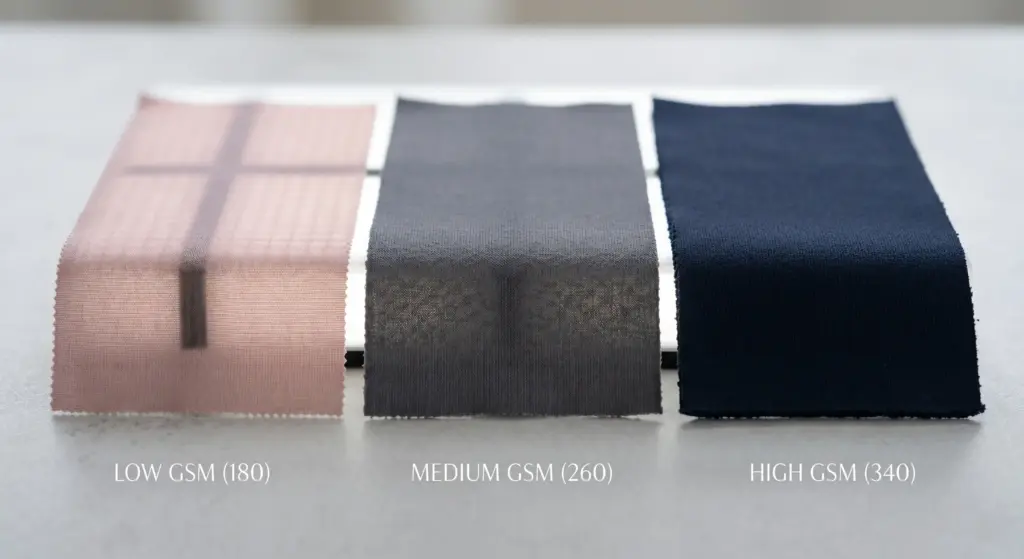
The most common sourcing mistake we see with stretch fabrics isn't choosing the wrong fiber — it's ignoring GSM. A fabric labeled 'nylon-spandex' can be anything from a sheer 120 GSM tricot to a dense 230 GSM compression fabric. Both stretch. Both technically fit the description. But they perform completely differently on a body.
For leggings: if you're buying by the yard without a swatch first, aim for at least 180 GSM unless you specifically want a lighter, layered-over look. Anything under 160 GSM is likely to be see-through under tension.
For structured dresses using scuba or ponte: going too heavy makes the garment stiff and uncomfortable. 220–260 GSM is the typical range for scuba. If a fabric feels board-like in the hand, it'll feel restrictive to wear.
For independent guidance on fiber performance across categories, the Textile Exchange Materials Benchmark offers publicly available reports on synthetic and natural fiber properties.
Frequently Asked Questions About Stretch Fabric Types
What is the stretchiest fabric available?
Fabrics with a higher spandex percentage and 4-way stretch construction stretch the most. Nylon-spandex blends with 20–25% spandex content have the highest stretch and recovery. Pure spandex fabric exists but is rarely used alone — it's almost always blended with another fiber for structure and appearance.
What's the real difference between 2-way and 4-way stretch for sewing?
For most casual sewing projects — T-shirts, dresses, tops — 2-way stretch is all you need. For fitted activewear, leggings, and anything that needs to move with the body in multiple directions at once, 4-way stretch is necessary. Trying to sew a leggings pattern in 2-way fabric usually results in a poor fit and restricted movement.
Is knit fabric always stretchy?
Most knit fabrics stretch to some degree because of their looped construction — but how much varies significantly. A tightly constructed double knit like scuba has limited give compared to a lightweight single jersey. The 'stretch percentage' on a spec sheet tells you exactly how much a fabric extends before it resists — a 50% stretch means it can extend to 1.5× its original width.
Which stretch fabric is easiest to start sewing with?
Single jersey and French terry are generally the most beginner-friendly because they're thicker and more stable than lightweight spandex fabrics. A relaxed T-shirt or hoodie in cotton jersey or French terry is a much easier first project than a leggings pattern in nylon-spandex.
Can stretch fabrics be used for non-athletic clothing?
Absolutely. Scuba, Ponte di Roma, and rib knit are all stretch fabrics that look nothing like activewear. They're used regularly for tailored dresses, work pants, and fitted blouses. The key is matching the structure of the fabric to the structure of the garment pattern — a drapey silhouette works better in lighter jersey; a fitted sheath dress works better in scuba.
The right stretch fabric makes a real difference — not just in how a finished garment looks, but in how long it holds its shape and how easy it is to sew. Browse our full range of stretchy fabrics by the yard and filter by stretch direction, weight, and fiber content to find the right match for your project.




 Login with Google