


How to Calculate Exactly How Much Fabric You Need for Any Project (Without Over-Ordering)

To calculate exactly how much fabric you need, measure every pattern piece (or project dimension), account for fabric width, add allowances for seams, hems, shrinkage, and pattern matching — then multiply by the number of units you’re producing. The single biggest reason buyers over-order is that they skip one or more of these variables and round up “just to be safe,” which at wholesale volumes can mean hundreds of wasted yards and thousands of wasted dollars. This guide gives you the actual formulas, the hidden multipliers most people forget, and a repeatable system you can use whether you’re cutting ten blouses or ten thousand curtain panels.
Why Most Fabric Estimates are Wrong (and Expensive)
Here’s a number that should bother you: the average small apparel brand over-orders fabric by 15–20% per production run. On a 500-yard order at $8 per yard, that’s $600–$800 sitting in dead stock after every single cut. The root cause isn’t bad math — it’s incomplete math. Most buyers calculate the flat area they need and stop there, ignoring fabric width differences, nap direction, shrinkage rates, and pattern-repeat offsets.
Over-ordering feels safe, but it creates real costs: storage fees, color-lot mismatches on reorders, and cash tied up in material you can’t use. Under-ordering is worse — production stops, you reorder from a different dye lot, and your finished goods look inconsistent. The goal isn’t to “buy extra just in case.” The goal is to calculate precisely, then add a controlled, intentional buffer.
Step 1: Measure Every Component — Not Just the Big Pieces
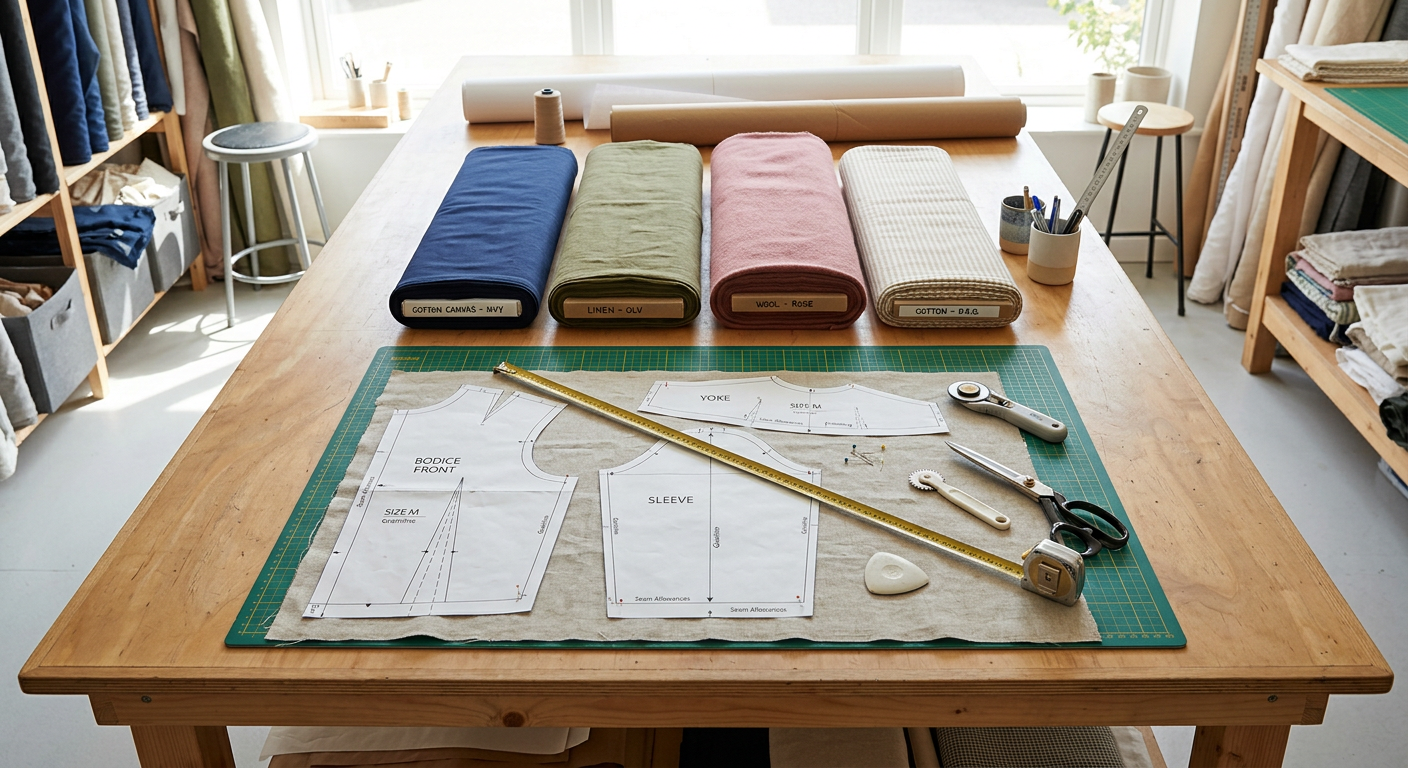
Before you touch a yardage chart, you need accurate measurements of every single piece that will be cut from the fabric. For garments, that means bodice front, bodice back, sleeves, collar, cuffs, facings, pockets, and any self-fabric trim. For home décor, it means the panel dimensions plus any ties, tabs, piping, or welting.
The Measurement Checklist
- Length of each piece — measured along the grainline, selvage to selvage direction.
- Width of each piece — measured perpendicular to the grainline.
- Seam allowances — typically 0.5 in for garments, 0.5–1 in for home décor. Add this to every edge that gets sewn.
- Hem allowances — 1–3 in depending on the project. A double-fold hem on curtains eats 4–6 in of length.
A common mistake: measuring the finished dimension and forgetting to add seam and hem allowances. On a single blouse that might cost you an inch. On a bulk run of 200 units, that inch compounds into yards of shortage. If you’re sourcing blouse fabric by the yard, getting this right from the start saves a painful mid-production reorder.
Step 2: Factor in Fabric Width — The Variable Everyone Underestimates
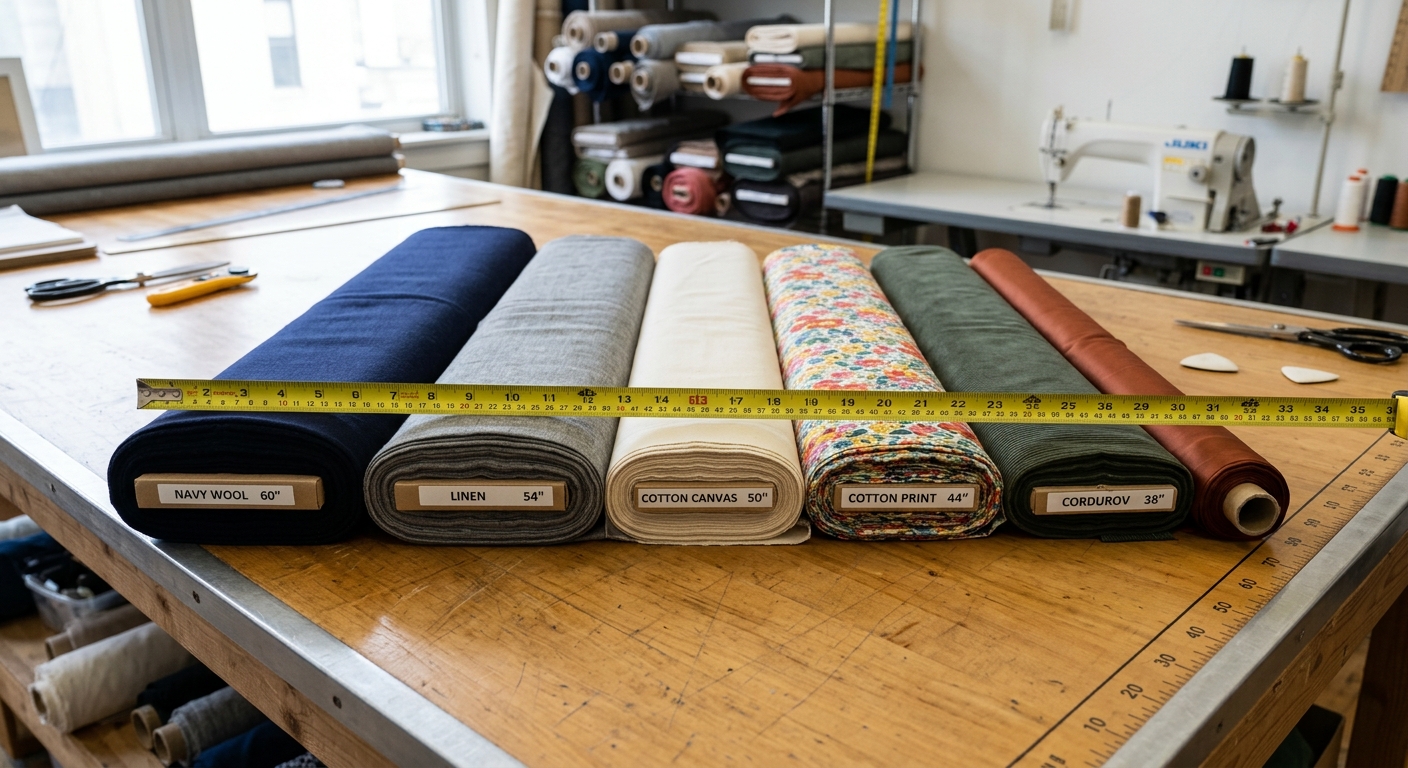
Fabric width changes everything. A bolt that’s 60 inches wide gives you dramatically more layout options than one that’s 44 inches wide — and you’ll need fewer linear yards to cut the same pieces. Yet many buyers grab a yardage estimate from a pattern envelope without checking whether it matches the width of the fabric they’re actually ordering.
The Width Conversion Formula
If your pattern calls for 3 yards of 45-inch fabric but you’re buying 60-inch fabric, here’s the quick conversion:
New yardage = (Original yardage × Original width) ÷ New width
So: (3 × 45) ÷ 60 = 2.25 yards. That’s a 25% reduction — significant when you’re ordering hundreds of yards.
This formula works as a rough guide for simple, rectangular-ish layouts. For complex pattern pieces with curves, you’ll want to do an actual marker layout (more on that in Step 4). But for quick estimates and budgeting, it’s reliable.
Common Fabric Widths to Know
- 36 in — some specialty silks and vintage reproductions
- 44–45 in — standard quilting cottons, many printed fabrics
- 54–60 in — most apparel and home décor fabrics, stretchy knits, suiting
- 108–120 in — wide sheeting and some drapery fabrics
Step 3: Account for Shrinkage Before You Cut, Not After
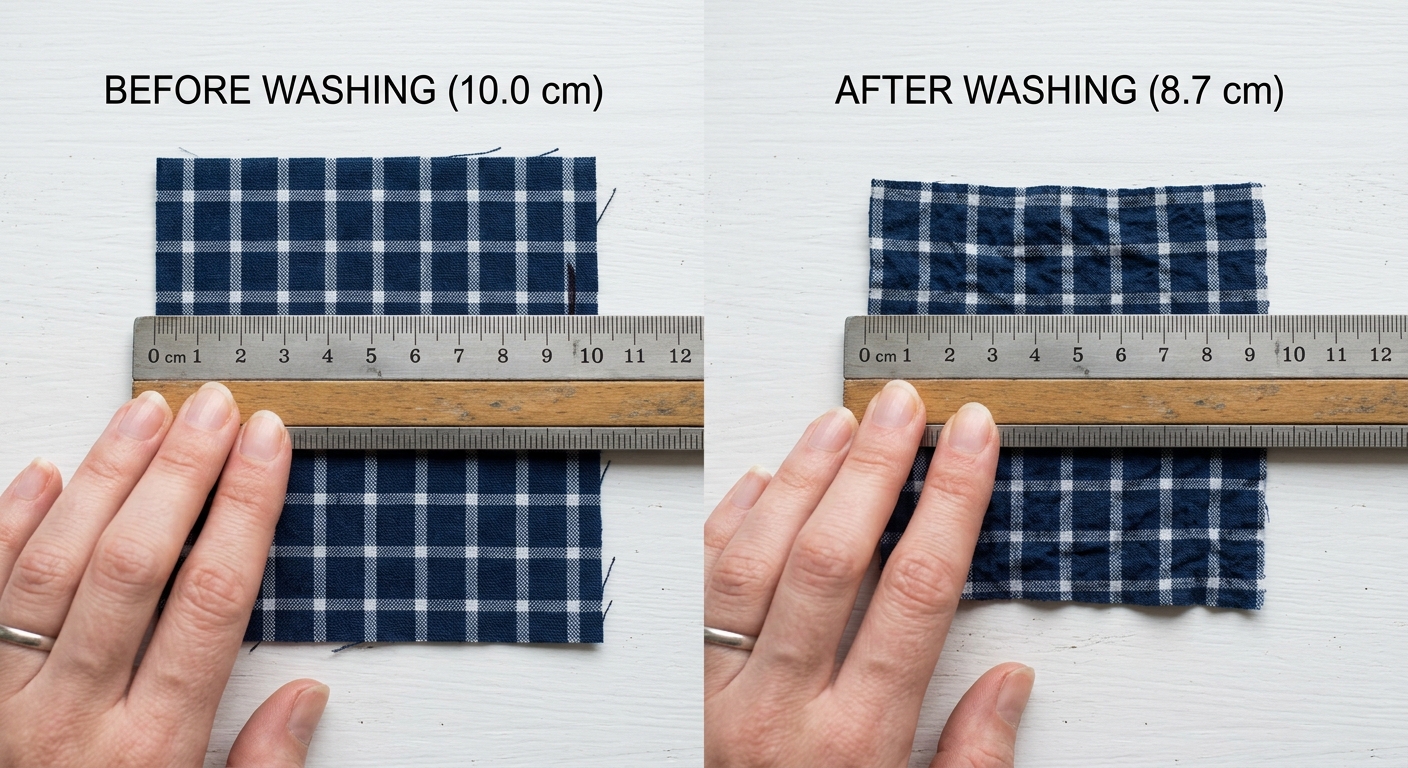
If you skip pre-shrinkage calculations, your finished products will be the wrong size. Period. Natural fibers shrink. Some synthetics shrink. And the shrinkage rate varies wildly by fiber and weave.
Typical Shrinkage Rates
- Cotton (woven) — 3–5% in length, 1–2% in width
- Linen — 5–10%
- Viscose / Rayon — 3–5%
- Polyester — less than 1%
- Wool / Cashmere — 3–8% depending on finish
- Cotton-poly blends — 1–3%
The formula is simple: Adjusted yardage = Base yardage ÷ (1 − shrinkage rate). If you need 100 yards of cotton that shrinks 5%, you actually need 100 ÷ 0.95 = 105.3 yards. Order 106.
For instance, a small home décor brand ordering viscose fabric by the yard for a line of throw pillow covers learned this the hard way. They ordered exactly to spec, washed the fabric, and came up 8 yards short on a 200-yard run because viscose can shrink up to 5% lengthwise. That 8-yard shortfall meant a second order, a different dye lot, and a two-week production delay. Always calculate shrinkage into your initial order.
Step 4: Do a Marker Layout (Even a Rough One)
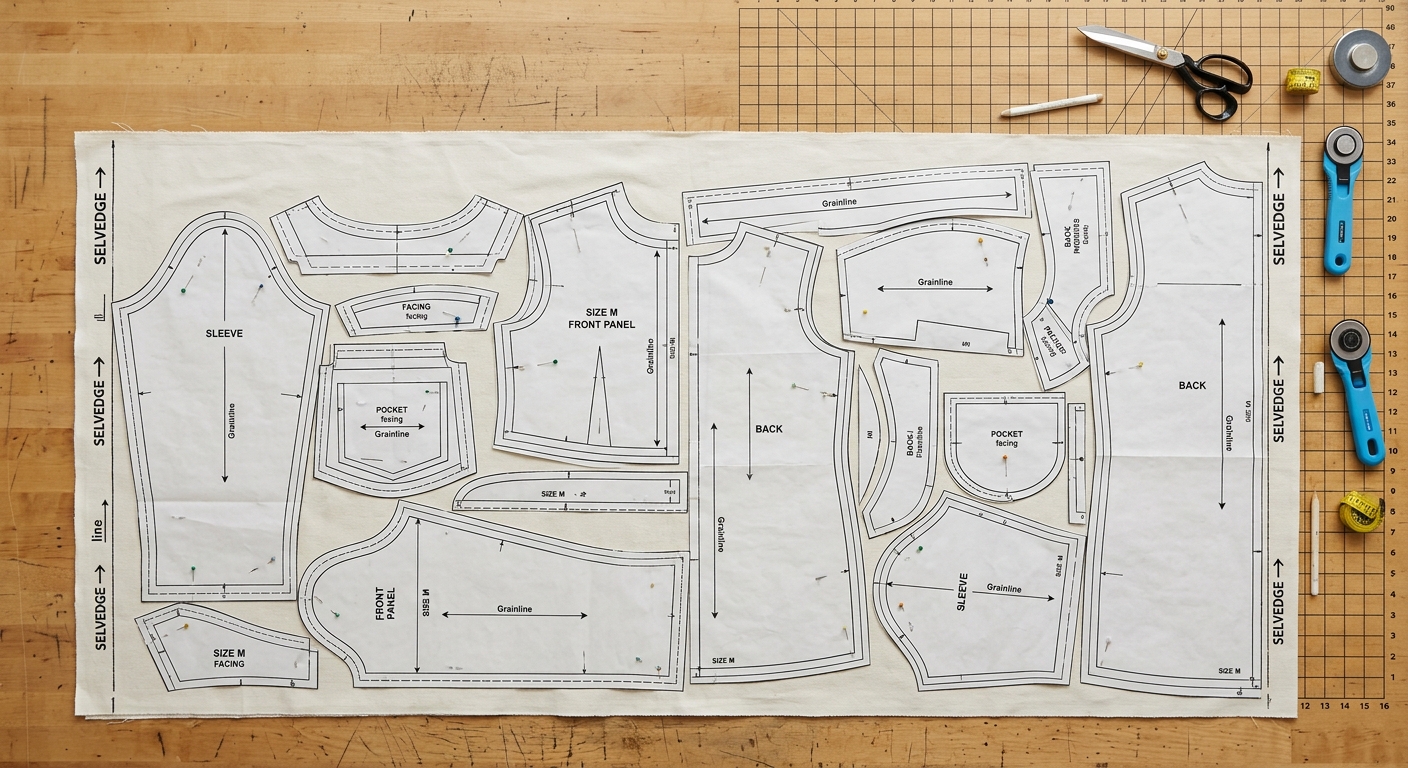
A marker layout is how professionals cut rooms figure out exactly how many pattern pieces fit across a given width and length of fabric. You don’t need expensive CAD software to do a basic version — you need a table, your pattern pieces (or scaled-down paper versions), and 30 minutes of patience.
How to Do a Quick Manual Marker
- Draw two parallel lines on a large sheet of paper (or tape paper together) spaced apart at your usable fabric width — that’s bolt width minus 1 inch for selvages.
- Cut out all your pattern pieces at scale (1:4 or 1:8 works fine).
- Arrange them between the lines, respecting grainline direction. Nestle pieces together like a puzzle — tuck a sleeve into the curve of a bodice, slide a pocket into the gap between two front panels.
- Measure the total length your layout requires. That’s your yardage per unit.
For bulk orders, multiply by the number of units and add your shrinkage buffer. A well-optimized marker layout can reduce fabric waste by 5–12% compared to a loose, generous estimate — and at wholesale volumes, that translates directly into profit margin.
Nap, Pile, and One-Way Prints
If your fabric has a directional element — the pile of velvet, the sheen of satin, the direction of a printed motif — all pattern pieces must face the same way. This “with nap” layout typically requires 10–15% more yardage than a non-directional layout because you lose the ability to flip pieces upside down to fill gaps. Fabrics like textured fabric with visible pile direction almost always require a nap layout.
Step 5: The Pattern Repeat Multiplier — The Sneakiest Cost Driver
Solid-color fabric? Skip this section. But if you’re working with stripes, plaids, florals, or any repeating motif, pattern matching will eat more yardage than you expect.
How to Calculate Pattern Repeat Waste
Every pattern piece must start at the same point in the repeat so the motif aligns across seams. The waste per piece equals one full repeat minus whatever fraction of the repeat your piece already uses.
Additional yardage per piece = Repeat length − (Piece length mod Repeat length)
Example: Your fabric has a 6-inch vertical repeat. Your bodice front is 22 inches long. 22 ÷ 6 = 3 remainder 4. You’ll waste 2 inches per bodice front to start the next piece on the correct repeat point. Across 8 pattern pieces and 500 units, those 2 inches become a meaningful number.
For large-scale prints with repeats of 12 inches or more, budget an extra 15–20% yardage. For small repeats (under 4 inches), 5–8% usually covers it. Fabrics like ikat prints and embroidered fabrics often have large, irregular repeats that demand careful planning.
Step 6: Multiply for Production Volume — The Bulk Order Formula
Once you know your per-unit yardage (with all adjustments), scaling up is straightforward — but there are two more variables to factor in.
The Complete Bulk Order Formula
Total yardage = (Per-unit yardage × Number of units) × (1 + Cutting waste %) × (1 ÷ (1 − Shrinkage rate))
Cutting waste accounts for the fabric lost between pattern pieces, at the start and end of each marker, and from defects in the bolt. Industry standard cutting waste for well-optimized markers is 8–15%. If you’re cutting by hand rather than with automated equipment, lean toward 15%.
Real-World Example: A 300-Unit Blouse Run
Let’s say your marker layout shows 1.8 yards per blouse on 58-inch fabric. You’re using a cotton-viscose blend with 4% shrinkage and a small print with a 3-inch repeat (adding roughly 6% for matching). Cutting waste is estimated at 12%.
- Base: 1.8 yd × 300 units = 540 yd
- Pattern repeat buffer: 540 × 1.06 = 572.4 yd
- Cutting waste: 572.4 × 1.12 = 641.1 yd
- Shrinkage: 641.1 ÷ 0.96 = 667.8 yd
- Order: 668 yards
Without these adjustments, you would have ordered 540 yards and come up 128 yards short. That’s a 24% gap — and now you understand why so many production managers either panic-reorder or over-buy by a huge margin. The formula eliminates both problems.
Quick-Reference Yardage Estimates by Project Type
Sometimes you need a ballpark before you dive into precise calculations — especially when you’re budgeting or comparing fabric options. The table above gives you baseline yardage for common projects on standard-width fabric (45–60 in) at an adult medium size. These are starting points, not final numbers. Always run the full calculation before placing a wholesale order.
Notes on the Table
- Wedding gowns are the most variable. A fitted sheath might need 4–5 yards; a cathedral-train ball gown can exceed 15. If you’re sourcing wedding dress fabric, get your pattern finalized before estimating yardage.
- Curtains depend heavily on fullness. Standard fullness is 2× the window width; sheer panels often use 2.5–3×.
- Table runners are one of the simplest calculations — length plus overhang plus hem allowance — making table runner fabric a great first wholesale project for new buyers.
Common Mistakes That Blow Up Your Yardage Estimate
Even experienced buyers make these errors. Recognizing them is half the battle.
Mistake 1: Ignoring Bolt-End Defects
Wholesale fabric bolts aren’t perfect end-to-end. You’ll occasionally find weaving flaws, dye inconsistencies, or fold marks near the beginning and end of a bolt. Budget 1–2% for defect waste on standard-quality goods; up to 5% on heavily discounted or off-grade stock.
Mistake 2: Using Finished Garment Measurements Instead of Pattern Piece Measurements
A finished blouse that measures 20 inches across the chest was cut from a piece that was 21–22 inches wide (seam allowances on both sides). Using the finished measurement means you’re short by 1–2 inches per piece — and it compounds across every single unit.
Mistake 3: Forgetting Grainline Requirements
Not every piece can be cut at any angle. Bias-cut garments require pieces placed at 45 degrees to the selvage, which dramatically reduces how many pieces fit per yard. A bias-cut dress can require 30–50% more fabric than the same design cut on-grain.
Mistake 4: Not Testing Shrinkage on a Swatch
Published shrinkage rates are averages. Your specific bolt might shrink more or less. Before committing to a large order, buy a yard, wash it exactly as your end customer will, and measure the actual shrinkage. It takes one day and can save thousands.
Put the Formula to Work and Order With Confidence
Accurate fabric estimation isn’t a talent — it’s a process. Measure every piece, adjust for fabric width, calculate shrinkage, do a marker layout, account for pattern repeats, and apply your cutting waste percentage. Run the numbers once, and you’ll have a precise order quantity that avoids both shortages and expensive dead stock.
The payoff is real. Brands that dial in their yardage calculations typically reduce fabric waste by 10–20% per production cycle. On a $10,000 fabric budget, that’s $1,000–$2,000 back in your pocket — every single run.
When you’re ready to order, Global Fabric Wholesale carries thousands of fabrics by the yard across every weight, fiber, and finish — so you can find exactly what your project demands and order exactly what you need. No more, no less.



 Login with Google